
Concrete is usually better for maximum fence-post stability, while compacted gravel can be better for drainage and easier future replacement. The right choice depends on fence height, post material, soil, wind, frost conditions, and whether the post supports a gate.
For a tall privacy fence, heavy gate, loose soil, or exposed site, concrete usually provides the stronger footing. For lighter fences in well-drained, stable soil, properly compacted angular gravel can work well and may reduce water trapped around wood posts.
Quick Answer
Is concrete or gravel better for fence posts?
Concrete is the better choice when the post needs maximum resistance to leaning and rotation. That includes many 5- to 6-foot privacy fences, gate posts, windy locations, and installations in weak or disturbed soil.
When is gravel better?
Compacted gravel is attractive when drainage, easier replacement, and a less permanent installation matter more than maximum rigidity. It works best with suitable soil, moderate fence loads, and careful compaction in thin lifts.
Rule of thumb: Choose concrete for structural stability and consider compacted angular gravel for drainage and serviceability when the fence load and local conditions allow it.
Do not choose the fill material before sizing the hole
Post depth, footing width, frost conditions, and soil support matter as much as whether you use concrete or gravel.
Best choice by situation
- 6-ft privacy fence: concrete is usually the safer choice.
- Gate post: concrete is usually preferred because of repeated leverage and off-center loads.
- Light picket fence: compacted gravel may work well in firm soil.
- Wet site: drainage details matter regardless of material.
- Future post replacement: gravel is generally easier to excavate and remove.
1. Concrete vs. Gravel: The Main Difference
The main difference is how each material supports the post. Concrete hardens into a rigid mass around the post and spreads loads into the surrounding soil. Properly compacted gravel works differently: angular particles lock together around the post and resist movement through friction and confinement.
Concrete generally provides greater rigidity. Once cured, it creates a solid footing that resists sideways movement and post rotation. This is useful when wind pushes against a fence panel or when a gate repeatedly pulls on its hinge post.
Gravel generally provides better drainage and easier removal. Water can move through the aggregate instead of being trapped against the post, and the material can usually be dug out more easily if the post must be replaced.
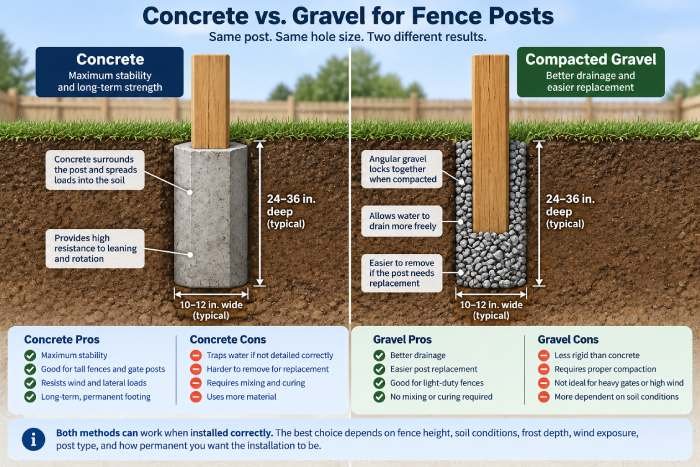
| Factor | Concrete | Compacted Gravel |
|---|---|---|
| Post stability | Excellent | Good when properly compacted |
| Drainage | Depends heavily on detailing | Very good |
| Gate posts | Usually preferred | Less common for heavy gates |
| Ease of replacement | Difficult | Easier |
| Installation effort | Mixing and curing required | Repeated compaction required |
| High wind | Usually stronger choice | Highly dependent on soil and compaction |
2. When Concrete Is the Better Choice
Concrete makes the most sense when the fence post must resist substantial lateral load. A solid privacy fence can catch a large amount of wind compared with an open picket or wire fence, and a rigid footing helps prevent the post from rotating in the soil.
Tall privacy fences
A 5- or 6-foot solid fence creates much more leverage at the bottom of the post than a low decorative fence. In these installations, concrete usually gives a larger margin of stability, especially when the site is exposed to wind.
Correct depth still matters. Before deciding how much concrete to use, review the guide on fence post footing depth because a strong material cannot compensate for a footing that is too shallow.
Gate posts
Gate posts are one of the clearest cases for concrete. A gate applies its weight to one side of the post and repeatedly loads the footing every time it opens, closes, or catches wind.
A deeper and wider concrete footing is generally preferable for heavy gate posts because it provides more resistance to post rotation and long-term sagging.
Loose or disturbed soil
Recently backfilled soil, loose sand, and disturbed ground may not confine a gravel-set post as effectively as dense native soil. A properly sized concrete footing can distribute loads into a larger soil mass and reduce movement.
3. When Gravel Can Be the Better Choice
Gravel is not simply a cheaper substitute for concrete. When installed correctly, it can be a practical footing material for certain fences, especially where drainage and future serviceability are priorities.
Light-duty and open fences
Low picket fences, garden fences, and other open designs place less wind load on the post. In firm native soil, well-compacted angular gravel may provide adequate support without creating a permanent concrete mass.
Wood posts where drainage is a priority
Wood durability depends heavily on moisture exposure. Gravel allows water to drain away more freely than a poorly shaped concrete footing that traps water around the post.
That does not mean concrete automatically causes wood posts to rot. A concrete footing can perform well when the post is suitable for ground contact, the top of the footing is shaped to shed water, and the site drains properly.
Posts you may need to replace later
Removing a broken wood post from a large concrete footing can be difficult. A gravel-set post is generally easier to excavate because the aggregate can be removed and reused or replaced.
If easy future replacement is a major priority and the fence loads are moderate, gravel has a real maintenance advantage.
4. Drainage: Gravel Has an Advantage, but Details Still Matter
Drainage is one of the most common arguments for setting wood fence posts in gravel. Angular stone leaves interconnected spaces that allow water to move downward rather than remaining trapped against the post.
However, drainage depends on the entire site. Gravel at the bottom of a hole does little good if the hole acts like a bucket in dense clay with nowhere for water to escape.
Concrete should shed water at the top
When setting a wood post in concrete, finish the top of the concrete slightly above grade and slope it away from the post. Do not leave a depression that directs rainwater toward the wood.
The complete installation process is covered in how to set a fence post in concrete, including bracing, drainage, concrete placement, and finishing around the post.
5. Gravel Must Be Compacted Properly
A common mistake is filling the entire hole with loose gravel and assuming the post will become stable on its own. Loose aggregate can shift, settle, and allow the post to move.
For gravel to work well, use angular crushed stone rather than rounded pea gravel. Angular particles interlock when compacted, while rounded stone can roll and move more easily under load.
Compact in thin lifts
Place a small amount of gravel around the post, compact it firmly, check the post for plumb, then add another lift. Repeat the process until the hole is filled.
Compacting the entire depth in one step does not reliably densify the gravel near the bottom of the hole. Thin lifts produce a much more stable result.
Keep checking the post
Compaction can push the post slightly out of alignment. Check plumb on two adjacent faces and sight along the fence line after every few lifts.
6. Frost Conditions Can Change the Decision
In climates with freezing winters, neither concrete nor gravel eliminates the need to consider frost depth. Frost-susceptible soil can freeze, expand, and move a shallow post installation.
The footing depth may need to extend below the locally relevant frost depth, depending on local construction requirements and site conditions.
A deeper gravel-set post can still move if frost grips the post or surrounding material. A concrete footing can also heave when its geometry gives frozen soil a surface to lift.
For this reason, material choice should come after checking frost conditions rather than before them.
7. Concrete Uses More Material but Gives Predictable Rigidity
A concrete footing requires buying, transporting, mixing, and placing concrete. Across a long fence line, those quantities can add up quickly.
For example, a 12 x 12 x 24-inch square hole has a gross volume of 2 ft³, or roughly 0.074 yd³ before subtracting the post itself.
You can review that exact size on the 12x12x24 footing example when comparing concrete requirements.
Using the site planning yield of 0.60 ft³ per 80 lb bag, 2 ft³ represents about 3.34 bags before post displacement and waste. In practice, you would round up when buying material so you do not run short during placement.
For multiple posts, use the concrete calculator to estimate the combined volume for the fence line.
If you are buying bagged concrete, the concrete bag calculator converts the required volume into common bag sizes.
8. Is Gravel Actually Cheaper Than Concrete?
Gravel often costs less per post in material, but total project cost depends on local prices, hole size, labor, and how much compaction is required.
A gravel installation eliminates mixing and curing time, but it requires repeated placement and compaction. Concrete costs more and is heavier to handle, but it provides a rigid footing once cured.
For only a few posts, bags are usually convenient. For a large fence with substantial concrete footings, the amount of bagged material can become significant.
The bagged vs. ready-mix concrete cost comparison can help when the total volume becomes large enough that the delivery option is worth considering.
9. Concrete vs. Gravel by Fence Type
| Fence Situation | Better Starting Choice | Why |
|---|---|---|
| 3–4 ft open picket fence | Gravel or concrete | Moderate loads allow either method where soil is suitable |
| 6 ft privacy fence | Concrete | Better resistance to wind-driven post rotation |
| Heavy gate post | Concrete | Handles repeated leverage and off-center loading better |
| Temporary or easily replaceable fence | Gravel | Easier to excavate and replace later |
| Firm soil with excellent drainage | Either | Loads and fence design may become the deciding factors |
| Loose soil or exposed high-wind site | Concrete | Greater footing mass and rigidity are usually beneficial |
These recommendations are starting points rather than universal structural rules. Local soil, frost depth, post spacing, fence material, terrain, and wind conditions can justify a different installation.
10. Which One Should You Choose?
For the average DIY homeowner, the choice becomes easier when you separate light-duty fence posts from posts that carry meaningful structural load.
Choose concrete when:
- The fence is 5 to 6 feet tall or taller.
- The panels are mostly solid and catch significant wind.
- The post supports a gate.
- The soil is loose, disturbed, or provides poor lateral support.
- Maximum rigidity matters more than easy future removal.
Consider compacted gravel when:
- The fence is relatively short or open.
- The soil is firm and stable.
- Drainage around a wood post is a major concern.
- You want easier post replacement later.
- Local frost, wind, and code conditions do not require a different footing.
If you are uncertain, concrete is generally the more conservative option for a permanent residential privacy fence. Gravel is most compelling when the structural demand is moderate and drainage or serviceability provides a clear benefit.
Tools & Next Steps
Calculate a concrete post footing
Enter your planned footing width and depth to estimate the concrete required for each post.
Compare common footing sizes
See pre-calculated footing dimensions and concrete quantities before choosing your post-hole size.
Frequently Asked Questions
Is it better to set fence posts in concrete or gravel?
Concrete is generally better for maximum stability, while gravel is better for drainage and easier future removal. Tall privacy fences, heavy gates, loose soil, and windy locations usually favor concrete.
Can you set a fence post in gravel instead of concrete?
Yes, some fence posts can be set successfully in properly compacted angular gravel. It works best for moderate loads in firm soil when the gravel is placed and compacted in thin lifts.
Does gravel stop fence posts from rotting?
Gravel can improve drainage, but it does not make a wood post rot-proof. Use wood rated for ground contact where appropriate and manage water around the post regardless of the footing material.
Should I put gravel under a fence post before concrete?
A compacted gravel base can be useful where drainage conditions justify it. However, it should not replace required footing depth or stable soil support beneath the post.
What type of gravel is best for fence posts?
Angular crushed stone is generally better than rounded gravel for supporting fence posts. Angular particles lock together when compacted, while rounded stone can shift more easily.
Should gate posts always be set in concrete?
Concrete is usually the preferred choice for substantial gate posts. Gates create repeated leverage and off-center loads that make footing rigidity especially important.
How deep should a gravel-set fence post be?
The required depth depends on the same factors that apply to a concrete-set post: fence height, frost depth, soil, wind, and gate loads. Gravel does not allow you to ignore proper embedment depth.
Does concrete make wood fence posts rot faster?
Concrete does not automatically cause faster rot, but poor drainage can keep wood wet and increase decay risk. Use suitable ground-contact posts and finish the top of the concrete so water sheds away from the wood.
Can gravel hold a 6-foot privacy fence?
It may work under favorable conditions, but concrete is generally the more conservative choice for a 6-foot solid privacy fence. Wind load, soil conditions, post spacing, and local requirements should guide the final installation.
Choose the footing, then calculate the concrete
Disclaimer
This guide provides general information for residential DIY planning. The correct fence-post installation depends on fence design, post material, soil conditions, frost depth, wind exposure, drainage, property conditions, and local building requirements. Verify underground utilities and local rules before digging, and consult a qualified contractor or engineer for large gates, tall fences, retaining-wall installations, steep slopes, extreme wind exposure, or other structural conditions.