
To repair a concrete crack correctly, first determine whether the crack is stable or still moving, clean out loose material, and then use a repair product suited to the crack width, location, exposure, and expected movement. Small stable cracks can often be sealed by a homeowner, while widening, displaced, leaking, or structural cracks need more careful diagnosis.
The biggest mistake is treating every crack the same way. A hairline shrinkage crack, an active crack caused by settlement, and a structural foundation crack may look similar at first but require very different repair methods.
Quick Answer
What is the best way to repair a crack in concrete?
For a small, stable, nonstructural crack, clean the crack thoroughly and fill or seal it with a concrete crack-repair material designed for the crack width and exposure. Flexible sealants are useful where some movement is expected, while rigid resin repairs are better suited to stable cracks when that repair method is appropriate.
Can you permanently fix a concrete crack?
You can seal or structurally repair many cracks, but the repair will not last if the underlying cause continues. Settlement, frost movement, drainage problems, corrosion, poor joints, or unstable soil should be addressed before relying on the crack filler itself.
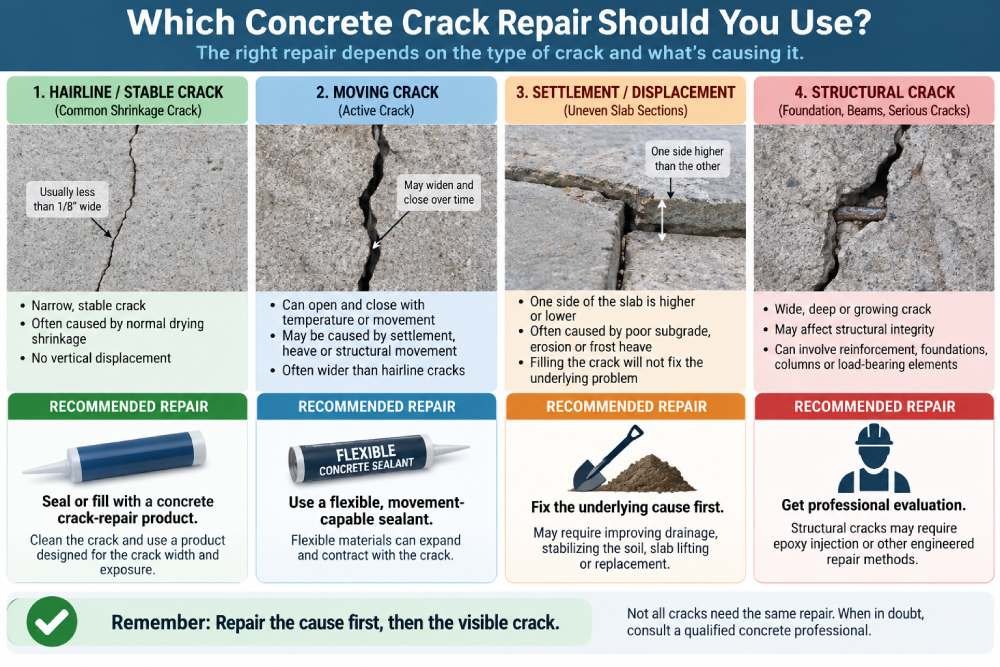
Rule of thumb: Repair the cause first and the visible crack second. If the crack is still changing, a rigid cosmetic patch alone is unlikely to solve the problem.
Replacing a badly damaged slab?
If repair no longer makes sense, calculate the replacement slab volume before pricing concrete and demolition.
Choose the repair by crack behavior
- Stable hairline crack: often seal or fill after cleaning.
- Small crack with expected movement: use a flexible repair system designed to accommodate movement.
- Stable dormant crack: rigid resin or other appropriate repair may be possible.
- Crack with vertical displacement: investigate settlement, heave, or loss of support first.
- Structural crack: get qualified professional evaluation before selecting a repair.
1. Determine Why the Concrete Cracked Before Repairing It
A successful repair starts with diagnosis. Filling a crack without understanding why it formed can hide the symptom while the movement continues underneath.
Common causes include:
- Drying shrinkage
- Plastic shrinkage
- Poorly placed or missing control joints
- Weak or settling subgrade
- Freeze-thaw movement
- Water erosion beneath the slab
- Overloading
- Corrosion of reinforcement
- Structural movement
A crack caused by normal shrinkage is a different repair problem from a crack caused by settlement.
If you have not identified the likely cause yet, start with the
guide to why new concrete cracks
before choosing a filler or sealant.
2. Is the Crack Active or Dormant?
This is one of the most important decisions in concrete crack repair.
Dormant crack
A dormant crack is essentially stable. It may have formed from drying shrinkage or a one-time movement event and is no longer noticeably opening, closing, or shifting.
Stable cracks can often accept a more rigid repair material, depending on the location and repair objective.
Active crack
An active crack is still moving because of temperature changes, slab movement, settlement, heave, structural loading, or another continuing cause.
Rigidly bonding an active crack can cause the repair itself to fail or simply force a new crack to form nearby.
Cracks that behave like moving joints generally need a repair material capable of accommodating movement.
Monitor questionable cracks first
If you are unsure, take dated photographs and measure the crack at several marked locations. Recheck it over time. A crack that continues widening or develops vertical displacement deserves investigation before cosmetic repair.
3. When Is a Concrete Crack Serious?
Crack width alone does not determine severity. Look at the full pattern and the behavior of the concrete around it.
| What You See | Typical Next Step |
|---|---|
| Fine stable hairline crack | Monitor and seal if needed for moisture or appearance |
| Stable wider surface crack | Clean and use an appropriate crack-repair product |
| Crack that opens and closes | Use a movement-capable repair or investigate the cause |
| One side higher than the other | Investigate settlement, frost heave, or base failure |
| Crack allowing repeated water entry | Address both the crack and the water source |
| Foundation, beam, column, or structural crack | Professional evaluation recommended |
Vertical displacement is generally a bigger warning sign than a simple narrow surface crack. Filling the gap will not level a slab that has lost support underneath.
4. How to Repair a Small Stable Crack in a Concrete Slab
For an ordinary nonstructural crack in a patio, walkway, driveway, or similar slab, the basic process is straightforward.
Step 1: Remove loose material
Brush, scrape, or vacuum away loose concrete, dirt, dust, vegetation, old failed filler, and other debris.
The repair material needs clean, sound concrete to bond properly.
Step 2: Clean the crack
Use a stiff brush, vacuum, oil-free compressed air, or another cleaning method appropriate for the repair product. If water is used, allow the crack to dry as required by the repair material.
Step 3: Prepare the crack if required
Some repair systems require opening or routing the top of the crack into a consistent groove. Others are intended to penetrate narrower cracks without widening them.
Follow the repair-product instructions rather than automatically grinding every crack wider.
Step 4: Apply the repair material
Force or inject the material into the prepared crack according to its intended application. Avoid leaving large voids beneath a cosmetic surface skin.
Step 5: Tool or finish the surface
Smooth the repair to the surrounding concrete if appearance matters, while respecting any minimum depth or geometry required by the product.
Step 6: Protect the repair while it cures
Keep traffic, water, freezing temperatures, or other exposure off the repair for the manufacturer’s required cure period.
5. Flexible Crack Sealant vs. Rigid Epoxy
The correct material depends mainly on whether the crack needs to accommodate movement or be bonded rigidly.
Flexible crack sealants
Flexible or elastomeric materials are useful when the crack may continue moving. Their job is often to reduce water and debris entry while stretching or compressing with limited movement.
These materials are commonly more appropriate than rigid epoxy for active nonstructural slab cracks.
Epoxy repair
Epoxy can create a rigid bond across suitable stable cracks. Professional epoxy injection is also used for certain structural crack repairs.
Do not automatically inject epoxy into a moving crack. A rigid bond does not eliminate the movement that caused the crack.
Structural epoxy injection also requires correct crack evaluation, surface preparation, resin selection, injection procedure, and verification. It is not the same as squeezing a surface filler into a patio crack.
6. Can You Repair Hairline Concrete Cracks?
Yes, but not every hairline crack needs aggressive repair. Very fine stable cracks are common in concrete and may be primarily cosmetic.
Repair becomes more useful when the crack:
- Allows water entry
- Collects dirt or vegetation
- Is exposed to freeze-thaw conditions
- Interferes with a coating or flooring system
- Creates an appearance problem
Low-viscosity repair materials may penetrate fine stable cracks better than thick patching compounds.
Do not assume a thin crack is harmless if it is located in a structural element or is clearly growing over time.
7. What About Cracks With Settlement or Uneven Slab Sections?
If one side of the crack is lower than the other, the issue is no longer just an open gap.
The slab may have lost support because of poor compaction, erosion, soft soil, frost movement, or settlement.
Possible solutions can include correcting drainage, stabilizing the supporting material, slab lifting in suitable cases, partial replacement, or full replacement.
Simply filling the crack may improve appearance but will not restore missing soil or eliminate a trip hazard created by vertical displacement.
If the original problem came from poor slab preparation, review the
common concrete slab mistakes to avoid
before repairing or replacing the affected area.
8. Do Not Fill a Control Joint Like a Random Crack
A control joint is an intentional weak plane designed to encourage shrinkage cracking in a planned location.
A joint is supposed to accommodate movement. Filling it rigidly from edge to edge can interfere with that function.
If a joint needs protection from water, debris, or traffic, use a joint treatment designed for the movement and service conditions rather than treating the joint as accidental cracking.
Crack beside a control joint
If a random crack formed close to a joint instead of inside it, the joint may have been cut too late, too shallow, or positioned poorly—or the crack may have another cause entirely.
This is one of the reasons the next guide in this cluster, concrete control joint spacing, is important when planning new slabs.
9. When Should You Replace Concrete Instead of Repairing the Crack?
Crack repair makes sense when the surrounding slab remains sound and the repair can address the actual performance problem.
Replacement may be more practical when:
- Large sections have settled or heaved
- There are many interconnected cracks
- The slab is badly scaled, spalled, or deteriorated
- Drainage or slope is fundamentally wrong
- Repeated repairs keep failing
- The slab is too thin or poorly supported for its use
If replacement becomes the better option, use the
concrete calculator
to estimate the replacement volume.
For smaller replacement sections using bagged concrete, the
bag calculator
can convert the required volume into common bag sizes.
10. How to Reduce Cracking on the Next Pour
No concrete slab can be guaranteed crack-free, but good construction practices can reduce random and excessive cracking.
Focus on:
- Firm and uniformly compacted subgrade
- Appropriate slab thickness
- Properly designed and placed reinforcement
- Correct control-joint layout and timing
- Avoiding unnecessary mix water
- Correct placement and finishing
- Proper curing
- Good drainage around the slab
The
concrete curing basics guide
explains how moisture and temperature control affect early strength, shrinkage, and long-term durability.
Tools & Next Steps
Replacing a damaged slab?
Calculate the concrete volume for the replacement section before ordering material.
Compare common slab sizes
Browse pre-calculated slab dimensions when repair has turned into partial or full replacement.
Frequently Asked Questions
What is the best product to repair cracks in concrete?
The best repair material depends on whether the crack is stable or moving, its width, exposure, and whether the repair is structural or cosmetic. Flexible sealants are useful for movement, while rigid resins may be appropriate for suitable stable cracks.
Can I repair a concrete crack myself?
Small, stable, nonstructural cracks in patios, sidewalks, and similar slabs can often be repaired as a DIY project. Structural cracks, significant settlement, vertical displacement, corrosion-related cracking, or continuously moving cracks deserve professional evaluation.
Should I fill hairline cracks in concrete?
Not every hairline crack requires repair, but sealing can be useful where water entry, freeze-thaw exposure, contamination, flooring, coatings, or appearance are concerns. Monitor the crack first if you are unsure whether it is stable.
Can epoxy fix a concrete crack?
Epoxy can repair suitable stable cracks and epoxy injection is used for certain structural repairs. It is generally not the right choice for a crack that is expected to continue moving unless the movement itself has been addressed.
How do you repair a crack that keeps moving?
First identify and address the source of movement. Where limited movement is expected to continue, a flexible repair or sealant system is usually more appropriate than a rigid cosmetic patch.
Can you just pour concrete into a crack?
No, ordinary concrete is generally unsuitable for filling narrow cracks. It cannot penetrate small openings effectively and may not bond or accommodate movement correctly. Use a material specifically intended for crack repair.
Should I widen a concrete crack before filling it?
Only when the selected repair method requires it. Some route-and-seal repairs use a prepared groove, while low-viscosity materials may be intended to penetrate narrow cracks without aggressive widening.
Why does my concrete crack repair keep failing?
Repeated failure usually means the repair material, preparation, or underlying diagnosis was wrong. Continuing movement, dirty crack faces, moisture, settlement, incorrect material selection, and poor application can all cause failure.
When should I call a professional for a concrete crack?
Get professional advice for widening structural cracks, major vertical displacement, foundation or retaining-wall cracks, reinforcement corrosion, substantial water intrusion, or conditions where concrete failure could affect safety or property.
Repair the cause before you repair the crack
Disclaimer
This guide provides general information for residential concrete crack repair and DIY planning. Crack appearance alone cannot determine structural safety or the correct repair system. Movement, soil conditions, reinforcement corrosion, moisture, loading, structural design, and exposure vary by project. Consult a qualified concrete repair contractor or structural engineer for structural cracks, significant settlement or heave, foundation movement, reinforcement corrosion, widening cracks, or conditions where failure could affect people or property.