
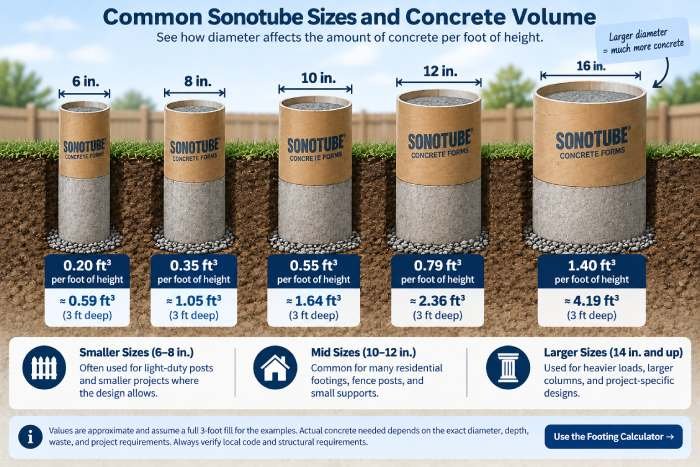
Common Sonotube diameters range from 6 inches upward, with 6-, 8-, 10-, and 12-inch tubes especially common for smaller DIY footings. The amount of concrete rises quickly as diameter increases, so choosing the correct tube size before buying concrete can prevent both shortages and unnecessary cost.
The charts below show concrete volume for common round form diameters and depths, plus estimated 60 lb and 80 lb bag quantities. Final footing diameter and depth should still follow the project design, soil conditions, frost requirements, loads, and local code.
Quick Answer
What are the most common Sonotube sizes?
For smaller residential and DIY projects, 6-, 8-, 10-, and 12-inch diameters are common. Larger round concrete forms are also available for bigger footings and columns, including diameters such as 14, 16, 18, 20, and 24 inches.
How much concrete does a Sonotube need?
Concrete volume depends on both tube diameter and filled height. A 12-inch-diameter round form uses about 0.79 ft³ of concrete per vertical foot, while an 8-inch form uses only about 0.35 ft³ per foot.
Rule of thumb: Increasing diameter has a much larger effect on concrete volume than many DIYers expect. Always calculate the actual round volume instead of estimating from height alone.
Know the diameter and depth before buying bags
A small change from an 8-inch to a 12-inch form more than doubles the cross-sectional area, so bag requirements can rise quickly.
Quick size guide
- 6–8 in.: small posts and light-duty applications where the design allows.
- 10–12 in.: common residential footing range for many posts and small supports.
- 14–18 in.: larger loads, wider posts, or project-specific footing requirements.
- 20–24 in. and larger: substantial footings and columns that usually deserve project-specific sizing.
- Depth: check frost line, soil, loads, and local requirements separately from diameter.
1. Sonotube Size and Concrete Volume Chart
The table below shows the approximate concrete volume inside a round tube at common diameters. These values are based on the volume of a cylinder and assume the full listed height is filled with concrete.
| Tube Diameter | Concrete per 1 ft | 2 ft Deep | 3 ft Deep | 4 ft Deep |
|---|---|---|---|---|
| 6 in. | 0.20 ft³ | 0.39 ft³ | 0.59 ft³ | 0.79 ft³ |
| 8 in. | 0.35 ft³ | 0.70 ft³ | 1.05 ft³ | 1.40 ft³ |
| 10 in. | 0.55 ft³ | 1.09 ft³ | 1.64 ft³ | 2.18 ft³ |
| 12 in. | 0.79 ft³ | 1.57 ft³ | 2.36 ft³ | 3.14 ft³ |
| 14 in. | 1.07 ft³ | 2.14 ft³ | 3.21 ft³ | 4.28 ft³ |
| 16 in. | 1.40 ft³ | 2.79 ft³ | 4.19 ft³ | 5.59 ft³ |
| 18 in. | 1.77 ft³ | 3.53 ft³ | 5.30 ft³ | 7.07 ft³ |
| 20 in. | 2.18 ft³ | 4.36 ft³ | 6.54 ft³ | 8.73 ft³ |
| 24 in. | 3.14 ft³ | 6.28 ft³ | 9.42 ft³ | 12.57 ft³ |
The numbers are planning values. Form diameters are nominal, and real excavation, waste, overfill, irregular bases, and project details can change the amount you actually need.
For several footings or a larger project, use the concrete yardage calculator to combine the total concrete volume before ordering or buying bags.
2. How to Calculate Concrete for a Round Sonotube
A Sonotube is essentially a cylinder, so its concrete volume is based on the area of a circle multiplied by the filled height.
Volume in cubic feet = π × radius² × height
Use feet for both radius and height. If the tube diameter is given in inches, divide the diameter by 12 to convert it to feet, then divide by 2 to get the radius.
Why diameter changes volume so quickly
The radius is squared in the formula. That means doubling the diameter does not merely double the amount of concrete—it increases the cross-sectional area by about four times.
For example, an 8-inch tube uses about 0.35 ft³ per foot of height, while a 16-inch tube uses about 1.40 ft³ per foot. The diameter doubled, but the concrete volume per foot increased roughly fourfold.
If you prefer not to run the cylinder formula manually, the footing calculator can help you estimate concrete for footing dimensions before purchasing material.
3. How Many Bags of Concrete Does a Sonotube Need?
Once you know the volume in cubic feet, divide it by the expected yield of each bag. For planning on this site, use approximately 0.60 ft³ for an 80 lb bag, 0.45 ft³ for a 60 lb bag, and 0.30 ft³ for a 40 lb bag.
The following table shows a practical estimate for a 3-foot filled height. Bag counts are rounded up because you cannot normally buy a fraction of a bag and real installations need some margin.
| Tube Size × 3 ft | Concrete Volume | 80 lb Bags | 60 lb Bags |
|---|---|---|---|
| 6 in. | 0.59 ft³ | 1 bag | 2 bags |
| 8 in. | 1.05 ft³ | 2 bags | 3 bags |
| 10 in. | 1.64 ft³ | 3 bags | 4 bags |
| 12 in. | 2.36 ft³ | 4 bags | 6 bags |
| 14 in. | 3.21 ft³ | 6 bags | 8 bags |
| 16 in. | 4.19 ft³ | 7 bags | 10 bags |
For a different depth or bag size, use the concrete bag calculator instead of multiplying rounded table values.
The guide on how many bags of concrete you need also explains bag yield, rounding, waste, and why buying exactly the theoretical quantity can leave a pour short.
4. What Sonotube Diameter Should You Use?
Choose the footing diameter from the load and project requirements—not from whichever tube happens to be available. Deck posts, fence posts, porch supports, columns, and other structural elements can require very different footing sizes.
6- to 8-inch tubes
These smaller diameters may be useful for light-duty posts or projects with modest loads where the design specifically permits them. They leave relatively little concrete around larger wood posts, so do not assume an 8-inch tube is automatically suitable for every 4×4 or 6×6 post.
10- to 12-inch tubes
10- and 12-inch forms are common DIY sizes because they provide more footing area without requiring an extreme amount of concrete. They can be useful for many small residential post and support applications when the required footing size falls within that range.
14 inches and larger
Larger diameters increase bearing area and concrete mass substantially. They may be appropriate for heavier loads, larger columns, poor soil, or project-specific structural designs.
When comparing possible footing dimensions, browse the footing size pages to see how quickly concrete quantities change as the dimensions increase.
For structural deck, porch, or building supports, footing diameter should come from the approved design, applicable code requirements, or a qualified professional rather than a generic diameter chart.
5. Sonotube Depth: How Far Down Should It Go?
Diameter answers only one part of the footing question. The required depth depends on frost conditions, soil, loading, footing design, and local requirements.
In climates with freezing winters, the footing may need to extend below the locally required frost depth. In warmer regions, soil bearing conditions or structural loads may become the controlling factors instead.
If the tube is being used for a fence post, the guide on fence post footing depth explains how fence height, frost, wind, gates, and soil affect the depth decision.
Do not automatically fill the entire excavated depth with a tube
A footing system may include a wider base, bell, pad, pier, or other geometry rather than one constant-diameter cylinder from top to bottom. Follow the actual design instead of assuming every footing should be one straight tube.
6. Should You Use Sonotube for Fence Posts?
A round concrete form can create a neat, controlled concrete pier around or beneath a fence post, but it is not necessary for every fence installation. Many ordinary fence posts are placed directly into properly sized excavated holes.
Forms are most useful when you need consistent diameter, a clean exposed portion above grade, or controlled pier geometry.
If you are setting wood posts directly into concrete, the guide on how to set a fence post in concrete covers hole preparation, bracing, drainage, placement, and finishing around the post.
If you have not decided whether concrete is appropriate at all, compare the tradeoffs in concrete vs. gravel for fence posts. The better method depends on stability requirements, drainage, soil, fence type, and how permanent you want the installation to be.
7. Common Sonotube Sizing Mistakes
Choosing diameter based only on post width
A footing does more than leave space around a post. It transfers loads into the soil. The required footing diameter can therefore be much larger than the post itself.
Forgetting that diameter is nominal
Do not assume every form measures exactly its labeled diameter. If concrete quantity, reinforcement clearance, or a structural detail depends on an exact inside dimension, measure the actual tube before the pour.
Ignoring frost depth
A large-diameter footing can still move if it is too shallow for local freeze-thaw conditions. Diameter and depth must be considered together.
Buying the exact theoretical number of bags
Concrete can be lost through spillage, uneven excavation, overfilling, or measurement differences. Round bag requirements up and allow a practical margin.
Using a larger tube instead of checking the design
More concrete is not a substitute for proper structural sizing. A larger pier may improve bearing area, but reinforcement, soil capacity, frost protection, connections, and load path still matter.
If a project has enough large footings that bag quantities become cumbersome, compare the economics with the bagged vs. ready-mix concrete cost comparison before purchasing dozens of bags.
Tools & Next Steps
Calculate your footing volume
Enter your footing dimensions to estimate how much concrete the project requires before buying bags or ordering ready-mix.
Compare common footing dimensions
Browse pre-calculated footing sizes to compare concrete quantities for different widths and depths.
Frequently Asked Questions
What sizes do Sonotubes come in?
Common DIY Builder’s Tube diameters include 6, 8, 10, and 12 inches, while larger round concrete forms are available for bigger applications. Availability varies by product line, supplier, and location, so confirm the actual diameter before designing around a specific form.
How much concrete does a 12-inch Sonotube need?
A 12-inch-diameter round form uses about 0.79 cubic feet of concrete per foot of filled height. At 3 feet high it requires about 2.36 ft³, and at 4 feet it requires about 3.14 ft³ before allowing for waste or other project details.
How many 80 lb bags fill a 12-inch Sonotube?
A 12-inch tube filled 3 feet high needs about four 80 lb bags using a planning yield of 0.60 ft³ per bag. A 4-foot fill needs about 5.24 theoretical bags, so you would round up and allow additional margin.
How much concrete does an 8-inch Sonotube hold?
An 8-inch round form holds about 0.35 ft³ of concrete per vertical foot. That is approximately 0.70 ft³ for a 2-foot fill, 1.05 ft³ for 3 feet, and 1.40 ft³ for 4 feet.
What size Sonotube should I use for a 4×4 post?
There is no universal Sonotube diameter for every 4×4 post. Footing size should be based on the load, soil, frost requirements, fence or structure design, wind conditions, and local code rather than post width alone.
What size Sonotube should I use for a 6×6 post?
A 6×6 post does not automatically determine a specific tube size. Many structural applications require a footing substantially wider than the post, so use the approved footing dimensions for the actual load and soil conditions.
Does Sonotube stay in the ground after the concrete cures?
Buried form material is commonly left in place where the installation permits it, while exposed formwork may be removed depending on the product and desired finish. Follow the form manufacturer’s instructions and the project specifications.
Do I need gravel under a Sonotube footing?
Not every round footing requires a gravel layer underneath. Base preparation should follow the footing design and local soil conditions. Do not substitute loose gravel for required bearing soil, footing thickness, or structural specifications.
Can I cut a Sonotube to the depth I need?
Concrete form tubes can generally be cut to the required project length when permitted by the product instructions. Measure the required elevation carefully and make a square cut so the finished pier height matches the design.
Calculate the concrete before you cut the tube
Disclaimer
This guide provides general information for DIY concrete planning and volume estimation. Footing and pier diameter, depth, reinforcement, frost protection, soil bearing requirements, and structural capacity vary by project and location. Verify local building requirements and the approved project design before construction, and consult a qualified contractor or engineer for decks, porches, structural columns, large loads, weak soils, or other structural work.