
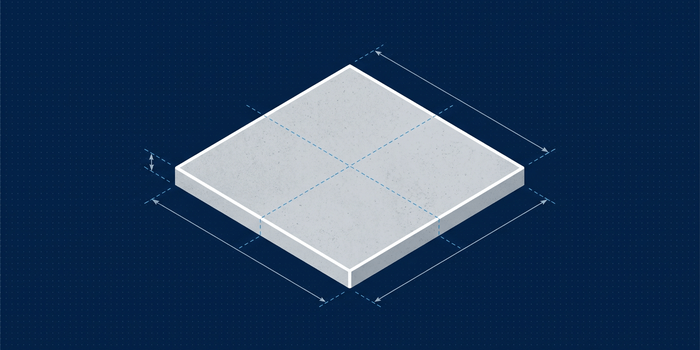
Use this free concrete slab calculator to estimate cubic yards, cubic feet, and bag counts for patios, driveways, garage floors, shed pads, and walkways. Enter slab length, width, thickness, and an optional waste allowance to get a fast slab-specific estimate. Looking for the formulas and conversions behind the math? See our main concrete calculator.
Concrete Slab Calculator
Estimates only. Bag yields vary by brand and mix. Always confirm with your supplier.
Quick Answer for Slabs
To estimate concrete for a slab, multiply length by width by thickness, all in feet, to get cubic feet, then divide by 27 for cubic yards. Add a five to ten percent waste factor for spillage, uneven base conditions, and measurement variation. For typical residential slabs, 4 inches works for patios and walkways, while 6 inches is the standard for driveways and garage floors.
Keep comparing slab pages, calculators, and project estimates
Move to the main calculator hub, browse ready-made slab size pages, or switch to footing planning if your project is not a flat slab pour.
How to Use the Slab Calculator
- Measure your slab area: Use a tape measure to determine the length and width of your pour area in feet. For irregular shapes, break the area into rectangles and calculate each section separately.
- Determine thickness: Measure or decide on slab thickness in inches. Common residential thicknesses are 4 inches for patios and 6 inches for driveways.
- Enter dimensions: Input length, width, and thickness into the calculator fields. The tool handles unit conversions automatically.
- Add waste factor: Select a waste percentage, typically five to ten percent, to account for over-excavation, spillage, and settling.
- Review results: The calculator displays cubic yards for ordering ready-mix and equivalent bag counts if you prefer bagged concrete.
- Verify measurements: Double-check your dimensions on-site before ordering. It is easier to order slightly more than to run short mid-pour.
- Contact supplier: Use the cubic yard estimate when calling ready-mix suppliers or the bag count when shopping at home improvement stores.
Slab-Specific Examples
Example A: 10 ft × 10 ft Patio Slab (4 inches thick)
Dimensions: Length = 10 ft, Width = 10 ft, Thickness = 4 inches (0.333 ft)
Volume in cubic feet: 10 × 10 × 0.333 = 33.3 ft³
Volume in cubic yards: 33.3 ÷ 27 = 1.23 yd³
With 10% waste factor: 1.23 × 1.10 = 1.35 yd³
Result: Order approximately 1.5 cubic yards from your ready-mix supplier to ensure adequate coverage.
Example B: 12 ft × 20 ft Driveway Slab (6 inches thick)
Dimensions: Length = 20 ft, Width = 12 ft, Thickness = 6 inches (0.5 ft)
Volume in cubic feet: 20 × 12 × 0.5 = 120 ft³
Volume in cubic yards: 120 ÷ 27 = 4.44 yd³
With 10% waste factor: 4.44 × 1.10 = 4.88 yd³
Result: Order 5 cubic yards to account for waste and ensure you do not run short during the pour.
Example C: 8 ft × 6 ft Shed Pad (4 inches thick)
Dimensions: Length = 8 ft, Width = 6 ft, Thickness = 4 inches (0.333 ft)
Volume in cubic feet: 8 × 6 × 0.333 = 16 ft³
Volume in cubic yards: 16 ÷ 27 = 0.59 yd³
With 10% waste factor: 0.59 × 1.10 = 0.65 yd³
Result: About 27 × 80 lb bags, often the breakeven point where ready-mix starts to make sense if delivery is available.
4-Inch vs 6-Inch Slabs: Which Should You Pour?
A 4-inch slab is standard for residential patios, walkways, and shed foundations where foot traffic and light equipment are the primary loads. This thickness is adequate for most non-vehicular applications and helps keep material costs under control.
A 6-inch slab is more appropriate for driveways, garage floors, and areas where vehicles will park or drive. The additional thickness improves strength and resistance to cracking under repeated heavier loads. Some local building codes also require minimum slab thicknesses for specific uses, so always verify requirements before pouring.
Heavily loaded commercial slabs or areas with poor soil conditions may require thicker pours or additional reinforcement such as rebar or fiber mesh. If your project involves unusual loads or unstable fill, it is worth getting professional guidance before ordering concrete. For a deeper comparison, see our guide on 4″ vs 6″ slab thickness.
Gravel Base, Reinforcement & Curing
Concrete volume is only half the slab story. The other half is what sits underneath the slab and what holds it together once it cures. Skipping any of these steps usually creates problems your calculator cannot fix later.
- Gravel base: A 4–6 inch compacted gravel or crushed stone base improves drainage, reduces settling, and limits cracking. See our slab base guide.
- Reinforcement: Wire mesh, rebar, or fiber additives reduce cracking under load and shrinkage. See rebar vs wire mesh vs fiber.
- Curing: Concrete reaches full strength over 28 days. Keep the surface moist for the first few days and avoid heavy loads for at least seven. See our curing best practices guide.
Slab Cost Planning
Concrete slab cost depends on more than just the amount of material. Ready-mix suppliers typically charge per cubic yard, with pricing influenced by region, PSI strength, and delivery distance. If you order less than a supplier’s minimum, you may also pay a short-load fee, often on smaller jobs below four or five yards.
Mix strength also affects price. Standard 3000 PSI works well for many residential slabs, while 4000 PSI is often recommended for driveways and garage floors in freeze-thaw climates. Stronger mixes cost more, but they can improve durability and reduce long-term cracking risk.
Other costs may include gravel base, compaction, forms, reinforcement, finishing labor, and sealing. It is smart to budget for those items early instead of focusing only on cubic yards. For a more detailed breakdown, visit our concrete cost per yard guide.
Common Slab Mistakes & Tips
- Forgetting the waste factor: Always add five to ten percent extra. Running short mid-pour creates cold joints and weak spots.
- Measuring in wrong units: Double-check whether your tape measure shows feet or inches. Mixing units leads to major calculation errors.
- Ignoring uneven base: An improperly compacted or uneven gravel base causes the slab to settle unevenly, requiring more concrete than calculated.
- Not accounting for forms: Wood forms take up space and slightly reduce the effective pour area. Measure inside the forms, not outside.
- Ordering too little: It is far better to have a small amount left over than to stop mid-pour and wait for another delivery. Leftover concrete can fill post holes or patch walkways.
- Ignoring weather and curing: Hot weather accelerates setting time and requires more frequent watering. Cold weather slows curing and risks freeze damage. Plan your pour date carefully.
- Skipping reinforcement: Wire mesh or rebar significantly reduces cracking, especially in larger slabs or areas with unstable soil. Do not skip this step to save a few dollars.
Slab Calculator FAQ
Can I pour a slab directly on dirt?
No, you should not pour concrete directly on bare soil. A proper base consists of four to six inches of compacted gravel or crushed stone to provide drainage, prevent settling, and reduce cracking. Some areas also require a vapor barrier between the gravel and concrete.
How long does a slab take to dry before I can walk on it?
A residential slab usually reaches sufficient strength for foot traffic in 24 to 48 hours under normal conditions. Full curing takes 28 days. Avoid heavy loads or vehicle traffic for at least seven days to prevent surface damage and cracking.
Do I need rebar or wire mesh in my slab?
Reinforcement is highly recommended for slabs over 100 square feet or any slab exposed to vehicle traffic. Rebar or welded wire mesh controls cracking by holding the concrete together even if minor cracks form. Check local building codes for specific requirements.
What PSI concrete should I use for a driveway?
Use 4000 PSI concrete for driveways and garage floors to handle vehicle weight and resist freeze-thaw damage. Standard 3000 PSI is adequate for patios, walkways, and shed pads where vehicles will not drive.
How do I calculate concrete for an irregular slab shape?
Break the irregular area into multiple rectangles or squares. Calculate the cubic yards for each section separately, then add them together. This approach is more accurate than trying to estimate a complex shape as a single calculation.
Can I use this calculator for a sloped slab or ramp?
This calculator assumes a flat slab with uniform thickness. For sloped slabs like wheelchair ramps, calculate using the average thickness across the slope. For complex grades, see our guide on estimating concrete for a ramp or sloped slab.
What happens if I order too much concrete?
Excess concrete can be used for smaller projects like filling post holes, building small pads, or creating stepping stones. You can also ask the driver to leave it in a designated area for later use, though it will harden quickly. Most suppliers do not accept returns of ready-mix concrete.
How thick should the gravel base be under my slab?
A four to six inch compacted gravel base is standard for most residential slabs. Areas with poor drainage or unstable soil may require a thicker base. The gravel provides a stable, well-draining foundation that prevents settling and cracking.
Should I add fiber to my concrete slab mix?
Fiber reinforcement reduces plastic shrinkage cracking and adds impact resistance. It is a low-cost upgrade often recommended for garage floors and driveways. Discuss fiber options with your ready-mix supplier when ordering.
What is the maximum size slab I can pour at once?
For DIY pours, manageable single sections are usually under 400 square feet to keep finishing time realistic. Larger slabs are commonly divided into bays with construction joints to control cracking and let crews finish each section before the concrete sets.
Explore More Tools & Guides
Estimates only. Always verify local requirements and supplier guidance.