
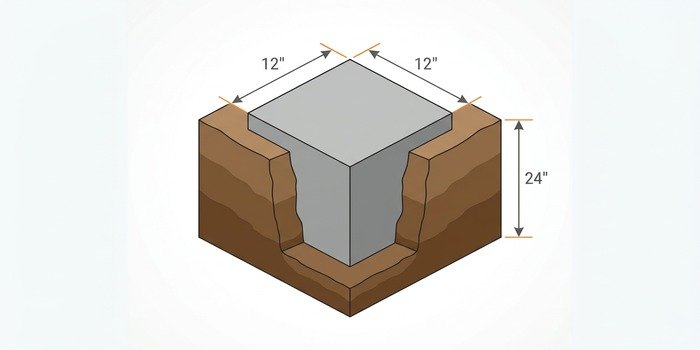
How Much Concrete for a 12x12x24 Footing?
Materials and planning for a 12" x 12" x 24" square footing: 2 cu ft (0.0741 yd³) and bag counts
Quick reference for a 12" x 12" x 24" square footing: 2 cubic feet (0.0741 yd³). Includes exact bag counts, 10% waste planning, and practical pouring tips.
Use cases for a 12" x 12" x 24" footing often include single deck posts, small stoop columns, and light support under posts or short columns. With a 24-inch depth this footing may be suitable where that depth aligns with local frost-depth requirements and where loads are modest to medium for a single post or column.
The footprint is just 1 sq ft, so material needs are small: the raw volume is 2 cubic feet (0.0741 yd³). That makes bagged concrete a convenient option for one or a few footings, while multiple footings may push you toward bulk mixing or a small readymix order.
Quick Answer
Exact concrete volume for a single 12" x 12" x 24" footing is 2.0 cubic feet, which is 0.0741 cubic yards. With a 10% allowance for waste and over-excavation the planning volume is 2.2 cubic feet (0.0815 yd³).
Exact bag counts for the footing are 7 40-lb bags, 5 60-lb bags, or 4 80-lb bags. For ordering with waste in mind, plan on 8 40-lb bags, 5 60-lb bags, or 4 80-lb bags to be safe.
Need a custom estimate? Use the Footing Calculator, try the concrete calculator for any pour, or browse footing size pages. All project pages.
How to Use This Footing Estimate
Simple steps to prepare and pour this footing:
- Confirm footing location, dimensions (12" x 12" x 24"), and any required setbacks or clearance.
- Excavate and level the subgrade, remove loose soil, and compact the bottom.
- Set formwork square and true to the 12" x 12" dimensions and check depth at 24" deep.
- Place any required reinforcement, such as a short piece of rebar or wire mesh, following engineer or code guidance.
- Mix bagged concrete or arrange ready-mix, pour into forms, and consolidate to eliminate voids.
- Screed and finish the top, then cure for the required time to reach design strength.
Formula
The basic volume formula for a rectangular footing is length × width × depth. For this footing the dimensions in feet are 1 ft × 1 ft × 2 ft, so the raw volume is 1 × 1 × 2 = 2.0 cubic feet.
Convert cubic feet to cubic yards by dividing by 27. That gives 2.0 ÷ 27 = 0.074074..., rounded to 0.0741 cubic yards for the single footing.
To allow for cutting, spillage, and slight over-excavation add 10% waste: 2.0 × 1.10 = 2.2 cubic feet. Converting the planning volume to cubic yards yields 2.2 ÷ 27 ≈ 0.08148, rounded to 0.0815 yd³.
Worked Example
Single-footing example: one 12" x 12" x 24" footing requires 2.0 cubic feet (0.0741 yd³). With a 10% allowance plan for 2.2 cubic feet (0.0815 yd³) and order the waste-adjusted bag quantities.
Multiple-footing example: three identical footings total 3 × 2.0 = 6.0 cubic feet. Converted to cubic yards that is 6.0 ÷ 27 = 0.2222 yd³. If you include 10% waste, plan for 3 × 2.2 = 6.6 cubic feet, which is about 0.2444 yd³ for all three footings.
Bag Count Estimate
- 4 bags of 80 lb concrete mix
- 5 bags of 60 lb concrete mix
- 8 bags of 40 lb concrete mix
Always verify the actual yield on the product label before buying materials.
Bag Counts by Waste Buffer for 12" x 12" x 24"
Pick a buffer based on site conditions: clean forms and accurate measurements can run leaner; rough subgrade or hard-to-reach pours need more cushion.
| Buffer | Volume (ft³) | 80 lb bags | 60 lb bags | 40 lb bags |
|---|---|---|---|---|
| No buffer | 2 | 4 | 5 | 7 |
| +5% typical DIY | 2.1 | 4 | 5 | 8 |
| +10% recommended | 2.2 | 4 | 5 | 8 |
| +15% rough conditions | 2.3 | 4 | 6 | 8 |
When Bagged Concrete vs Ready-Mix Makes Sense
For a single 12" x 12" x 24" footing, bagged concrete is usually the most practical choice. The total planned volume with waste is only 0.0815 cubic yards, so buying bagged concrete lets you match small quantities closely and avoid a large leftover load.
If you have many footings or want a faster pour, readymix can be efficient, but small total volumes like this often mean a surplus of concrete and additional cost. For multiple footings clustered together, compare the total planned volume to local ready-mix minimums and waste before deciding.
Common Uses for This Footing Size
A 12x12x24 footing is commonly used for supporting single posts in residential settings. You might see it under deck posts, pergola posts, fence posts, or small porch columns. Its size fits well where the loads are light to moderate and the post spacing is typical. This footing helps keep posts stable and anchored to the ground without needing a large concrete base.
Whether this footing size is right depends on several factors. The weight of what’s being supported, the type of soil, how deep the frost line is in your area, and if any reinforcement like rebar is needed all play a role. Local building codes can also affect what footing dimensions are acceptable for your project.
Common Mistakes to Avoid
Common mistakes to avoid when installing a small footing:
- Underordering material by not including a waste allowance.
- Failing to compact and level the subgrade before placing concrete.
- Incorrectly setting form depth or dimensions—double-check 12" x 12" x 24".
- Skipping reinforcement when it’s required for the load or code.
- Poor mixing or inadequate consolidation that leaves voids.
- Insufficient curing time, which reduces final strength.
Frequently Asked Questions
How much concrete does a 12" x 12" x 24" footing need?
A single 12" x 12" x 24" footing requires 2.0 cubic feet of concrete, which equals 0.0741 cubic yards. With a 10% waste allowance plan for 2.2 cubic feet (0.0815 yd³).
How many bags of concrete do I need for this footing?
Exact counts are 7 40-lb bags, 5 60-lb bags, or 4 80-lb bags. When you include a 10% waste allowance plan to order 8 40-lb bags, 5 60-lb bags, or 4 80-lb bags.
Why add 10% waste to the calculation?
Ten percent accounts for spillage, uneven subgrades, slight over-excavation, and mixing variances. Using the planning volume prevents running short on site and matches the listed planning bag counts.
Is a 12" x 12" x 24" footing adequate for a deck post?
It depends on the post load, soil bearing capacity, frost depth, and local building code. A 24-inch depth may meet frost requirements in some areas, but check soil conditions, reinforcement needs, and any permit or engineer recommendations before relying on this single footing size for a deck post.
Keep Planning Your Concrete Project
Use the calculator, compare footing pages, and keep your estimate practical before you buy materials.
Disclaimer: This page provides planning estimates only. Actual concrete needs vary with excavation accuracy, site conditions, local code requirements, bag yield, and supplier guidance. Always verify measurements before buying materials, and consult a qualified professional for structural or code-sensitive work.