
A basic poured concrete patio commonly costs about $4 to $12 per square foot installed in the U.S. in 2026, while decorative stained or stamped patios can reach roughly $8 to $30 per square foot. The final price depends on patio size, site preparation, slab thickness, reinforcement, access, labor, and finish.
For a straightforward broom-finished patio, using about $6 to $12 per square foot is a useful early planning range. That puts a 12 × 20-foot patio at roughly $1,440 to $2,880 before unusual excavation, demolition, drainage work, pumping, or premium decorative finishes.
Quick Answer
How much does it cost to pour a concrete patio?
Plain concrete patio installation typically falls around $4–$12 per square foot, with simple broom-finished work commonly around $6–$13 per square foot. Decorative stamped, stained, colored, or exposed-aggregate finishes can cost substantially more.
How much does a 12 × 20 concrete patio cost?
A 12 × 20-foot patio covers 240 square feet. At a practical $6–$12 per square foot planning range, that works out to approximately $1,440–$2,880 for a straightforward installation.
Rule of thumb: Calculate square footage and concrete volume first, then add costs for excavation, gravel base, reinforcement, finishing, demolition, access, and delivery.
Patio size is only the starting point
Two patios with identical dimensions can have very different prices if one needs difficult excavation, a pump, decorative stamping, or extensive drainage work.
Main patio cost drivers
- Size: larger patios require more concrete, base material, forms, labor, and finishing.
- Thickness: 6 inches uses 50% more concrete than 4 inches over the same area.
- Base preparation: soft soil, grading, drainage, and imported stone increase cost.
- Finish: plain or broom-finished concrete costs less than stamped or stained surfaces.
- Access: difficult backyard access may require wheelbarrows, extra labor, or a concrete pump.
- Existing patio: demolition and disposal add another cost before the new pour begins.
1. Concrete Patio Cost by Size
The table below uses $6–$12 per square foot as a practical planning range for a relatively simple residential patio with a basic finish and normal site conditions.
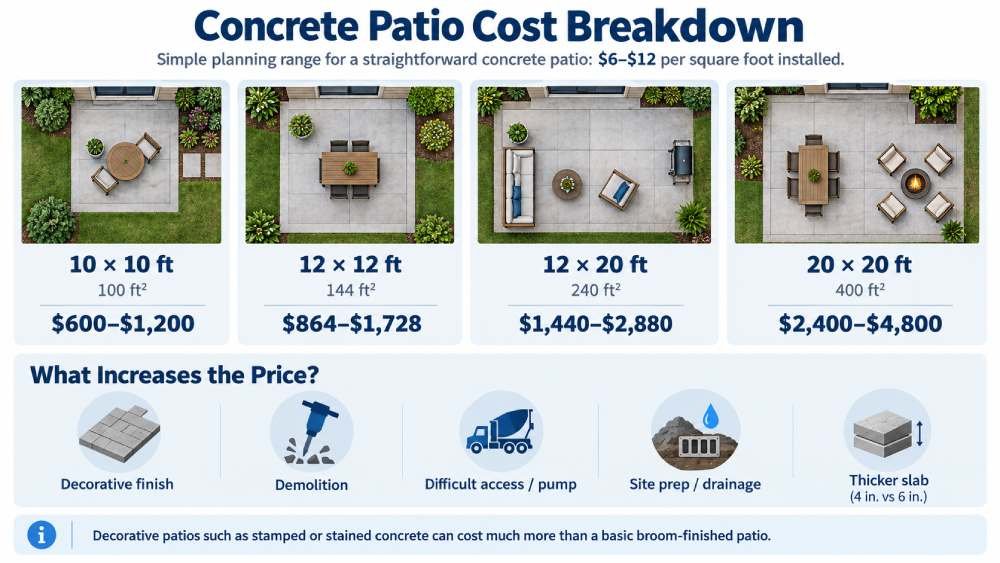
| Patio Size | Area | Planning Cost at $6–$12/ft² |
|---|---|---|
| 10 × 10 ft | 100 ft² | $600–$1,200 |
| 12 × 12 ft | 144 ft² | $864–$1,728 |
| 12 × 20 ft | 240 ft² | $1,440–$2,880 |
| 16 × 20 ft | 320 ft² | $1,920–$3,840 |
| 20 × 20 ft | 400 ft² | $2,400–$4,800 |
These figures are early budget estimates rather than contractor quotes. Small patios can also have relatively high per-square-foot costs because contractors still need to mobilize equipment, forms, tools, and labor even when the concrete quantity is small.
2. How Much Concrete Does a Patio Need?
Patio installation is usually discussed by square foot, but concrete itself is ordered in cubic yards. Thickness therefore has a direct effect on the material portion of your budget.
Example: 12 × 20 ft patio at 4 inches
A 12 × 20-foot patio covers 240 ft². At 4 inches thick:
240 × 0.333 = approximately 80 ft³
80 ÷ 27 = approximately 2.96 yd³
You can see that exact configuration on the 12×20 4-inch slab example.
What if the patio is 6 inches thick?
At 6 inches, the same 12 × 20-foot patio contains approximately 4.44 yd³. That is about 1.48 additional cubic yards compared with a 4-inch slab.
For your own patio dimensions, use the concrete estimator before requesting material or contractor pricing.
3. Is a 4-Inch Patio Thick Enough?
Four inches is common for many ground-level residential patios intended primarily for people, furniture, grills, and ordinary outdoor living. A thicker slab may be appropriate where loads, soil, design, or project requirements justify it.
A patio supporting a hot tub, heavy masonry outdoor kitchen, structural posts, vehicle access, or other concentrated loads should not automatically use the same section as a simple seating patio.
The 4-inch vs. 6-inch slab guide explains how increasing thickness changes both concrete quantity and performance.
Do not pour the entire patio thicker just because a roof is planned
If a pergola, patio roof, or other structure needs posts, those supports may require separate structural footings rather than simply increasing the thickness of the patio slab everywhere.
4. How Much Does Ready-Mix Concrete Add to the Patio Cost?
Current national pricing puts general-purpose ready-mix concrete at roughly $130 per cubic yard as a representative 2026 figure, with actual supplier pricing varying by mix, location, delivery distance, quantity, and fees.
Using the 12 × 20 × 4-inch example above:
2.96 yd³ × $130 ≈ $385 in theoretical base concrete material cost.
But a three-yard order may cost substantially more than $385 delivered because it is below a full truckload.
Short-load fees matter on patios
Patios often need only a few cubic yards of concrete. Current delivery data shows short-load charges can add roughly $40–$60 per cubic yard when the order is below a full truckload.
The concrete cost per yard guide explains material prices, short loads, delivery fees, and why the advertised per-yard number rarely represents the entire delivered invoice.
5. Base Preparation Can Change the Budget Quickly
A patio needs uniform support beneath the slab. Installing concrete over soft topsoil, roots, mud, or loose fill may save excavation money initially but can lead to settlement and cracking later.
Typical preparation can include:
- Removing grass and topsoil
- Excavating for the slab and base
- Correcting soft spots
- Importing crushed stone
- Compacting the granular base
- Grading the patio away from structures
- Setting and bracing forms
Difficult grading and drainage work can cost more than homeowners expect. Current cost data shows grading and site leveling alone can add significant expense to some patio projects.
If you are evaluating the existing ground, the guide to pouring concrete over dirt explains what soil can remain and what should be removed or stabilized before pouring.
6. Does a Concrete Patio Need Rebar?
Patios can use rebar, welded wire reinforcement, fibers, or other reinforcement depending on the slab design and local practices.
Reinforcement is not a substitute for proper thickness, base preparation, joints, or curing.
A simple pedestrian patio on good subgrade may have different requirements than a slab carrying a hot tub, outdoor fireplace, masonry kitchen, or heavy structure.
If reinforcement is specified, factor both material and installation labor into the patio budget.
7. Patio Finish Can Double or Triple the Price
Finish is one of the biggest differences between a basic concrete patio and a premium backyard project.
| Patio Finish | Typical Planning Range |
|---|---|
| Plain concrete | About $4–$12/ft² |
| Broom finish | About $6–$13/ft² |
| Exposed aggregate | About $7–$18/ft² |
| Stained concrete | About $8–$25/ft² |
| Stamped concrete | About $9–$30/ft² |
A broom finish is a common practical choice because it provides outdoor traction without the labor and material cost of elaborate stamping or coloring.
Decorative concrete is where patio budgets can change dramatically. Multiple colors, borders, intricate stamp patterns, specialty sealers, and custom edges all add labor.
8. What If an Old Patio Needs to Be Removed?
If an existing concrete patio is badly cracked, incorrectly sloped, or being replaced with a different layout, demolition may be necessary before the new slab can be installed.
Current national planning data puts concrete removal around $2–$6 per square foot in many cases.
For a 12 × 20 patio:
240 ft² × $2 = $480
240 ft² × $6 = $1,440
So demolition alone could add roughly $480–$1,440 before site preparation for the replacement slab.
Do not leave the original problem underneath
If the old patio settled because of poor drainage, loose fill, or erosion, removing the concrete without correcting the underlying cause can allow the replacement patio to develop similar problems.
9. Backyard Access Can Add Significant Labor
A driveway is often easy for a ready-mix truck to approach. A backyard patio may be completely different.
If the truck cannot reach the forms, concrete may need to travel by:
- Wheelbarrow
- Powered buggy
- Conveyor
- Concrete pump
Each option adds labor or equipment cost.
A three-yard patio still represents more than 12,000 lb of fresh normal-weight concrete. Moving that material manually through a narrow side yard is a much bigger task than the cubic-yard number suggests.
Plan access before ordering
Check gates, slopes, stairs, landscaping, overhead obstructions, soft lawns, and the distance from the truck to the pour before choosing a placement method.
10. Example Budget: 12 × 20 ft Concrete Patio
Consider a straightforward 12 × 20-foot, 4-inch-thick broom-finished patio on a reasonably accessible site.
Area
12 × 20 = 240 ft²
Installed planning range
At $6–$12 per square foot:
240 × $6 = $1,440
240 × $12 = $2,880
Concrete volume
At 4 inches thick, approximately 2.96 yd³ before allowance.
This early budget would assume relatively normal excavation, standard base preparation, simple rectangular forms, basic finishing, and reasonable access.
The total could rise substantially if the project adds:
- Old patio demolition
- Major grading or drainage
- Concrete pumping
- Stamped or stained finish
- Heavy reinforcement
- Curved or complex forms
- Structural footings for a roof or pergola
11. DIY vs. Hiring a Concrete Contractor
Patios are more realistic DIY projects than large driveways, but scale matters.
A 10 × 10 patio may be manageable for an experienced DIYer with enough helpers. A 20 × 20 patio contains substantially more concrete and gives the crew the same limited window to place, screed, float, edge, joint, and finish the surface.
Saving labor money only works if the pour can be completed correctly. A failed finish or incorrectly sloped patio is expensive to remove and replace.
The step-by-step concrete slab guide shows the full sequence from excavation and base preparation through placement, finishing, joints, and curing.
For smaller projects, also compare hand-mixed bags against ready-mix using the bagged vs. ready-mix concrete cost comparison.
Tools & Next Steps
Calculate your patio concrete
Enter patio length, width, and thickness to determine cubic feet and cubic yards before requesting prices.
Compare common patio sizes
Browse pre-calculated slab dimensions to compare concrete quantities for different patio layouts.
Frequently Asked Questions
How much does a concrete patio cost per square foot?
A basic poured concrete patio commonly costs about $4–$12 per square foot installed. Broom-finished patios often fall around $6–$13, while stained, stamped, or other decorative work can cost substantially more.
How much does a 10 × 10 concrete patio cost?
A 10 × 10 patio covers 100 square feet. Using a straightforward $6–$12 per square foot planning range gives an estimated installed cost of roughly $600–$1,200.
How much does a 12 × 12 concrete patio cost?
A 12 × 12 patio covers 144 square feet. At $6–$12 per square foot, a simple planning range is approximately $864–$1,728.
How much does a 12 × 20 concrete patio cost?
A 12 × 20 patio covers 240 square feet. At $6–$12 per square foot, expect an early planning range around $1,440–$2,880 before unusual site work or decorative upgrades.
How much does a 20 × 20 concrete patio cost?
A 20 × 20 patio covers 400 square feet. Using $6–$12 per square foot gives approximately $2,400–$4,800 for straightforward work.
How thick should a concrete patio be?
Four inches is common for many ground-level residential patios. Heavy concentrated loads, structural supports, unusual soil conditions, or project-specific requirements may require a different slab or separate footings.
How much concrete does a 12 × 20 patio need?
A 12 × 20-foot patio at 4 inches thick requires approximately 2.96 cubic yards before waste. At 6 inches thick, the same patio requires approximately 4.44 cubic yards.
Is stamped concrete more expensive than a plain patio?
Yes, stamped concrete generally costs significantly more because of additional labor, coloring, pattern work, release agents, detailing, and sealing. Current planning ranges can reach roughly $9–$30 per square foot depending on complexity.
Is it cheaper to pour a concrete patio yourself?
DIY can reduce labor costs on small, simple patios, but the savings depend on your ability to complete the pour correctly. Equipment rental, helpers, ready-mix delivery, forms, tools, base material, reinforcement, and potential mistakes should all be included in the comparison.
Calculate the patio before comparing prices
Disclaimer
This guide provides general U.S. cost and DIY planning information. Concrete, labor, site preparation, reinforcement, demolition, disposal, pumping, permits, drainage, and finishing prices vary significantly by location and project. Cost ranges are planning estimates rather than contractor quotes. Verify local pricing and requirements, and consult a qualified contractor or engineer for structural loads, roofs, pergolas, hot tubs, poor soils, complex drainage, or other conditions requiring project-specific design.