
Concrete curing and concrete drying are two different processes: curing helps cement hydrate and concrete develop strength, while drying is the gradual loss of excess moisture from the hardened slab. Concrete may receive only several days of active curing yet still take weeks or even months to dry enough for moisture-sensitive flooring or coatings.
This distinction explains why a slab can be hard enough to walk on, strong enough for normal use, and still contain significant internal moisture. It also explains why the familiar 28-day concrete milestone should not be treated as a universal drying deadline.
Quick Answer
What is the difference between concrete curing and drying?
Curing keeps newly placed concrete at suitable moisture and temperature conditions so cement hydration can continue. Drying happens afterward and simultaneously as excess moisture gradually moves through the slab and escapes into the surrounding air.
How long does concrete take to cure?
Initial curing commonly lasts about 3–7 days, depending on the concrete, weather, specification, and curing method. Concrete continues developing strength beyond that period, and 28 days is a common reference age for specified compressive strength.
How long does concrete take to dry?
There is no universal number of days. Interior slabs can require weeks to months to reach moisture levels acceptable for particular flooring or coating systems. Thickness, mixture water, humidity, temperature, curing method, airflow, and moisture from below the slab all affect drying.
28 days does not mean “completely dry”
The 28-day milestone relates primarily to conventional concrete strength testing. A 28-day-old slab can still contain enough moisture to damage moisture-sensitive flooring or coatings.
Concrete timeline at a glance
- Setting: fresh concrete changes from plastic to rigid over the first several hours.
- Curing: moisture and temperature are controlled to support hydration, commonly for roughly 3–7 days or as specified.
- Strength gain: continues well beyond the initial curing period.
- 28 days: common reference age for specified compressive strength—not a drying guarantee.
- Drying: internal moisture leaves gradually and may take weeks or months.
1. Concrete Curing vs. Drying: The Main Difference
The easiest way to understand the difference is to look at what happens to water during each process.
Curing keeps useful moisture in the concrete
Concrete hardens through a chemical reaction called hydration. Cementitious materials react with water and form the hardened paste that binds the aggregate together.
During the early life of the slab, losing too much water from the surface can interfere with that reaction and contribute to weak, dusty, cracked, or less durable concrete.
Curing therefore tries to prevent premature moisture loss.
Common methods include:
- Wet coverings
- Plastic sheeting
- Spraying or fogging
- Ponding where appropriate
- Curing compounds
For a deeper explanation of these methods, see the
concrete curing basics guide.
Drying removes excess moisture
Drying refers to moisture gradually moving from inside the hardened concrete toward exposed surfaces and then evaporating into the surrounding air.
That process may continue long after curing has ended.
This matters especially indoors when installing vinyl, wood, adhesives, epoxy coatings, or other moisture-sensitive finishes.
2. Setting, Curing, Strength Gain, and Drying Are Not the Same Thing
Several concrete timelines overlap, which is why homeowners often use the terms interchangeably.
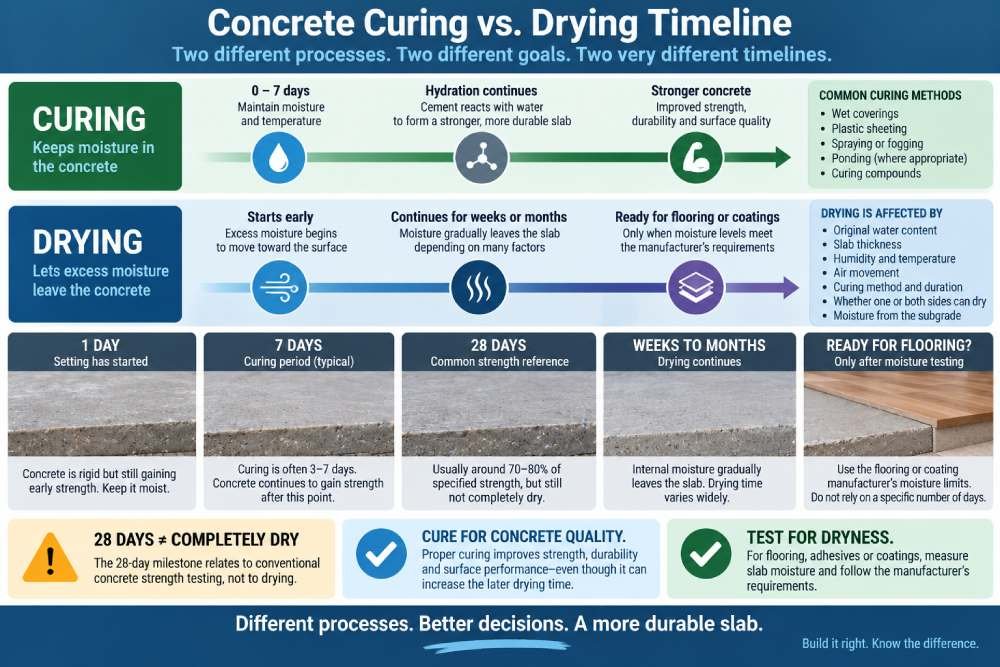
| Process | What Is Happening? | Typical Time Scale |
|---|---|---|
| Setting | Concrete changes from workable plastic material to rigid material | Hours |
| Curing | Moisture and temperature are controlled to support hydration | Commonly 3–7 days or as specified |
| Strength gain | Hydration continues and concrete develops additional strength | Days, weeks, and beyond |
| Drying | Excess internal moisture migrates toward exposed surfaces | Weeks to months in many slabs |
A slab can therefore be set but not adequately cured, cured but not fully dry, and strong enough for traffic while still too moist for a particular floor covering.
3. Why Is 28 Days So Often Mentioned With Concrete?
The 28-day figure comes largely from the way concrete compressive strength is conventionally specified and tested.
ACI notes that specified compressive strength is generally based on 28-day test results unless the construction documents specify otherwise.
That does not mean:
- Concrete suddenly stops gaining strength on day 28
- The slab is completely dry on day 28
- Every coating can automatically be installed on day 28
- The slab needs to remain untouched for 28 days
Think of 28 days as an important strength-reference age, not a universal finish line.
Actual strength development changes with concrete temperature, mixture proportions, cementitious materials, curing, and other conditions.
If you are deciding when a new slab can handle normal use, use the appropriate traffic guidance rather than waiting for the slab to become “dry.”
4. How Long Should Concrete Be Cured?
NRMCA describes curing as beginning after placement and finishing and continuing for a sufficient period, typically about 3–7 days.
That range should not be interpreted as a universal requirement for every concrete mixture and project.
Curing duration can depend on:
- Concrete mixture
- Cement type
- Supplementary cementitious materials
- Air and concrete temperature
- Humidity and wind
- Exposure conditions
- Required strength and durability
- Project specifications
The objective is not merely to keep the slab visibly wet. The objective is to maintain conditions favorable for hydration and strength development.
In cold conditions, strength develops more slowly. Review the
cold weather concrete guide
if temperatures are near or below the normal cold-weather threshold.
5. Why Proper Curing Can Actually Delay Drying
This sounds contradictory, but it makes sense once the two processes are separated.
Curing intentionally retains moisture. Drying intentionally allows excess moisture to leave.
NRMCA specifically notes that moist curing can increase the later drying time of a slab. That does not mean proper curing should be skipped.
A good slab first needs adequate curing to develop the intended properties. When the required curing period ends, the project can transition toward the drying conditions needed for the next finish or flooring system.
Do not sacrifice concrete quality simply to make the surface appear dry sooner.
Poor curing can contribute to:
- Lower potential strength
- Reduced surface hardness
- Higher cracking potential
- Dusting
- Scaling
- Reduced durability
If cracking has already appeared, see
how to repair concrete cracks
after identifying the underlying cause.
6. How Long Does Concrete Actually Take to Dry?
There is no reliable calendar rule that works for every slab.
NRMCA states that concrete slabs can require weeks to months in favorable interior conditions to reach moisture levels acceptable to flooring manufacturers and industry requirements.
Drying rate is affected by:
- Original water content of the concrete
- Water-cementitious material ratio
- Slab thickness
- Concrete type
- Curing method and duration
- Ambient relative humidity
- Temperature
- Air movement
- Whether one or both slab surfaces can dry
- Rain or construction water after placement
- Moisture migrating from beneath the slab
A thicker slab generally contains more moisture and has a longer path for that moisture to travel.
That is one reason a calendar-based statement such as “concrete dries in 28 days” can be misleading.
7. Is the “One Month per Inch” Drying Rule Accurate?
You may hear a rule claiming that concrete needs roughly one month of drying for every inch of thickness.
Do not use that rule as proof that a slab is ready for flooring, coating, or another moisture-sensitive system.
Drying is not controlled by thickness alone. A 4-inch slab in warm, dry, conditioned air with a low-water concrete mixture can behave very differently from another 4-inch slab exposed to high humidity, rain, or moisture from the subgrade.
The correct approach for a moisture-sensitive installation is to measure slab moisture and compare the results with the flooring, adhesive, or coating manufacturer’s limits.
8. How Do You Know When a Concrete Slab Is Dry Enough?
You cannot reliably determine internal slab moisture simply by looking at the surface.
A slab may appear light gray and completely dry while still holding substantial moisture below the surface.
For moisture-sensitive flooring, recognized testing methods include measurements such as in-situ relative humidity testing under ASTM F2170 and other specified moisture-testing methods.
The important point for a homeowner is simple:
Use the acceptance criteria required by the flooring, adhesive, coating, or system being installed—not a generic number of days.
What about taping plastic to the floor?
A plastic-sheet test can indicate that excess moisture is present when condensation or darkening appears under the sheet.
However, NRMCA cautions that a negative plastic-sheet result does not prove the slab is sufficiently dry deeper inside.
For important indoor finishes, use the specified quantitative test rather than relying only on surface appearance or a DIY plastic test.
9. When Can You Walk on Concrete?
Walking on concrete is a strength question, not a drying question.
You do not need to wait until the slab has dried internally before allowing light foot traffic.
Concrete may support carefully controlled foot traffic much earlier, depending on the mixture, temperature, curing conditions, and project.
For the specific timeline and precautions, see
when you can walk on new concrete.
Do not stop curing simply because the slab feels hard enough to walk on. Surface hardness and adequate curing are separate issues.
10. When Can You Drive on Concrete?
Vehicle traffic also depends primarily on strength development and loading, not whether all internal moisture has evaporated.
A vehicle creates much higher concentrated loads than a person walking across the slab, so the waiting period is longer.
Concrete mixture, slab thickness, vehicle weight, temperature, curing, subgrade support, and reinforcement can all affect readiness.
See
when you can drive on new concrete
before putting vehicles on a new driveway or slab.
11. Drying Matters Most Before Flooring, Coatings, and Sealers
Excess slab moisture becomes especially important when the concrete will be covered with a material that restricts evaporation.
Potential problems include:
- Flooring adhesive failure
- Bubbles or blisters beneath coatings
- Discoloration
- Loss of bond
- Moisture-related flooring damage
Always follow the moisture limits and surface-preparation requirements for the actual product being installed.
Do not assume that because another slab was coated successfully after a particular number of days, yours will behave the same way.
12. Vapor Barriers Affect Long-Term Slab Moisture
For interior slabs receiving moisture-sensitive flooring, moisture does not come only from the original concrete mixture.
The soil beneath a slab can remain at very high relative humidity and continuously supply water vapor upward.
An appropriate vapor retarder helps separate the slab from that moisture source.
NRMCA guidance recommends an ASTM E1745-compliant vapor retarder directly beneath slabs where controlling moisture migration is important.
See the
vapor barrier under concrete slab guide
for placement, gravel-base considerations, and common installation mistakes.
13. How to Help a Concrete Slab Dry After Curing
Once the required curing period is complete, drying can be encouraged by creating favorable environmental conditions.
Depending on the project, this may include:
- Keeping the slab protected from additional rain or water
- Providing ventilation
- Using conditioned indoor air
- Reducing ambient humidity
- Using dehumidification where appropriate
- Maintaining reasonable temperature
Avoid repeatedly wetting a slab that is now supposed to be drying for a flooring installation.
NRMCA specifically notes that wetting from precipitation or construction activities after curing can raise slab moisture and extend the drying period.
14. Plan the Slab Before You Pour
If you are still planning a new slab rather than waiting for one to dry, getting the concrete quantity and thickness right is the first step.
Use the
concrete calculator
to estimate cubic yards from your project dimensions.
You can also compare common sizes in the
concrete slab project hub.
Do not add unnecessary water to the concrete simply to make placement easier. Extra mixture water can affect concrete performance and also leaves additional moisture that must eventually leave the slab.
Tools & Next Steps
Planning a new slab?
Calculate concrete volume from slab length, width, and thickness before ordering material.
Already poured?
Review proper curing practices while the concrete develops early strength and durability.
Frequently Asked Questions
Is concrete cured after 7 days?
Seven days is a common curing period, but it does not mean all concrete has reached its final strength or finished drying. Required curing duration varies with mixture, temperature, exposure, materials, and project specifications.
Is concrete fully cured after 28 days?
Twenty-eight days is a common reference age for specified compressive strength, not a point when all hydration or strength development suddenly stops. Concrete can continue changing beyond 28 days.
Is concrete completely dry after 28 days?
No. A 28-day-old slab may still contain substantial internal moisture. Interior concrete can require weeks or months to reach moisture levels acceptable for certain floor coverings or coatings.
Does curing concrete make it dry faster?
No. Proper curing retains moisture to support cement hydration and can actually extend the subsequent drying period. That does not mean curing should be skipped; good curing is important for strength and durability.
Can concrete be strong but still wet inside?
Yes. Concrete can develop enough strength for service while still containing significant internal moisture. Strength and moisture condition are different properties.
How do I know when concrete is dry enough for flooring?
Test the slab using the moisture-testing method and acceptance limit specified for the flooring, adhesive, or coating system. Surface appearance and slab age alone are not reliable proof.
How long does a 4-inch concrete slab take to dry?
There is no reliable universal drying time for a 4-inch slab. Concrete mixture, humidity, temperature, curing, airflow, vapor protection, and exposure to additional water can change the drying period substantially.
Can I walk on concrete before it is fully cured?
Yes, concrete can normally support controlled foot traffic well before its later strength-development milestones. The safe timing depends on concrete and environmental conditions, so use traffic-specific guidance rather than waiting for the slab to become dry.
Does a vapor barrier help concrete dry?
A vapor retarder prevents or reduces moisture migration from the soil into the slab. It does not remove the original mixture water, but it is important for preventing a continuous moisture source beneath many interior slabs.
Cure for concrete quality. Test for dryness.
Disclaimer
This guide provides general information for residential concrete planning. Curing duration, strength development, traffic readiness, drying time, and acceptable slab moisture vary with concrete mixture, slab thickness, weather, environmental conditions, flooring systems, coatings, project specifications, and structural requirements. Follow the concrete supplier, flooring or coating manufacturer, applicable standards, and project specifications. Structural or unusual projects should be evaluated by a qualified concrete professional or engineer.