
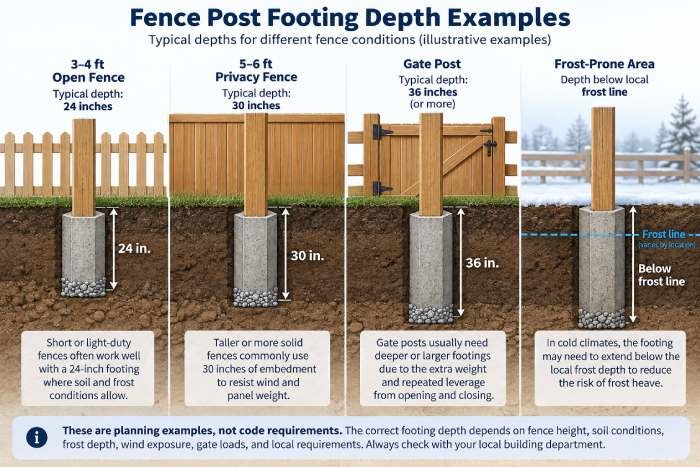
Fence post footings are commonly 24 to 36 inches deep for residential fences, but the correct depth depends on fence height, frost depth, soil conditions, wind exposure, and whether the post supports a gate.
A shallow footing may allow the post to lean, rotate, or move during freeze-thaw cycles, while an unnecessarily deep footing adds digging, concrete, and cost. The goal is to choose enough embedment to keep the post stable for the conditions at your property.
Quick Answer
How deep should a typical fence post footing be?
For many residential fences, 24 inches is a practical minimum starting point, while 30 to 36 inches is common for taller privacy fences, heavier panels, weaker soil, or higher wind exposure. These are planning ranges, not universal code requirements.
What if the ground freezes?
In cold climates, the footing may need to extend below the local frost depth to reduce the risk of frost heave. Local requirements can therefore make a fence footing significantly deeper than 36 inches.
Rule of thumb: Start with the fence height and load, then check local frost depth, soil stability, wind exposure, and gate loads before choosing the final footing depth.
Depth is only half of the footing
A deep but very narrow footing can still perform poorly. Check both the footing depth and width before calculating how much concrete you need.
Typical planning ranges
- Short or light-duty fence: about 24 inches may be adequate where soil and frost conditions allow.
- 5- to 6-foot privacy fence: 30 to 36 inches is a common planning range.
- Gate post: often deeper and wider than nearby line posts.
- Cold climate: footing depth may be controlled by the local frost line.
- Weak soil or high wind: increase footing dimensions or get project-specific guidance.
1. Start With a 24- to 36-Inch Planning Range
Most ordinary residential fence projects fall somewhere around 2 to 3 feet of post embedment. That range provides a useful place to begin estimating, but it should not be treated as a fixed formula.
A 3- or 4-foot decorative fence creates much less leverage on the post than a solid 6-foot privacy fence. Similarly, an open picket fence allows more wind to pass through than solid wood or vinyl panels.
Do not rely on the “one-third rule” alone
You may hear that roughly one-third of a fence post should be underground. That can be a useful rough planning check, but it does not account for frost depth, wind, soil, gates, or local construction requirements.
For example, a post supporting a 6-foot fence may need around 30 to 36 inches of embedment under many conditions, but a local frost requirement could require a deeper footing even if the one-third guideline suggests less.
Once you choose a tentative depth, compare the volume of different dimensions using the footing size pages before buying concrete.
2. Frost Depth Can Control the Final Footing Depth
In areas with freezing winters, frost heave is one of the biggest reasons not to use a universal fence-post depth. Water in frost-susceptible soil can freeze, expand, and move shallow footings upward.
Check your local frost depth
Frost conditions vary dramatically across the United States. In some warm regions, frost may have little influence on a residential fence footing. In colder regions, the required depth can extend well beyond 36 inches.
Where local code or accepted construction practice requires it, the bottom of the footing should extend below the relevant frost depth. The exact requirement should come from your local building department or other qualified local source rather than a national rule of thumb.
Shape matters in frost-prone soil
A footing that becomes wider near the surface and narrower below can provide surfaces for frozen soil to grip and lift. Avoid creating a pronounced narrow neck or mushroom shape unless the footing detail is specifically designed that way.
If you are installing the posts yourself, the companion guide on how to set a fence post in concrete covers bracing, placement, drainage, and finishing the concrete around the post.
3. Taller and More Solid Fences Usually Need More Embedment
A fence panel acts like a lever. As the fence becomes taller, wind acting on the upper portion of the panel creates more force at ground level. A deeper footing gives the post more resistance against rotation.
| Fence Condition | Planning Consideration |
|---|---|
| 3–4 ft open fence | 24 in. may be a reasonable starting depth where frost and soil permit |
| 5–6 ft privacy fence | 30–36 in. is a common planning range |
| Solid fence in high wind | Consider a deeper and/or wider footing |
| Gate post | Usually needs more footing capacity than a line post |
| Cold climate | Local frost depth may control the minimum depth |
These are planning guidelines, not structural specifications. Panel material, post spacing, terrain, expected wind, and local requirements can change the footing needed for the same fence height.
Solid privacy panels need extra attention
Wood privacy panels, vinyl panels, and other relatively solid fence systems catch considerably more wind than open-wire or widely spaced picket fencing. If the site is exposed rather than sheltered by buildings or terrain, do not size the footing from fence height alone.
4. Gate Posts Usually Need Deeper or Larger Footings
A gate post experiences loads that ordinary line posts do not. The gate places weight on one side of the post, and every opening and closing cycle applies additional leverage.
A small lightweight pedestrian gate may need only a modest increase over the adjacent fence posts. A wide wood driveway gate or heavy metal gate can require a much more substantial footing.
Watch for sagging and post rotation
If a gate post rotates even slightly, the far edge of the gate can drop enough to drag on the ground or prevent the latch from aligning. For this reason, gate posts are one place where undersizing the footing can become obvious very quickly.
Concrete compressive strength is only one part of that system. The 3000 vs. 4000 PSI concrete guide explains why using stronger concrete does not compensate for a footing that is too small or poorly supported by the soil.
5. Soil Conditions Can Change the Required Depth
Firm native soil provides better lateral support than loose fill, wet organic soil, or recently disturbed ground. Two identical fence posts can therefore perform very differently even when both have 30-inch footings.
Firm soil
Dense, stable native soil can provide good resistance around the footing. Under favorable conditions, a standard residential footing may work well without increasing depth beyond what the fence load and frost conditions require.
Loose or disturbed soil
Backfilled trenches, recently graded yards, loose sand, and uncompacted fill may provide much less resistance. In these conditions, a wider footing, deeper footing, or both may be appropriate.
Wet clay and poor drainage
Water-retaining soils can create both drainage and freeze-thaw concerns. Remove loose material from the bottom of the hole and avoid pouring concrete into standing water or unstable mud. In some soils it is worth weighing a gravel-set post against a poured footing; the concrete vs. gravel for fence posts comparison covers that tradeoff.
For multiple posts, use the concrete yardage calculator to estimate total concrete after you settle on a realistic footing size.
6. How Wide Should a Fence Post Footing Be?
Depth gets most of the attention, but footing width is also important. A common starting guideline is a hole around three times the width of the post.
For a nominal 4×4 post, that often means roughly a 10- to 12-inch-wide hole. Larger 6×6 posts, heavy gates, poor soil, or substantial wind loads may call for more width. If you plan to use a round tube form instead of an excavated square hole, the Sonotube sizes and concrete volumes chart lists the concrete needed for each diameter.
Example: 12 x 12 x 24-inch footing
A square footing measuring 12 inches by 12 inches and 24 inches deep has a gross volume of 2 cubic feet, or about 0.074 cubic yards.
You can see that exact configuration on the 12x12x24 footing example. The actual concrete quantity will be somewhat lower when the post itself displaces part of the volume, but allowing a margin is useful because real post holes are rarely perfectly shaped.
If you plan to use bagged concrete, the bag calculator can convert the required volume into 40, 60, or 80 lb bags.
7. How Much Concrete Does a Deeper Footing Add?
Increasing footing depth can add more concrete than expected, especially when you multiply the difference across an entire fence line.
For a 12-inch square footing, every additional 6 inches of depth adds 0.5 ft³ of gross volume. Across 20 posts, that additional depth represents about 10 ft³ of extra concrete before accounting for post displacement.
This is why it makes sense to choose the footing dimensions first and calculate the total second rather than buying an arbitrary number of bags.
For small jobs, bagged concrete is often convenient because you can mix one post at a time. For many large footings, however, the labor difference can become substantial. The bagged vs. ready-mix concrete comparison explains when each approach starts to make sense.
8. Do Not Load the Post Immediately After Pouring
Footing depth does not matter much if the post is knocked out of alignment before the concrete develops enough strength. Brace the post securely during placement and keep it supported while the concrete hardens.
Avoid immediately hanging a heavy gate or using fence panels to pull an out-of-plumb post into position. Fresh concrete may look solid before it has developed enough strength for substantial loading.
The concrete curing basics guide explains how temperature, moisture, and time affect early concrete strength.
When deeper is not automatically better
Extra depth can improve stability, but digging deeper does not fix every problem. A narrow footing in weak soil, an inadequately sized gate post, poor drainage, weak bracing, or a fence exposed to extreme wind can still fail.
For unusual conditions, including retaining walls with fences above them, steep slopes, large gates, very tall fences, or extreme wind exposure, get local professional guidance rather than simply adding another foot of concrete.
Tools & Next Steps
Calculate your footing volume
Enter the planned width, length, and depth to estimate the concrete required for each post footing.
Compare footing dimensions
Browse pre-calculated footing sizes to compare concrete quantities before you dig.
Frequently Asked Questions
Is 2 feet deep enough for a fence post?
Two feet can be enough for some short or light residential fences, but it is not adequate for every installation. Taller fences, solid privacy panels, weak soil, frost conditions, and high wind may require 30 to 36 inches or more.
Is 3 feet deep enough for a 6-foot fence?
Three feet is a common planning depth for a 6-foot fence. However, local frost depth, soil conditions, panel design, wind exposure, and code requirements can require a different footing.
Should fence posts be below the frost line?
In frost-prone areas, local requirements may call for the footing to extend below the relevant frost depth. This helps reduce the chance that freezing soil will lift or shift the footing.
How deep should a 4×4 fence post be?
A 4×4 fence post is commonly embedded about 24 to 36 inches for residential fencing. The correct depth depends more on the fence load, soil, frost conditions, and wind than on the post size alone.
How deep should a gate post footing be?
Gate posts often need deeper or wider footings than ordinary line posts. A gate creates off-center weight and repeated leverage, so footing size should reflect the gate width, weight, post size, soil, and wind exposure.
How wide should a fence post hole be?
A common starting point is about three times the post width. For a nominal 4×4, this frequently results in a hole roughly 10 to 12 inches wide, although difficult soil or heavy loads may require more.
Can a fence post footing be too deep?
Extra depth is usually more of a cost and labor issue than a problem by itself, provided the installation is otherwise correct. But making a footing much deeper than necessary wastes concrete and does not correct poor width, weak soil, drainage problems, or inadequate post sizing.
Does a deeper fence post need more concrete?
Yes. For the same hole width, every increase in depth increases concrete volume directly. Calculate the total for all posts before buying bags so a small increase in depth does not unexpectedly leave you short of material.
Do all fence posts need the same footing depth?
Not necessarily. Gate posts, corner posts, posts near slopes, and sections exposed to stronger wind may require different footing dimensions than ordinary line posts. Local frost requirements may still establish a common minimum depth.
Size the footing before you start digging
Disclaimer
This guide provides general information for residential DIY planning. Required fence-post footing depth and width vary with local frost conditions, soil, wind exposure, fence design, property conditions, and building requirements. Always verify local rules and underground utilities before digging, and consult a qualified contractor or engineer for large gates, tall fences, retaining-wall installations, steep slopes, extreme wind exposure, or other structural conditions.