
You generally need a vapor barrier under an interior slab-on-ground when ground moisture could affect flooring, coatings, adhesives, stored materials, or the indoor environment. An uncovered outdoor patio usually has a different moisture risk and may not need the same vapor-control layer.
For moisture-sensitive floors and enclosed spaces, the vapor retarder is commonly installed directly below the concrete slab, over the prepared base or insulation system. The correct material, seams, penetrations, and perimeter details matter just as much as simply putting down plastic.
Quick Answer
Do you need a vapor barrier under a concrete slab?
For most enclosed slabs that will receive moisture-sensitive flooring or coatings, a below-slab vapor retarder is strongly recommended. It limits water vapor moving upward from the ground into the concrete and helps protect materials installed on top of the slab.
Where should the vapor barrier go?
For the highest level of moisture protection, the vapor retarder is typically placed directly beneath the concrete, with the compacted granular layer below it. If rigid insulation is part of the slab assembly, follow the approved assembly details so the membrane remains in the intended moisture-control location.
Rule of thumb: If the slab is inside a building—or may eventually receive flooring, epoxy, adhesive, cabinets, or moisture-sensitive finishes—plan for vapor control before the pour rather than trying to fix moisture afterward.
Do not forget the slab itself
The vapor barrier controls moisture from below, but you still need the correct slab thickness, base, concrete quantity, joints, and curing.
When a vapor barrier makes the most sense
- Basement or interior slab: generally yes.
- Flooring or adhesive over the slab: moisture protection is especially important.
- Epoxy or other impermeable coating: plan vapor control before pouring.
- Attached or enclosed garage: often worth including, particularly if coatings or future conversion are possible.
- Open outdoor patio: often a different case because there is no moisture-sensitive interior finish above it.
1. What Does a Vapor Barrier Under Concrete Actually Do?
Soil beneath a slab contains moisture even when the surface looks dry. Water vapor can move upward from the ground toward the drier environment above the slab.
A below-slab vapor retarder limits that movement before the moisture enters the concrete. This becomes especially important when the finished slab will be covered by wood, vinyl, carpet, rubber flooring, coatings, adhesives, or other moisture-sensitive materials.
Concrete itself contains moisture too
A vapor barrier does not make freshly poured concrete dry. Concrete contains mixing water and must lose excess construction moisture upward as it cures and dries.
The barrier controls moisture entering from the ground; it does not remove water already inside fresh concrete.
That distinction matters when deciding when to install flooring or coatings. A slab can be protected from ground moisture and still need additional drying time before receiving a moisture-sensitive finish.
2. Which Concrete Slabs Need a Vapor Barrier?
The need is strongest when a slab separates the ground from an enclosed building environment.
Interior residential slabs
Basements, finished slab-on-grade rooms, workshops, conditioned spaces, and other interior floors are strong candidates for below-slab vapor protection. Moisture that reaches the top of these slabs can affect floor finishes and indoor conditions.
Garages
An unfinished detached garage may tolerate ground moisture differently from a finished living space. However, a vapor retarder can still be useful if the garage will receive an epoxy coating, stored moisture-sensitive materials, or may be converted to finished space later.
Outdoor patios and sidewalks
An uncovered patio, walkway, or similar exterior slab normally does not have wood flooring, adhesive, carpet, or other moisture-sensitive materials above it. A vapor retarder may therefore provide much less benefit in a simple exterior application.
That does not mean every exterior slab should omit one. Project details, enclosed structures, local requirements, soil conditions, and future use can change the decision.
3. Does the Vapor Barrier Go Above or Below the Gravel?
For slabs requiring strong moisture protection, a common assembly is:
- Concrete slab
- Vapor retarder directly beneath the slab
- Compacted granular or capillary-break layer
- Prepared subgrade
The important detail is that you generally do not want a layer of sand or moisture-holding fill trapped between the vapor barrier and the concrete when maximum floor-moisture protection is the goal.
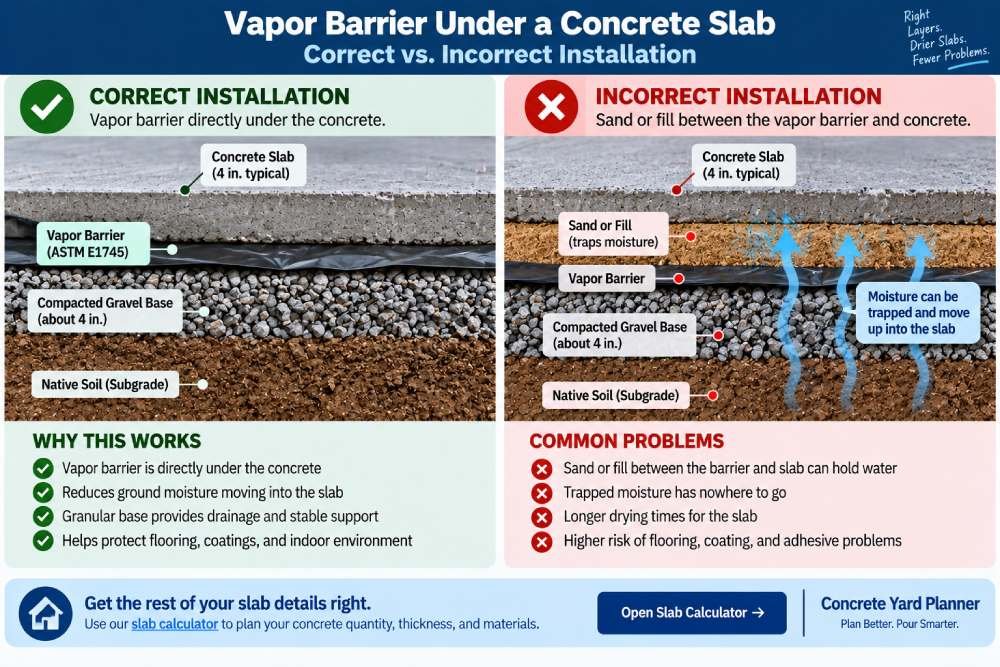
Why not put several inches of sand above the plastic?
Water from rain, curing, cleaning, saw cutting, or construction can enter that fill layer. Once a vapor retarder is below it, the moisture cannot easily dry downward and instead has to move upward through the slab.
That can increase the time required for the slab to become dry enough for flooring or coatings.
The gravel layer still has an important job. Our concrete slab base and gravel guide explains subgrade preparation, compactable aggregate, drainage, and base thickness in more detail.
4. What Thickness Vapor Barrier Should You Use?
Do not choose a below-slab vapor retarder by thickness alone. A thicker sheet may be more durable during construction, but performance also depends on water-vapor permeance, tensile strength, puncture resistance, seams, penetrations, and product quality.
For a slab where moisture control matters, look for a membrane specifically intended for under-slab use and compliant with ASTM E1745 rather than using generic construction plastic simply because it has a certain mil thickness.
Is 6 mil polyethylene enough?
Traditional 6 mil polyethylene has been widely used in older slab construction, but generic 6 mil poly should not automatically be treated as equivalent to a dedicated ASTM E1745-compliant vapor retarder.
What about 10 mil or 15 mil?
Greater thickness can improve durability and resistance to jobsite damage, but “15 mil” by itself does not prove that a product meets the required vapor-retarder performance. Check the product specification, ASTM compliance, permeance, and project requirements.
For residential DIY work, choosing a purpose-made under-slab membrane with clearly published performance data is a better approach than buying the cheapest roll of polyethylene available.
5. How to Install a Vapor Barrier Under a Concrete Slab
The membrane needs to cover the slab footprint as continuously as practical before concrete placement.
Step 1: Prepare and compact the ground
Remove topsoil, roots, organic material, mud, and unstable fill. A vapor barrier does not correct weak soil or poor compaction.
If you are unsure whether the existing soil can support the slab, review whether you can pour concrete over dirt before installing the membrane.
Step 2: Prepare the granular layer
Grade and compact the required base or capillary-break layer. Remove sharp debris or conditions likely to cause unnecessary membrane damage.
Step 3: Roll out the membrane
Lay the vapor retarder over the prepared assembly without unnecessary wrinkles. Extend it to the slab perimeter according to the project detail.
Step 4: Overlap and seal seams
Overlap adjoining sheets and seal seams with the membrane manufacturer’s approved tape or adhesive. Do not leave long open seams where ground vapor can bypass the system.
Step 5: Seal penetrations
Pipes, conduits, drains, and other penetrations interrupt the membrane. Detail these areas with compatible materials according to the membrane and project requirements.
Step 6: Repair obvious damage
Construction traffic, reinforcement chairs, tools, and boots can puncture or tear the membrane. Inspect it before pouring and patch significant damaged areas with compatible membrane material and tape.
Step 7: Protect it during reinforcement and placement
Install reinforcement carefully and keep it properly supported rather than dragging bars or mesh across the membrane unnecessarily.
6. Does a Vapor Barrier Make Concrete Crack?
A vapor barrier does not simply “cause cracks,” but placing concrete directly over a low-permeance membrane changes how moisture leaves the fresh concrete.
Because the underside cannot lose water into the base, concrete may bleed and dry differently than concrete placed on an absorptive granular surface. That can affect finishing timing, shrinkage, curling, and settlement behavior.
This is not a reason to omit needed moisture protection
Where flooring or the building environment needs protection from ground moisture, removing the vapor barrier simply to make finishing easier can create a much more expensive long-term moisture problem.
The better approach is to use an appropriate concrete mixture, place it correctly, avoid excess water, finish at the right time, provide proper joints, and cure the slab well.
If a recent slab has already developed random cracks, the new concrete cracking guide explains how shrinkage, joints, curing, base movement, and other factors affect cracking.
7. Vapor Barrier vs. Gravel: You May Need Both
A vapor barrier and a granular base solve different problems.
| Layer | Main Purpose |
|---|---|
| Concrete slab | Carries the intended surface loads |
| Vapor retarder | Limits water-vapor movement upward from below |
| Granular base | Provides grading, support, compaction, and potentially a capillary break |
| Subgrade | Provides the underlying soil support system |
Do not substitute one for the other. Gravel is not automatically a vapor barrier, and plastic does not stabilize weak soil.
8. Example: 12 × 20 ft Interior Slab
Consider a 12 × 20-foot slab that is 4 inches thick. The finished slab covers 240 ft² and requires approximately 80 ft³, or 2.96 yd³, of concrete before allowing for field variation.
You can check that concrete quantity on the 12×20 4-inch slab example.
The vapor-retarder quantity is based primarily on the 240 ft² footprint, but you also need enough membrane for seams, overlaps, perimeter detailing, penetrations, and a reasonable installation margin.
The concrete itself should still be calculated independently with the concrete yardage calculator so membrane area and concrete volume do not get confused.
If the slab thickness is not yet decided, review the 4-inch vs. 6-inch slab guide before excavating and setting final elevations.
9. Common Vapor Barrier Mistakes to Avoid
Using generic thin plastic without checking the specification
Mil thickness alone is not a complete performance specification. Use a membrane designed for below-slab vapor control and verify the required standard.
Putting sand between the membrane and the slab
A moisture-holding layer above the vapor retarder can become a reservoir that has difficulty drying downward.
Leaving seams open
Overlap and seal seams according to the membrane manufacturer’s instructions rather than treating individual sheets as separate pieces.
Ignoring penetrations
Pipes and conduits create openings that should be detailed rather than simply cutting a large hole in the plastic and leaving it open.
Using the vapor barrier to hide poor base preparation
A membrane controls vapor—it does not compact soil, correct drainage, or support the slab.
Ordering concrete before the assembly is ready
Base preparation, membrane installation, reinforcement, forms, concrete quantity, access, tools, and crew should all be ready before placement begins.
The complete concrete slab pouring process covers the work from measurement and excavation through finishing, joints, and curing.
10. What About Radon and Soil Gas?
A below-slab membrane can be part of a broader soil-gas control system because it reduces pathways between the ground and the building.
However, a vapor barrier alone should not be treated as a complete radon mitigation system. Radon-prone construction may also include a gas-permeable layer, sealed penetrations, vent piping, perimeter detailing, and other measures required by the applicable design or local code.
If radon is a concern in your area, follow the locally required radon-resistant construction details rather than relying on ordinary slab plastic alone.
Tools & Next Steps
Calculate your slab volume
Enter length, width, and thickness to estimate the concrete required before setting final base elevations.
Compare slab dimensions
Browse pre-calculated slab sizes and quantities for common residential projects.
Frequently Asked Questions
Do I really need a vapor barrier under a concrete slab?
You generally should use one where ground moisture could affect an interior environment, flooring, coatings, adhesives, or moisture-sensitive materials. Simple uncovered exterior slabs may have different requirements.
Does the vapor barrier go above or below the gravel?
For strong moisture protection, the vapor retarder is commonly installed above the prepared granular layer and directly beneath the concrete. Follow the approved assembly details when insulation or other layers are included.
Is 6 mil plastic enough under a concrete slab?
Generic 6 mil polyethylene should not automatically be assumed to provide the performance of a purpose-made under-slab vapor retarder. Use a product that meets the specified below-slab vapor-control requirements, such as applicable ASTM E1745 criteria.
Is a 10 mil or 15 mil vapor barrier better?
A thicker membrane can offer greater jobsite durability, but thickness alone does not determine vapor-control performance. Compare ASTM compliance, permeance, puncture resistance, tensile strength, and the requirements of the flooring or project.
Do I need a vapor barrier under a garage slab?
It is often beneficial, especially in an enclosed garage that may receive epoxy, flooring, storage, or future conditioned use. Final requirements depend on the building design and local code.
Do I need a vapor barrier under an outdoor patio?
Many simple uncovered patios do not need the same vapor protection as interior slabs with moisture-sensitive finishes. Site conditions, enclosed structures, local requirements, and future use can still change the decision.
Can I put sand on top of a vapor barrier before pouring concrete?
A sand or moisture-holding fill layer between the membrane and slab can trap construction water and slow slab drying. Where maximum moisture protection is needed, direct contact between the slab and vapor retarder is generally preferred.
Does a vapor barrier stop groundwater?
A vapor retarder primarily controls water vapor and is not a substitute for drainage or waterproofing against hydrostatic groundwater pressure. Persistent groundwater requires proper site drainage and, where applicable, a designed waterproofing system.
Can a vapor barrier cause concrete to crack?
The membrane changes how fresh concrete loses moisture but does not simply cause cracking by itself. Mix design, excess water, curing, joints, finishing, reinforcement, slab geometry, and base support all influence cracking behavior.
Build the slab assembly before you pour
Disclaimer
This guide provides general information for residential concrete and moisture-control planning. Vapor-retarder requirements, slab assemblies, insulation, radon control, waterproofing, drainage, soil conditions, flooring specifications, and building-code requirements vary by project and location. Follow the approved project documents and membrane manufacturer’s instructions, and consult a qualified contractor, designer, engineer, flooring professional, or other appropriate specialist for conditioned spaces, structural slabs, persistent groundwater, radon-control systems, or moisture-sensitive floor assemblies.