
You can pour concrete in cold weather, but once temperatures approach or fall below 40°F, the concrete needs special temperature control, curing, and protection from freezing. For a typical thin residential slab, the concrete itself should generally be about 55°F or warmer when placed, and it must not freeze while it is still young.
Cold weather slows setting and strength gain, while freezing fresh concrete can cause permanent damage. Successful winter pours depend on warm enough concrete, a thawed base, insulated blankets or enclosures, proper curing, and enough protection time after finishing.
Quick Answer
How cold is too cold to pour concrete?
An air temperature below 40°F does not automatically mean concrete cannot be poured, but it does mean cold-weather procedures may be required. Fresh concrete can freeze when its own temperature drops to roughly 25°F, so the real concern is the temperature of the concrete, base, forms, and surrounding environment during the protection period.
What temperature should concrete be when poured?
For sections less than 12 inches thick—including typical residential slabs—a common cold-weather recommendation is approximately 55°F concrete temperature at placement. Larger concrete sections can generally be placed at somewhat lower temperatures because they retain heat more effectively.
Rule of thumb: Do not pour onto frozen ground, snow, ice, or frozen forms, and have blankets or other protection ready before the concrete arrives.
Cold weather does not change your concrete volume
Calculate slab dimensions before ordering. Winter protection changes the placement process, not the basic cubic-yard calculation.
Cold-weather pour checklist
- Concrete temperature: keep thin residential slabs warm enough at placement.
- Subgrade: never place concrete over frozen ground.
- Snow and ice: remove completely before pouring.
- Protection: have insulated blankets, tarps, or an enclosure ready before finishing.
- Early strength: protect the concrete from freezing until it has developed adequate strength.
1. What Counts as Cold Weather for Concrete?
Concrete professionals generally begin treating a placement as cold-weather work when ambient temperatures are around 40°F or lower or are expected to fall below that level during the protection period.
That threshold does not mean concrete suddenly fails at 39°F. Instead, hydration slows as temperature drops, finishing takes longer, and the risk of early freezing increases.
Air temperature is not the only number that matters
You need to think about:
- Air temperature during and after placement
- Concrete temperature
- Subgrade and base temperature
- Form and reinforcement temperature
- Wind exposure
- Overnight lows
- How long the slab will remain protected
A sunny 42°F afternoon followed by a 20°F night may require far more planning than the daytime temperature suggests.
2. What Happens if Fresh Concrete Freezes?
Fresh concrete can freeze when its internal temperature falls to roughly 25°F. Water inside the fresh mixture expands as it freezes and can disrupt the developing cement paste before it has enough strength to resist the pressure.
Early freezing can permanently reduce strength and durability. This is why simply allowing frozen concrete to thaw later does not restore the slab to the condition it would have reached with proper protection.
The first 500 psi are especially important
Concrete should be protected from freezing until it has developed approximately 500 psi of compressive strength. Under appropriate cold-weather protection, that may occur in roughly the first couple of days, but the actual time depends on mixture, temperature, cementitious materials, and protection conditions.
Do not use a fixed number of hours as proof that the slab is safe. Colder concrete gains strength more slowly.
If a new slab has already frozen or developed unusual cracking, the guide to new concrete cracking explains several other early-age problems that can produce visible defects.
3. Do Not Pour Concrete on Frozen Ground
Frozen subgrade can cause two separate problems. First, it can pull heat from fresh concrete. Second, the frozen soil may thaw later and lose volume or support, allowing the slab to settle.
Snow, ice, and frozen soil must be removed or thawed before placement. The ground or base should be above freezing and stable enough to support the slab.
Never use concrete to thaw the base
Warm ready-mix is not a substitute for preparing frozen ground. Heat from fresh concrete should be conserved for hydration—not spent thawing soil or ice beneath the slab.
The concrete slab base and gravel guide explains how subgrade, compacted aggregate, and drainage should be prepared before the pour.
For DIY slabs, also confirm that you are not placing concrete over loose or unsuitable soil. The guide to pouring concrete over dirt explains which ground conditions need correction first.
4. Keep the Concrete Warm Enough at Placement
Thin concrete sections lose heat quickly. For cold-weather placements where the minimum section dimension is less than 12 inches, such as a typical patio or driveway slab, approximately 55°F at placement is a useful industry target.
Ready-mix producers can adjust concrete temperature by managing mixing water and aggregate temperatures. For a bagged DIY pour, cold bags, frozen aggregate, icy water, and a frozen mixing area can work against you.
Hotter is not automatically better
Do not assume extremely hot concrete is the solution. Excessive concrete temperature can increase water demand, slump loss, and cracking potential.
The goal is controlled warmth, not maximum heat.
If you are ordering ready-mix, communicate that the placement is a cold-weather pour rather than attempting to change the delivered mix at the jobsite without guidance.
5. Accelerators Help, but They Are Not Antifreeze
Accelerating admixtures can reduce setting time and help concrete gain early strength faster in cold conditions.
An accelerator does not prevent fresh concrete from freezing. You still need temperature protection, curing, and proper preparation.
Do not improvise with additives
Use admixtures appropriate for the concrete mixture and project. Chloride-containing accelerators can create corrosion concerns around reinforcement and embedded metals, so non-chloride accelerators are often selected when corrosion is a concern.
For DIY homeowners, the safest approach is usually to discuss the required performance with the ready-mix producer or use a bagged product specifically intended for the conditions rather than adding an unknown chemical onsite.
Concrete compressive strength is another separate decision. The 3000 vs. 4000 PSI concrete guide explains why choosing a higher PSI does not eliminate the need for correct cold-weather protection.
6. Protect the Slab Immediately After Finishing
Once finishing is complete, the main objective is to retain enough heat and moisture for continued hydration.
Insulated concrete blankets
Insulated blankets are one of the most practical protection methods for residential winter slabs. They trap heat generated by cement hydration and reduce heat loss to cold air.
Secure blankets against wind and pay particular attention to edges and corners, which lose heat faster than the middle of the slab.
Heated enclosures
For colder conditions, temporary enclosures and heaters may be required. Heaters must be used safely, and combustion equipment inside an enclosure should be properly vented to avoid both safety hazards and surface problems.
Protect before temperatures fall
Do not wait for frost to form before covering the slab. Have the protection system onsite and ready before concrete placement begins.
7. Cold Weather Changes Curing
Cold temperatures slow hydration and strength development. That means a slab poured in winter may require a longer protected curing period than the same concrete in mild weather.
Curing requires both favorable temperature and moisture. Heating a slab while allowing the surface to dry aggressively is not good curing.
Avoid water curing when freezing is imminent
Sprinkling or ponding water is generally a poor choice when freezing temperatures are expected. Other methods such as suitable curing compounds or moisture-retaining sheets may be more practical in winter conditions.
The concrete curing basics guide explains why moisture retention and temperature control are essential to strength and durability.
Do not remove protection abruptly
After a protected slab has been kept warm, exposing it suddenly to very cold air can create a rapid temperature change.
Remove protection gradually when conditions require it rather than thermally shocking young concrete.
8. Cold Weather Concrete Planning by Temperature
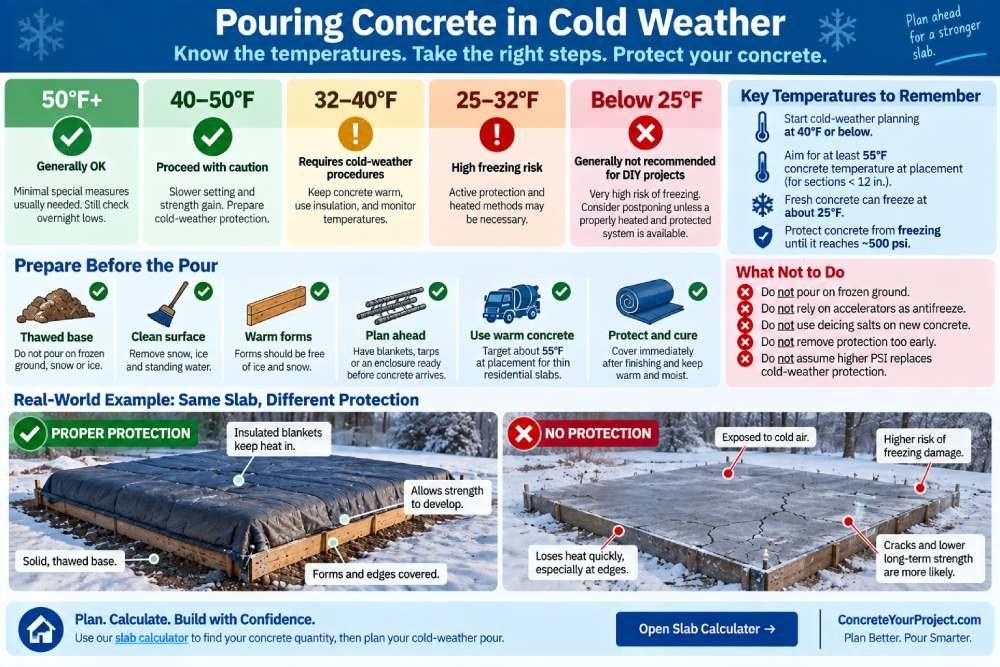
The following table is a practical planning guide rather than a substitute for project specifications. Remember that air temperature and concrete temperature are not the same thing.
| Forecast Condition | Planning Approach |
|---|---|
| Above 50°F | Generally straightforward, but monitor overnight lows |
| 40–50°F | Expect slower setting and strength gain; prepare cold-weather protection |
| 32–40°F | Cold-weather procedures and insulation become increasingly important |
| 25–32°F | High freezing risk if concrete cools; active protection may be necessary |
| Below 25°F | DIY placement becomes much harder; consider postponing unless a properly heated and protected system is available |
A forecast of 35°F does not mean the concrete itself will be 35°F, but it tells you how aggressively heat may be lost after placement.
9. Example: Pouring a 12 × 20 ft Patio in Cold Weather
Suppose you are pouring a 12 × 20-foot patio at 4 inches thick. The slab requires about 80 ft³ of concrete, or approximately 2.96 cubic yards before adding a field allowance.
You can verify that quantity on the 12×20 4-inch slab example.
The cold weather does not change that base volume. What changes is your preparation:
- Base completely thawed and free of ice
- Forms ready before delivery
- Concrete delivered at an appropriate placement temperature
- Enough labor to place and finish without long delays
- Insulated blankets ready immediately after finishing
- A plan for overnight and multi-day protection
For another slab size, use the concrete calculator to determine the volume before scheduling ready-mix and winter protection.
The full placement sequence is covered in how to pour a concrete slab step by step.
10. When Should You Postpone the Pour?
Cold-weather concrete is possible, but a small DIY slab is not always worth forcing into a bad forecast.
Consider postponing when:
- The ground is frozen and cannot be thawed properly.
- Snow or ice cannot be completely removed.
- You do not have enough blankets or other protection.
- A severe temperature drop is forecast immediately after placement.
- You cannot keep the slab protected for the required period.
- You are relying on an accelerator instead of actual freeze protection.
- The project is structural and you do not have an approved cold-weather plan.
For a small patio or shed pad, waiting for a more manageable weather window can be cheaper and safer than buying heaters, enclosures, and additional protection.
For structural slabs, foundations, or critical work, follow the project specifications and professional cold-weather procedures rather than a general DIY rule.
Tools & Next Steps
Calculate the slab volume
Enter slab dimensions and thickness to determine how much concrete you need before scheduling a cold-weather pour.
Compare common slab sizes
Browse pre-calculated concrete quantities for common residential slab dimensions.
Frequently Asked Questions
What temperature is too cold to pour concrete?
There is no single air temperature at which concrete suddenly becomes impossible to place, but temperatures around or below 40°F require cold-weather precautions. The concrete itself, subgrade, forms, protection system, and forecast all matter.
Can you pour concrete at 40°F?
Yes, concrete can be placed around 40°F ambient temperature when proper cold-weather procedures are used. Use adequately warm concrete, place only on thawed surfaces, and protect the slab from freezing and excessive heat loss afterward.
Can you pour concrete at 32°F?
It is possible with proper preparation and protection, but the risk is much higher. The base must not be frozen, the concrete must be warm enough at placement, and insulation or heated protection may be required after finishing.
At what temperature does fresh concrete freeze?
Fresh concrete can begin freezing at roughly 25°F. Early freezing can permanently reduce strength and durability, so concrete must be protected before its temperature reaches that point.
How long should concrete be protected from freezing?
At minimum, protect young concrete until it has developed enough strength to resist early freezing damage—approximately 500 psi is a widely used benchmark. Additional protection may be needed for continued strength development, exposure, loading, or project requirements.
Do concrete blankets really work?
Yes, insulated blankets help retain heat generated by cement hydration and reduce heat loss to cold air. They are especially useful on slabs, but edges and corners require careful coverage because they cool faster.
Does calcium chloride keep concrete from freezing?
No, accelerating admixtures do not act as antifreeze. They can speed setting and early strength development, but the concrete still requires proper temperature protection.
Can you pour concrete on frozen ground?
No, concrete should not be placed directly on frozen subgrade. Frozen soil can cool the concrete and may settle after thawing, leaving the slab with uneven support.
Does concrete take longer to cure in cold weather?
Yes, cold temperatures slow cement hydration and strength development. Cold-weather concrete may need longer curing and protection before forms are removed, loads are applied, or the slab is exposed to severe conditions.
Calculate first, then plan the cold-weather protection
Disclaimer
This guide provides general information for residential DIY cold-weather concrete planning. Required concrete temperatures, protection periods, curing methods, admixtures, air entrainment, strength requirements, and winter construction procedures vary with mixture, slab design, exposure, weather, and project specifications. Follow local requirements and supplier instructions, and consult a qualified concrete contractor or engineer for structural concrete, foundations, severe winter conditions, critical loads, or projects where freezing could affect safety or structural performance.