
Cement and concrete are not the same thing: cement is a binding ingredient, while concrete is the finished building material made by combining cement, water, sand, and coarse aggregate. Calling a concrete driveway a “cement driveway” is common in everyday speech, but technically the driveway is concrete.
The easiest way to remember the difference is to think of cement as one ingredient in concrete, similar to flour being one ingredient in bread. Cement reacts with water and binds the sand and stone together into a hard mass.
Quick Answer
What is the difference between cement and concrete?
Cement is a fine powdered binder; concrete is a mixture made with cement, water, sand, and aggregate. Cement hardens through a chemical reaction with water, creating a paste that holds the aggregate together.
Is a sidewalk made of cement or concrete?
Most sidewalks, patios, driveways, slabs, and footings are made of concrete. Cement is inside the concrete mixture, but it is not normally used by itself to build these elements.
Rule of thumb: If you can see stone or aggregate in a hardened structural or paving material, you are probably looking at concrete—not pure cement.
Planning an actual concrete project?
Once you know the material you need, calculate the volume in cubic feet or cubic yards before buying bags or ordering ready-mix.
Cement vs. concrete in one minute
- Cement: powdered hydraulic binder used as an ingredient.
- Concrete: cement + water + fine aggregate + coarse aggregate.
- Mortar: cementitious binder + water + fine aggregate, generally without large coarse stone.
- Cement paste: cement + water.
- Most slabs, patios, driveways, walls, and footings: concrete.
1. What Is Cement?
Cement is a very fine powder that acts as the binding material in concrete and many mortars. When cement is mixed with water, chemical reactions begin that cause the paste to stiffen and eventually harden.
This reaction is called hydration. It is not simply a matter of the water “drying out.” Water reacts with cement compounds and contributes to the hardened structure that binds the aggregate together.
What is Portland cement?
Portland cement is the familiar hydraulic cement used as the primary binder in many conventional concrete mixtures. Modern concrete may also contain supplementary cementitious materials or blended cements, depending on the mix design and performance requirements.
Cement by itself is not normally what you order when you need a patio, footing, driveway, or slab. For those projects, you need concrete or a packaged concrete mix.
2. What Is Concrete?
Concrete combines several materials into one engineered composite:
- Cementitious binder
- Water
- Fine aggregate, usually sand
- Coarse aggregate, such as gravel or crushed stone
- Optional admixtures or supplementary materials
The cement and water form a paste that coats the aggregate. As hydration progresses, that paste hardens and locks the sand and coarse aggregate into a solid mass.
Why use aggregate at all?
Aggregate is not just cheap filler. It forms a large portion of the concrete volume and plays an important role in dimensional stability, strength, workability, and other properties.
This is also why concrete is heavy. Normal-weight concrete is commonly around 150 lb per cubic foot. The concrete weight per cubic yard guide explains how that density translates into pounds and tons for real projects.
3. Cement vs. Concrete vs. Mortar
Cement, concrete, and mortar are often confused because all three are related, but they serve different purposes.
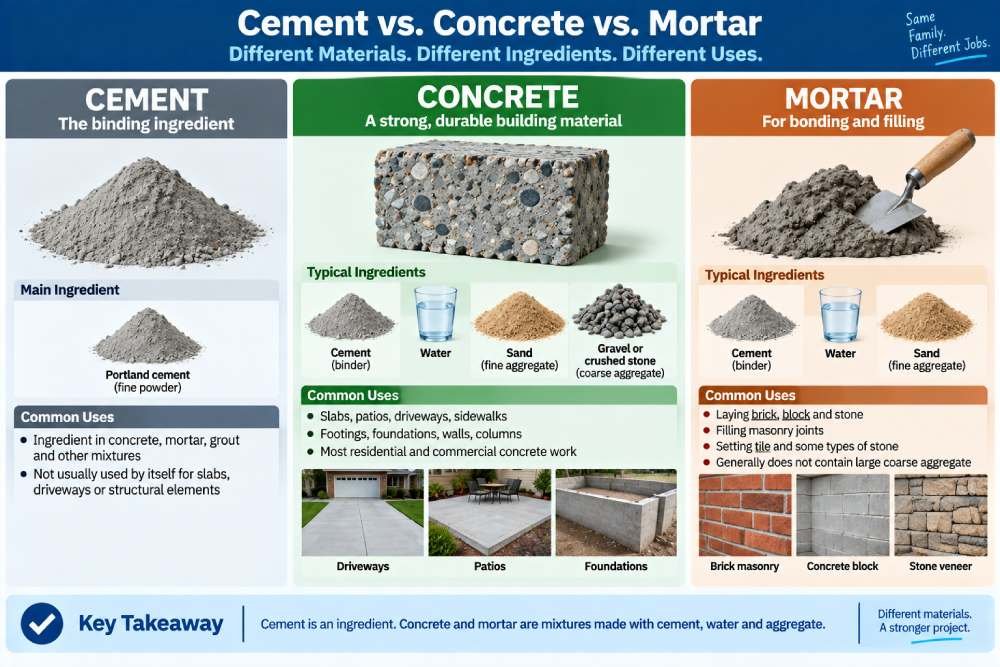
| Material | Main Ingredients | Common Uses |
|---|---|---|
| Cement | Powdered hydraulic binder | Ingredient in concrete, mortar, grout, and related materials |
| Concrete | Cementitious binder, water, sand, coarse aggregate | Slabs, patios, driveways, footings, walls, columns |
| Mortar | Binder, water, fine aggregate | Laying brick, block, stone, and filling masonry joints |
| Cement paste | Cement + water | Binding phase within concrete or mortar |
The key visual difference is the coarse aggregate in concrete. Break open a piece of a typical slab and you will usually see stone embedded throughout the hardened cement paste.
4. Is Concrete Stronger Than Cement?
Comparing the strength of “concrete vs. cement” is not especially useful because cement is an ingredient rather than an alternative structural material.
The strength of concrete comes from the complete mixture and how it is proportioned, placed, consolidated, finished, and cured.
Important factors include:
- Water-to-cementitious-material ratio
- Type and amount of cementitious materials
- Aggregate quality and grading
- Air content
- Admixtures
- Placement and consolidation
- Curing temperature and moisture
Residential concrete is often discussed in terms of compressive strength such as 3000 or 4000 PSI. The 3000 vs. 4000 PSI concrete guide explains what those numbers mean and why higher PSI is not automatically necessary for every project.
5. Why You Should Not Add Extra Cement or Water at Random
Because cement is the binder, it is easy to assume that adding more cement automatically produces better concrete. Concrete mix design is more complicated than that.
Concrete performance depends on the proportions of the entire mixture. Randomly changing cement, water, sand, or aggregate can affect workability, shrinkage, heat generation, strength, finishing, and durability.
Extra water is a particularly common mistake
Adding water can make concrete easier to place temporarily, but excessive water can reduce strength and increase drying shrinkage.
That increased shrinkage can contribute to cracking. If you are troubleshooting an existing slab, the guide to why new concrete cracks covers excess water, curing, joints, subgrade movement, and other common causes.
6. What Are Concrete Mix Bags Made Of?
When you buy an 80 lb or 60 lb bag labeled as concrete mix, you are not buying a bag of pure cement.
A packaged concrete mix normally contains the dry cementitious binder plus sand and coarse aggregate in approximately the proportions intended by the manufacturer. You add the specified amount of water and mix it thoroughly.
Cement bags and concrete bags are different products
A bag of Portland cement generally needs additional aggregate and an appropriate mix design before it becomes concrete. A bagged concrete mix is intended to produce concrete after water is added according to its instructions.
If you already know the project dimensions, use the concrete bag calculator to estimate how many common bag sizes the job requires.
The how many bags of concrete do I need guide explains bag yields, cubic-foot conversion, and why larger projects can quickly require dozens of bags.
7. Concrete vs. Cement for Common Projects
For most DIY projects, the material choice is much simpler than the terminology makes it sound.
| Project | Usually Uses |
|---|---|
| Patio slab | Concrete |
| Driveway | Concrete |
| Sidewalk | Concrete |
| Fence-post footing | Concrete |
| Deck footing | Concrete |
| Brick joints | Mortar |
| Making concrete from separate raw materials | Cement + aggregates + water |
If your project is a slab, start by calculating the required volume with the concrete yardage calculator rather than trying to determine how many bags of cement you need.
8. Why Do People Call Concrete “Cement”?
“Cement” has become a common everyday shorthand for concrete because cement is the ingredient that makes the mixture harden.
You will hear phrases such as:
- “cement driveway”
- “cement patio”
- “cement sidewalk”
- “cement foundation”
People generally understand what these phrases mean, but technically these structures are usually concrete driveways, concrete patios, concrete sidewalks, and concrete foundations.
Does the terminology really matter?
For casual conversation, usually not much. When purchasing materials, estimating quantities, or communicating with a contractor or ready-mix supplier, however, the difference becomes important.
Ordering “cement” when you actually need ready-mix concrete can mean asking for an entirely different product.
9. Ready-Mix Concrete vs. Bagged Concrete
Once you establish that your project needs concrete, the next question is often how to get it onsite.
Bagged concrete
Bagged mixes work well for smaller jobs because the dry ingredients are already proportioned and can be mixed as needed.
Ready-mix concrete
Ready-mix is batched at a concrete plant and delivered in a mixer truck. It is often more practical for larger slabs because several cubic yards can be placed without hand-mixing dozens or hundreds of bags.
The bagged vs. ready-mix concrete comparison covers the cost, labor, quantity, and delivery tradeoffs.
For packaged material, the bag conversion pages provide pre-calculated examples for common concrete volumes and bag sizes.
10. Cement, Concrete, and Curing
Concrete hardens because the cementitious binder reacts with water. This is why curing is such an important part of concrete construction.
Fresh concrete needs suitable moisture and temperature conditions for continued hydration and strength development.
Allowing the surface to dry too rapidly can contribute to poor strength development, shrinkage, and durability problems.
The concrete curing basics guide explains moisture retention, temperature, curing time, and why concrete continues gaining strength after it first becomes hard.
This also explains why describing concrete as material that simply “dries” is incomplete. Concrete cures through chemical hydration while also gradually losing excess moisture.
Tools & Next Steps
Calculate your concrete volume
Enter project dimensions to estimate cubic feet and cubic yards before ordering ready-mix or buying bags.
Convert volume to bags
Estimate how many 40, 60, or 80 lb bags are needed for smaller DIY concrete projects.
Frequently Asked Questions
Is cement the same thing as concrete?
No, cement is an ingredient in concrete. Concrete is made by combining cementitious binder, water, fine aggregate, coarse aggregate, and sometimes admixtures or supplementary materials.
Is a driveway made of cement or concrete?
A typical driveway is made of concrete. Cement is part of the concrete mixture, but the finished material containing sand and coarse aggregate is concrete.
Which is stronger, cement or concrete?
They are not direct alternatives that should be compared that way. Cement is the binder used to make concrete, while concrete is the composite construction material designed to carry loads.
What is concrete made of?
Concrete is primarily made from cementitious binder, water, fine aggregate such as sand, and coarse aggregate such as gravel or crushed stone. Admixtures and additional cementitious materials may also be included.
What is Portland cement?
Portland cement is a hydraulic cement commonly used as a primary binder in concrete and mortar. When mixed with water, it undergoes hydration and develops hardened cementitious products that bind aggregate together.
Is mortar the same as concrete?
No, mortar and concrete are different materials. Mortar typically uses cementitious binder, water, and fine aggregate and is designed for masonry work, while concrete also contains coarse aggregate.
Can I make concrete with just cement and water?
Cement and water create cement paste, not conventional concrete. Normal concrete also requires aggregate, including sand and coarse stone, in proportions appropriate for the intended mixture.
Is bagged concrete just cement?
No, packaged concrete mix normally contains cementitious material plus sand and coarse aggregate. You add the specified amount of water to produce concrete.
Why do people call concrete cement?
“Cement” is commonly used as an informal name for concrete because cement is the binding ingredient that makes the mixture harden. Technically, slabs, driveways, sidewalks, and most footings are concrete.
Now calculate how much concrete you actually need
Disclaimer
This guide provides general educational information about cement, concrete, mortar, and common residential materials. Concrete mixture proportions, cement types, aggregate requirements, strength, exposure conditions, and structural specifications vary by application. Follow the manufacturer’s instructions for packaged products and approved project specifications, and consult a qualified concrete contractor or engineer for structural or safety-critical work.