
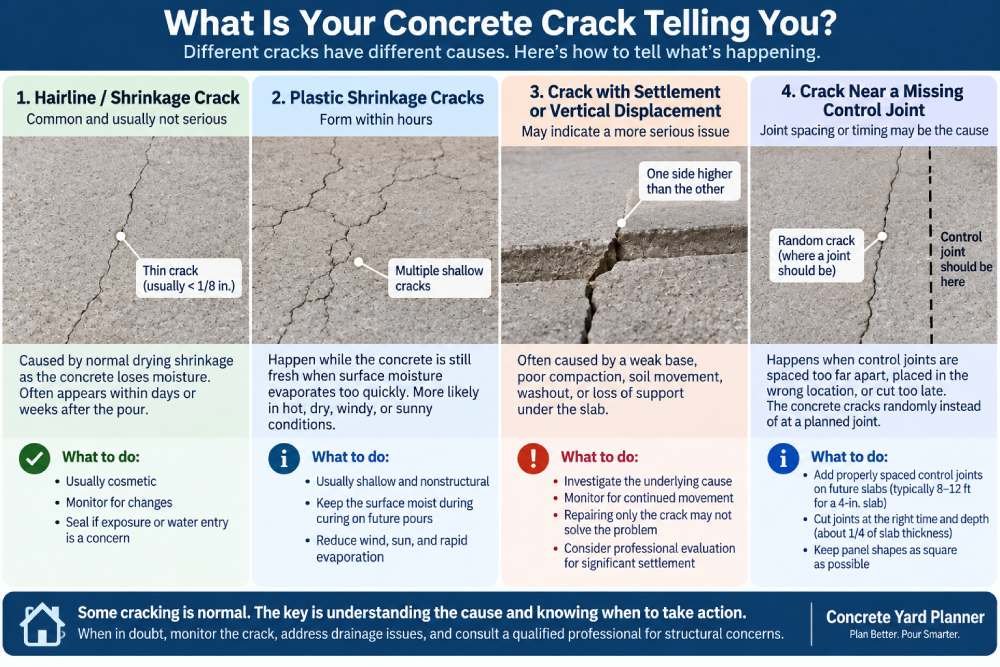
New concrete usually cracks because it shrinks as it dries, loses moisture too quickly, moves over a weak base, or was poured without enough properly placed control joints. Small, stable hairline cracks are common, but widening cracks, vertical displacement, settlement, or water intrusion can indicate a more serious problem.
The appearance, timing, location, and movement of the crack matter more than the fact that a crack exists. Use the guide below to identify the likely cause, decide whether the crack is mostly cosmetic, and determine when repair or professional evaluation makes sense.
Quick Answer
Is it normal for new concrete to crack?
Some cracking is normal in concrete because concrete shrinks as moisture leaves the mix. Proper joints, reinforcement, base preparation, placement, and curing help control where cracks form and how wide they become, but they cannot guarantee a completely crack-free slab.
When should a concrete crack worry you?
A crack deserves closer attention when it is getting wider, creating a height difference between the two sides, associated with settlement, allowing significant water entry, or affecting a structural element. Crack width alone does not tell the full story.
Rule of thumb: A thin, stable crack with no vertical movement is often less concerning than a crack that continues changing or leaves one side of the slab higher than the other.
Planning a replacement or new slab?
Correct slab thickness and concrete quantity before the pour so you are not forced to stretch material or create thin areas.
What the crack may be telling you
- Fine random cracks soon after finishing: rapid surface moisture loss or plastic shrinkage may be involved.
- Straight crack near where a joint should be: joint spacing or timing may have allowed the slab to crack elsewhere first.
- Crack with one side lower: base movement, settlement, erosion, or loss of support may be occurring.
- Cracks spreading from corners or concentrated loads: slab thickness, support, loading, or reinforcement may need closer review.
- Stable hairline crack: often mainly cosmetic, although exposure and water entry still matter.
1. Concrete Naturally Shrinks as It Dries
Concrete starts with more water than remains permanently locked into the hardened material. As excess moisture leaves and the concrete dries, the slab contracts. If the slab cannot move freely, tensile stress builds until the concrete relieves that stress by cracking.
This is why a crack does not automatically mean the concrete was defective. The goal of good concrete work is usually to control cracking, not promise that cracking can never happen.
Control joints give shrinkage a planned weak point
Saw-cut or tooled control joints create deliberate weakened planes where the slab is encouraged to crack in a straight, controlled location rather than randomly across the surface.
A common practical starting point for a 4-inch slab is joint spacing of roughly 8 to 12 feet, although slab geometry, reinforcement, concrete mix, exposure, and project requirements can change the layout. Joint depth is commonly at least about one-quarter of the slab thickness, which means approximately 1 inch for a 4-inch slab.
Slab thickness itself also affects performance. If you are deciding between common residential dimensions, the 4-inch vs. 6-inch concrete slab guide explains when the extra thickness may be justified.
2. Plastic Shrinkage Cracks Can Form Within Hours
Plastic shrinkage happens while the concrete is still fresh. If moisture evaporates from the surface faster than bleed water can replace it, the surface contracts while the concrete below is still plastic.
The result can be a group of relatively shallow cracks that appear during finishing or within the first few hours after placement.
Hot, dry, and windy weather increases the risk
High concrete temperature, warm air, low humidity, direct sun, and wind can accelerate surface evaporation. Even on a day that does not feel extremely hot, wind can remove moisture surprisingly fast.
Reducing plastic shrinkage risk may involve planning the pour for better conditions, using wind protection, avoiding unnecessary delays, and beginning appropriate curing procedures as soon as finishing allows.
Adding extra water to the surface during finishing is not the correct solution. Excess surface water can weaken the top layer and create additional finishing problems.
3. Poor Curing Can Increase Shrinkage and Surface Cracking
Fresh concrete needs moisture and suitable temperature conditions so cement hydration can continue. If the slab dries too rapidly after finishing, the surface can shrink more aggressively and may not develop the durability expected from the mix.
Curing is not the same as simply waiting for concrete to become hard. A slab can feel solid enough to touch or walk near while hydration and strength development are still continuing.
The concrete curing basics guide explains common curing methods, moisture retention, temperature concerns, and why the first days after placement are especially important.
Too much mix water can also increase shrinkage
Adding excessive water to make concrete easier to place increases the amount of water that eventually has to leave the slab. That can increase drying shrinkage and reduce strength.
Follow the water requirements for the mix being used instead of repeatedly adding water simply to make the concrete flow more easily.
4. A Weak or Moving Base Can Cause More Serious Cracks
Concrete performs best when it has uniform support underneath. If part of the slab is placed over loose soil, poorly compacted fill, soft material, or a washed-out area, the slab may eventually lose support and bend.
Unlike ordinary shrinkage cracking, settlement cracks may be accompanied by vertical displacement, sinking, rocking, or a visible low spot.
Compaction matters before the concrete arrives
Adding gravel underneath a slab does not automatically create a good base. The material should be suitable for the project, placed at the correct depth, and compacted properly. If you’re planning a new slab and want to avoid poor soil beneath a concrete slab, that guide explains which ground can stay and what must be removed first.
Our guide to concrete slab base, gravel, compaction, and drainage covers the preparation steps that help provide uniform slab support.
Water can remove support later
Drainage problems can erode soil or base material beneath the slab. Downspouts, leaking irrigation, poorly directed runoff, or water moving along the slab edge can gradually create voids.
If a crack is accompanied by sinking or a height difference between slab sections, repairing only the crack may not solve the underlying problem.
5. Missing or Poorly Timed Joints Can Lead to Random Cracking
Control joints must be planned before shrinkage stress creates its own crack. If joints are spaced too far apart, placed in poor locations, or cut too late, the concrete may crack randomly before the planned joint can do its job.
Irregular slab shapes are especially vulnerable. Re-entrant corners—inside corners around steps, columns, house foundations, drains, or other interruptions—create stress concentrations where cracks often begin.
Avoid long, narrow slab panels
Joint layouts generally work better when panels are reasonably square rather than extremely long and narrow. Exact spacing should follow the project requirements, but the main principle is to divide the slab into manageable sections where shrinkage movement can occur predictably.
For a new project, use the concrete estimator to verify volume before the pour so the final slab does not end up thinner in some areas because material ran short.
Example: 12 × 20 ft patio
A 12 × 20-foot slab at 4 inches thick contains about 80 cubic feet of concrete before waste, or roughly 2.96 cubic yards. That size should not simply be treated as one large unjointed rectangle.
You can review the volume for that configuration on the 12×20 4-inch slab example while planning both concrete quantity and joint layout.
6. Reinforcement Helps Control Cracks but Does Not Prevent Them
Rebar, welded wire reinforcement, and fibers are often misunderstood as products that make concrete completely crack-free. They do not.
Reinforcement is mainly used to help hold cracked sections together, limit crack opening, distribute stresses, or provide structural capacity depending on the design. The type and placement matter.
Wire mesh lying on the bottom of the slab instead of being supported at the intended elevation cannot perform the same way as reinforcement correctly positioned within the concrete.
The rebar vs. wire mesh vs. fiber guide compares what each reinforcement option actually does and where each is commonly used.
Overloading can also create cracks
A sidewalk, patio, garage floor, and driveway do not experience the same loads. A slab designed for pedestrians may crack or settle if it later carries vehicles or concentrated equipment loads.
Do not assume higher concrete PSI alone will correct an undersized slab, poor base, insufficient reinforcement, or inadequate structural design.
7. How to Tell Whether a Concrete Crack Is Serious
No single crack-width number can diagnose every slab. Instead, look at several characteristics together.
| What You See | What It May Mean | What to Do |
|---|---|---|
| Fine, stable hairline crack | Often shrinkage-related | Monitor it and seal if exposure or water entry makes that useful |
| Crack at a planned joint | Joint may be working as intended | Usually expected behavior |
| Crack getting wider over time | Continuing movement may be occurring | Investigate the cause |
| One side higher than the other | Settlement, heave, or loss of support | Professional evaluation may be appropriate |
| Repeated water entry | Drainage or exposure issue | Address water source and crack |
| Cracks in structural footing, wall, beam, or column | Potential structural concern | Get qualified professional advice |
Measure and photograph a changing crack
If you are unsure whether a crack is moving, take dated photographs and record its approximate width at the same locations. Monitoring provides more useful information than trying to remember whether it “looks bigger” several months later.
8. Should You Repair a New Concrete Crack?
The right repair depends on why the crack formed. A cosmetic shrinkage crack and a settlement crack require very different responses.
Stable nonstructural cracks
Small stable cracks can often be cleaned and sealed with a concrete crack repair material suited to the width, exposure, and movement expected. Outdoor slabs may benefit from sealing where water intrusion or freeze-thaw exposure is a concern.
Moving or displaced cracks
If the crack continues opening, one side has dropped, or the slab is rocking, filling the visible gap is usually only a cosmetic treatment. The underlying movement should be diagnosed first.
Structural concrete
Cracks in foundations, structural footings, retaining walls, beams, suspended slabs, columns, or other load-bearing concrete should not be diagnosed from appearance alone. Get qualified professional advice when structural performance may be involved.
Before another pour, reviewing the common concrete slab mistakes to avoid can help prevent problems with base preparation, water addition, reinforcement, joints, finishing, and curing.
Tools & Next Steps
Plan your next slab correctly
Calculate slab volume from length, width, and thickness before ordering concrete.
Compare common slab dimensions
Browse pre-calculated slab sizes to check concrete quantities for typical projects.
Frequently Asked Questions
Is it normal for brand-new concrete to crack?
Yes, some cracking can occur even in properly placed concrete because concrete shrinks as it dries. Good base preparation, jointing, reinforcement, placement, and curing help control cracks but cannot guarantee a completely crack-free slab.
Why did my concrete crack the day it was poured?
Cracks appearing within hours may be related to rapid surface moisture loss, plastic shrinkage, settlement of fresh concrete, or finishing and weather conditions. Hot, dry, sunny, and windy conditions can increase evaporation and make early cracking more likely.
Why is my concrete cracking after one week?
Drying shrinkage may become visible as the slab loses moisture during the days and weeks after placement. Joint layout, curing, mix water, slab geometry, and restraint all affect where those cracks develop.
Are hairline cracks in new concrete bad?
Stable hairline cracks are often mainly cosmetic, but they should still be monitored. Exposure to water, freezing conditions, chemicals, or continued movement can make even a small crack more important over time.
How wide can a concrete crack be before it is a problem?
There is no universal crack-width threshold that determines whether every crack is serious. Width, depth, location, movement, vertical displacement, water entry, exposure, and whether the concrete is structural all matter.
Does rebar stop concrete from cracking?
No, rebar does not guarantee crack-free concrete. Reinforcement can help control crack width, keep cracked sections connected, distribute loads, or provide structural capacity depending on the design.
Can too much water cause concrete to crack?
Yes, excessive mix water can increase drying shrinkage and reduce concrete strength. Do not add unnecessary water simply to make the mix easier to place or finish.
Should I seal cracks in new concrete?
Stable nonstructural cracks can often be sealed when water entry, freeze-thaw exposure, appearance, or contamination is a concern. If the crack is still moving or the slab has settled, identify the underlying cause before treating only the surface.
When should I call a professional about a concrete crack?
Get professional advice when cracks are widening, vertically displaced, associated with significant settlement or heave, repeatedly admitting water, or located in structural concrete. Foundations, beams, columns, retaining walls, and structural footings deserve more caution than an ordinary cosmetic patio crack.
Plan the slab before the next pour
Disclaimer
This guide provides general information for residential concrete troubleshooting and DIY planning. Crack appearance alone cannot determine structural safety. Soil conditions, drainage, frost movement, slab design, reinforcement, loads, and local construction requirements vary by project. Consult a qualified concrete contractor, engineer, or other appropriate professional for structural concrete, significant settlement or heave, widening cracks, vertical displacement, or conditions where failure could affect people or property.