
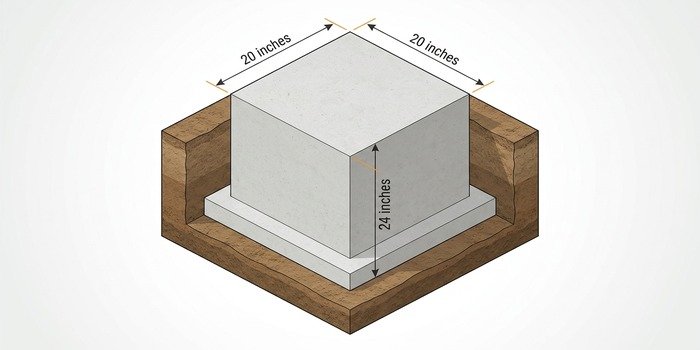
How Much Concrete for a 20x20x24 Footing?
How much concrete a 20" x 20" x 24" footing needs — cubic feet, cubic yards, and bag counts for planning
Exact volumes and planning bag counts for a single 20" x 20" x 24" concrete footing. Includes cubic feet, cubic yards, and waste-adjusted totals for 40-, 60-, and 80-pound bags.
Use this 20" x 20" x 24" footing for posts and light columns where a compact, deep footing is preferred. It works well for a single deck post, small column, or light masonry pier when the load and bearing soil match the size.
Before you build, check soil bearing and the loads the footing must carry. A 24-inch depth may be suitable where that depth aligns with local frost-depth requirements, but you should confirm bearing capacity, reinforcement needs, and any permit requirements for your site.
Quick Answer
Exact volume for one 20" x 20" x 24" footing is 5.5556 cubic feet, which is 0.2058 cubic yards. Exact bag counts (no waste) are 19 40-lb bags, 13 60-lb bags, or 10 80-lb bags.
With a standard 10% allowance for waste and overage plan on 6.1112 cubic feet (0.2264 cubic yards). That equals about 21 40-lb bags, 14 60-lb bags, or 11 80-lb bags for a single footing.
Need a custom estimate? Use the Footing Calculator, try the concrete calculator for any pour, or browse footing size pages. All project pages.
How to Use This Footing Estimate
Quick steps to go from measurement to a poured footing:
- Confirm the exact location, depth, and dimensions: 20" x 20" x 24" for this footing.
- Check soil bearing and any permitting or reinforcement requirements before digging.
- Order materials using the planning volume (6.1112 cu ft or 0.2264 yd3) to include 10% waste.
- Mix or receive concrete and place it into a well-prepared, compacted form with any required rebar or wire mesh.
- Consolidate and screed the concrete, finish as needed, then cure for the recommended time.
- Keep spare bags on hand if mixing on site, or arrange a small delivery window if using a mini-mix truck.
Formula
The basic volume formula is length × width × depth. For a rectangular or square footing the measurements must be in the same units — feet are easiest for cubic-yard conversion.
Convert inches to feet: 20 in = 1.6667 ft (length), 20 in = 1.6667 ft (width), 24 in = 2 ft (depth). The footing area is 1.6667 ft × 1.6667 ft = 2.7778 square feet. Multiply area by depth: 2.7778 ft² × 2 ft = 5.5556 cubic feet.
Convert cubic feet to cubic yards by dividing by 27: 5.5556 cu ft ÷ 27 = 0.2058 cubic yards. Add a 10% allowance for waste: 5.5556 cu ft × 1.10 = 6.1112 cu ft, which is 0.2264 cubic yards.
Worked Example
Single footing example: one 20" x 20" x 24" footing requires 5.5556 cubic feet (0.2058 yd³) of concrete. With a 10% waste allowance plan on 6.1112 cubic feet (0.2264 yd³), which is roughly 21 40-lb bags.
Multiple-footing example: three identical footings total 3 × 5.5556 = 16.6668 cubic feet, which equals 0.6174 cubic yards. With waste the total is 3 × 6.1112 = 18.3336 cubic feet, or 0.6792 cubic yards. For bags that means about 63 40-lb bags, 42 60-lb bags, or 33 80-lb bags when planning.
Bag Count Estimate
- 11 bags of 80 lb concrete mix
- 14 bags of 60 lb concrete mix
- 21 bags of 40 lb concrete mix
Always verify the actual yield on the product label before buying materials.
Bag Counts by Waste Buffer for 20" x 20" x 24"
Pick a buffer based on site conditions: clean forms and accurate measurements can run leaner; rough subgrade or hard-to-reach pours need more cushion.
| Buffer | Volume (ft³) | 80 lb bags | 60 lb bags | 40 lb bags |
|---|---|---|---|---|
| No buffer | 5.56 | 10 | 13 | 19 |
| +5% typical DIY | 5.83 | 10 | 13 | 20 |
| +10% recommended | 6.11 | 11 | 14 | 21 |
| +15% rough conditions | 6.39 | 11 | 15 | 22 |
When Bagged Concrete vs Ready-Mix Makes Sense
For a single 20" x 20" x 24" footing the volume is only 0.2058 cubic yards, which is well below the typical 1-yard minimum for many ready-mix trucks. That makes bagged concrete a practical choice for one or two footings: plan on 21 40-lb bags (with 10% waste) if mixing on site.
If you have several footings or other nearby work, ready-mix becomes more economical and faster to place. Some suppliers offer mini-mix deliveries smaller than 1 yard; if you order ready-mix, confirm minimums, delivery fees, and arrival timing to avoid cold joints.
Common Uses for This Footing Size
A 20x20x24 footing is commonly used for supporting deck posts, pergola posts, fence posts, and small porch columns. Its size fits well under single-point supports where the loads are relatively light, such as residential outdoor structures. This footing can help spread the weight of wooden posts or light columns into the ground, making it a frequent choice for smaller projects that don’t require large foundations.
Whether this footing size is suitable depends on several factors like the weight it needs to carry, the type of soil, how deep the frost line is in your area, and if any reinforcement is necessary. Local building codes also play a big role in determining if this footing meets the requirements for your specific project. It’s important to consider these details before deciding on footing dimensions.
Common Mistakes to Avoid
Avoid these common errors when preparing and pouring a 20" x 20" x 24" footing:
- Underestimating volume by skipping the 10% waste allowance.
- Ignoring soil-bearing capacity and not increasing footing size or reinforcement when needed.
- Failing to compact the base or provide a level, stable form.
- Not using the required reinforcement or placing rebar incorrectly.
- Ordering ready-mix without checking truck minimums and timing.
- Pouring in unsuitable weather or not curing the concrete long enough.
Frequently Asked Questions
How much concrete do I need for one 20" x 20" x 24" footing?
One 20" x 20" x 24" footing requires 5.5556 cubic feet of concrete, which is 0.2058 cubic yards.
How many 60-pound bags of concrete mix will I need?
For a single footing plan on 14 60-lb bags when you include a 10% waste allowance. The exact count without waste is 13 60-lb bags.
Why should I add 10% waste to the calculated volume?
Adding about 10% covers spillage, minor over-excavation, uneven forms, and small measurement errors. For this footing the planning volume becomes 6.1112 cubic feet (0.2264 cubic yards) with waste.
Is a 20" x 20" x 24" footing big enough for a deck post?
It depends on the post load, soil bearing capacity, frost depth, and local building requirements. A 24-inch depth may be suitable where that aligns with frost-depth rules, but check loads, reinforcement needs, and local permits or consult an engineer if unsure.
Keep Planning Your Concrete Project
Use the calculator, compare footing pages, and keep your estimate practical before you buy materials.
Disclaimer: This page provides planning estimates only. Actual concrete needs vary with excavation accuracy, site conditions, local code requirements, bag yield, and supplier guidance. Always verify measurements before buying materials, and consult a qualified professional for structural or code-sensitive work.