
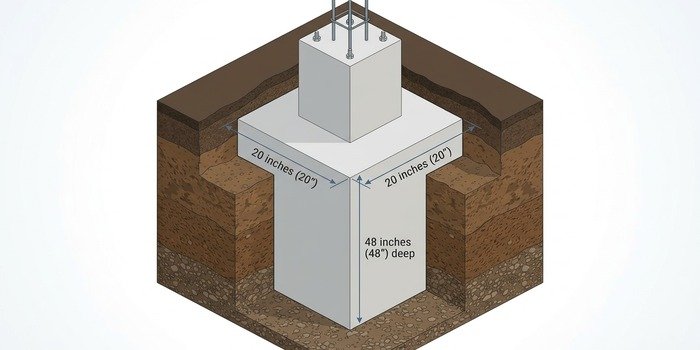
How Much Concrete for a 20x20x48 Footing?
Concrete needed for a 20" × 20" × 48" square footing — cubic feet, cubic yards, and bag estimates.
Exact volumes and planning bag counts for a 20" × 20" × 48" footing. See cubic feet, cubic yards, and suggested 40/60/80-lb bag totals with waste included.
At 48 inches deep this footing is focused on depth and below-grade performance. The 20" × 20" footprint with a full 48" depth requires careful excavation, backfill planning, and attention to frost or seasonal depth requirements in your area.
This size is commonly used where deep support is needed for posts or columns in colder climates or on sites with lower soil-bearing capacity. Expect significant digging and plan safe shoring and access before placing concrete.
Quick Answer
The exact concrete volume for a single 20" × 20" × 48" footing is 11.1111 cubic feet, which equals 0.4115 cubic yards. Allowing for 10% waste gives a planning volume of 12.2222 cubic feet (0.4527 cubic yards).
For ready planning, that waste-adjusted volume translates to about 41 40-lb bags, 28 60-lb bags, or 21 80-lb bags. The exact counts without waste are 38 (40-lb), 25 (60-lb), and 19 (80-lb).
Need a custom estimate? Use the Footing Calculator, try the concrete calculator for any pour, or browse footing size pages. All project pages.
How to Use This Footing Estimate
Quick steps to prepare and place concrete for this deep footing.
- Excavate to a square 20" × 20" section and a true 48" depth; check for level and uniform depth.
- Compact the bottom and add a thin leveling layer of coarse gravel if specified by the engineer.
- Place any required reinforcement—rebar cage or stirrups—per structural plans before setting forms.
- Mix or stage concrete: use about 12.2222 cu ft (0.4527 yd³) for planning with waste, or order bagged mix accordingly.
- Pour in lifts if necessary, consolidate with a rod or vibrator, and finish the top to the required slope or bearing surface.
- Cure according to mix instructions and protect from rapid drying or freezing for the specified time.
Formula
The basic formula multiplies the footing footprint by depth in feet: length × width × depth = volume in cubic feet. For this footing the math uses the inch dimensions converted to feet.
Convert inches to feet: length 20" = 1.6667 ft, width 20" = 1.6667 ft, depth 48" = 4 ft. Multiply: 1.6667 ft × 1.6667 ft = 2.7778 sq ft. Then 2.7778 sq ft × 4 ft = 11.1111 cubic feet.
To get cubic yards divide cubic feet by 27: 11.1111 cu ft ÷ 27 = 0.4115 cubic yards. Add the default 10% waste by multiplying by 1.10: 11.1111 cu ft × 1.10 = 12.2222 cu ft (12.2222 ÷ 27 = 0.4527 yd³).
Worked Example
Single-footing example: one 20" × 20" × 48" footing uses 11.1111 cu ft (0.4115 yd³) of concrete exactly, or 12.2222 cu ft (0.4527 yd³) with 10% waste. That planning volume is about 41 40-lb bags if you choose bagged concrete.
Multiple-footing example: three identical footings require 3 × 11.1111 cu ft = 33.3333 cu ft total, which is 33.3333 ÷ 27 = 1.2346 cubic yards exactly. With 10% waste plan for 3 × 12.2222 cu ft = 36.6666 cu ft (1.3584 yd³) — roughly 123 40-lb bags in total when using bagged concrete.
Bag Count Estimate
- 21 bags of 80 lb concrete mix
- 28 bags of 60 lb concrete mix
- 41 bags of 40 lb concrete mix
Always verify the actual yield on the product label before buying materials.
Bag Counts by Waste Buffer for 20" x 20" x 48"
Pick a buffer based on site conditions: clean forms and accurate measurements can run leaner; rough subgrade or hard-to-reach pours need more cushion.
| Buffer | Volume (ft³) | 80 lb bags | 60 lb bags | 40 lb bags |
|---|---|---|---|---|
| No buffer | 11.11 | 19 | 25 | 38 |
| +5% typical DIY | 11.67 | 20 | 26 | 39 |
| +10% recommended | 12.22 | 21 | 28 | 41 |
| +15% rough conditions | 12.78 | 22 | 29 | 43 |
When Bagged Concrete vs Ready-Mix Makes Sense
For a single 20" × 20" × 48" footing the waste-adjusted volume is only 0.4527 cubic yards, which is under a full cubic yard. That makes bagged concrete practical: you can buy the exact number of bags needed and mix on-site, reducing leftover ready-mix waste.
Ready-mix concrete saves time and provides consistent placement for deeper or larger pours, but trucks often have minimum delivery volumes and may charge for short loads. For this footing, bagged concrete is commonly the economical choice when labor and mixing equipment are available; ready-mix is worth considering for multiple footings poured in one day or when you need a faster, continuous placement.
Common Uses for This Footing Size
A 20x20x48 footing is commonly used for supporting deck posts, pergola posts, fence posts, and small porch columns. Its size fits well for single-point supports where the load isn't too heavy, such as a backyard deck or a garden structure. The square shape helps keep posts steady in typical residential settings, especially when the soil is fairly stable and the supported structure is light to moderate in weight.
Whether this footing size works for your project depends on several factors. The load from the structure, the type of soil, how deep the frost line is in your area, and whether reinforcement like rebar is needed all play a role. Local building codes might have specific requirements too, so it’s important to check those before deciding on footing dimensions.
Common Mistakes to Avoid
Common mistakes when placing a deep 20" × 20" × 48" footing.
- Failing to excavate square and to the full 48" depth before measuring volume.
- Skipping compaction or a granular leveling layer at the bottom of the excavation.
- Forgetting the required reinforcement cage or misplacing rebar relative to bearing surfaces.
- Underestimating waste and running short during the pour.
- Poor formwork or bracing that allows the form to bulge or leak under pressure.
- Not staging enough mixing or labor resources for a continuous pour.
Frequently Asked Questions
How much concrete does a 20" × 20" × 48" footing need?
The footing needs 11.1111 cubic feet of concrete, which is 0.4115 cubic yards exactly. With a 10% planning allowance expect about 12.2222 cubic feet (0.4527 cubic yards).
How many bags of concrete mix will I need for this footing?
Plan on roughly 41 40-lb bags, 28 60-lb bags, or 21 80-lb bags when you include a 10% waste allowance. Exact counts without waste are 38 (40-lb), 25 (60-lb), and 19 (80-lb).
Why should I add waste to the concrete volume?
Adding waste accounts for spillage, over-excavation, uneven forms, and slight variation in measurements. For this footing a 10% allowance increases the estimate from 11.1111 cu ft to 12.2222 cu ft to reduce the chance of running short during the pour.
Is a 20" × 20" × 48" footing adequate for a deck post?
It depends on the post load, soil-bearing capacity, and required frost depth in your area. A 48" depth can meet deep frost requirements in many locations, but reinforcement, footing width, and local building department requirements also affect adequacy; consult a structural plan or inspector for a site-specific determination.
Keep Planning Your Concrete Project
Use the calculator, compare footing pages, and keep your estimate practical before you buy materials.
Disclaimer: This page provides planning estimates only. Actual concrete needs vary with excavation accuracy, site conditions, local code requirements, bag yield, and supplier guidance. Always verify measurements before buying materials, and consult a qualified professional for structural or code-sensitive work.