
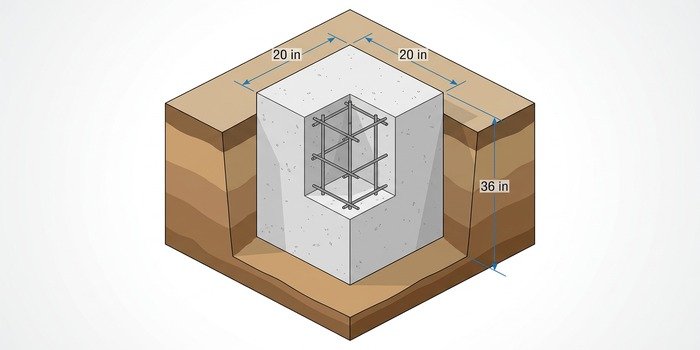
How Much Concrete for a 20x20x36 Footing?
20" × 20" × 36" square footing: 8.3333 ft³ (0.3086 yd³), with exact bag counts and a 10% planning example.
A 20" × 20" × 36" square footing contains 8.3333 ft³ (0.3086 yd³) of concrete before an allowance for excavation variation or spillage. Its 20" × 20" square base has a 2.78 ft² footprint; increasing depth changes the quantity without changing that base area.
For one footing, the bag count is significant enough to plan mixing cycles and handling before digging; repeat footings increase the batch total quickly. At 36 inches deep, confirm the specified bearing level, frost exposure, and excavation stability rather than assuming a deeper hole automatically meets code. Footing thickness, soil bearing, supported loads and reinforcement must come from the project design or local authority—not from the bag count.
Quick Answer
One 20" × 20" × 36" footing: 8.3333 ft³ / 0.3086 yd³ before waste. With a 10% example allowance, plan for 9.1667 ft³ / 0.3395 yd³. This allowance is a planning scenario, not a universal requirement.
Without waste: 28 × 40 lb, 19 × 60 lb, or 14 × 80 lb bags. With 10%: 31 × 40 lb, 21 × 60 lb, or 16 × 80 lb bags. Assumed mixed yields: 0.30/0.45/0.60 ft³ per 40/60/80 lb bag; always check the chosen product label.
Need a custom estimate? Use the Footing Calculator, try the concrete yardage calculator for any pour, or browse footing size pages. All project pages.
How to Use This Footing Estimate
Use these steps to plan quantities for the 20" × 20" × 36" footing; they do not replace an approved structural design.
- Verify the design: confirm that a 20" × 20" × 36" footing is specified for the supported loads, soil bearing and local frost/depth rules. Locate underground utilities before excavation.
- Measure the concrete cavity: check clear internal dimensions of 20" long × 20" wide × 36" deep; account for any bell, extra base or irregular excavation separately.
- Estimate the concrete: one footing needs 8.3333 ft³ before waste; a 10% example gives 9.1667 ft³. Multiply by the actual number of identical footings.
- Choose delivery: for one footing with 10% extra, compare 31 40 lb, 21 60 lb, or 16 80 lb bags with ready-mix. Check the published yield of the exact bagged product.
- Plan the placement: follow the approved excavation, bearing preparation, formwork, reinforcement and anchorage details. Organize access, equipment and enough help for continuous placement.
- Mix, place and cure: follow the concrete product instructions for water, mixing, placement, consolidation and curing; do not treat a nominal curing age as automatic structural approval.
Formula
Rectangular or square footing volume: length × width × depth, with all three measurements in the same units. To calculate directly from inches, divide cubic inches by 1,728.
In cubic feet: (20 × 20 × 36) ÷ 1,728 = 8.3333 ft³. In cubic yards: the unrounded ft³ result ÷ 27 = 0.3086 yd³. Values shown here are rounded for display; bag counts use full precision.
10% planning example: base volume × 1.10 = 9.1667 ft³, or 0.3395 yd³. Because the allowance is applied to volume before dividing by bag yield, it is not the same as multiplying a previously rounded whole-bag count.
Worked Example
One 20" × 20" × 36" footing: 8.3333 ft³ (0.3086 yd³). With a 10% example allowance, 9.1667 ft³ (0.3395 yd³), equivalent to 31 × 40 lb, 21 × 60 lb, or 16 × 80 lb bags based on standard yields.
Three identical footings: 3 × 8.3333 = 25 ft³ (0.9259 yd³) before waste. Add 10% to the combined volume: 27.5 ft³ (1.0185 yd³), then round up once to 92 40 lb, 62 60 lb, or 46 80 lb bags. This can differ from rounding each footing separately.
Bag Count Estimate
- 16 bags of 80 lb concrete mix
- 21 bags of 60 lb concrete mix
- 31 bags of 40 lb concrete mix
Always verify the actual yield on the product label before buying materials.
Bag Counts by Waste Buffer for 20" x 20" x 36"
These buffers are examples, not a universal recommendation. The right percentage depends on excavation accuracy, how precisely you measured, soil and ground conditions, and placement losses such as spillage or over-dig. This page uses 10% as its own planning figure.
| Buffer | Volume (ft³) | 80 lb bags | 60 lb bags | 40 lb bags |
|---|---|---|---|---|
| No buffer | 8.33 | 14 | 19 | 28 |
| +5% example | 8.75 | 15 | 20 | 30 |
| +10% example | 9.17 | 16 | 21 | 31 |
| +15% example | 9.58 | 16 | 22 | 32 |
When Bagged Concrete vs Ready-Mix Makes Sense
For one footing, the 10% example needs 16 × 80 lb bags, approximately 1,280 lb of dry mix. Compare bag availability, mixer capacity and hauling time with a supplier quote rather than assuming bagged concrete is cheaper.
If there are three identical 20" × 20" × 36" footings, the combined volume with the same 10% example is 1.0185 yd³. Order based on the combined measured cavities, not just the single-footing result; confirm truck access and what the supplier charges for short loads. Neither bag count nor material weight establishes the footing’s load-bearing capacity.
Common Uses for This Footing Size
This is a 20" square concrete footprint, so the material calculation applies to a symmetric footing below a post or pier if that geometry is specified on the plans. A square layout is simpler to measure than a non-square pad, but the area is not evidence of structural capacity.
The base area is 2.78 ft² and the concrete volume is 8.3333 ft³. This page is useful for estimating a single cavity, comparing alternate depths, or calculating several identical footings. A 36" depth adds half again as much concrete as the same footprint at 24". That comparison is only about quantity, not a recommendation to make the footing deeper. Soil bearing, reinforcement, supported loads and local construction rules remain separate design checks.
Common Mistakes to Avoid
For this square footing, avoid these estimating and site-planning errors:
- Confusing a 20" square base with a 20"-diameter round hole; square and circular volumes are different.
- Ordering bags from a rounded 0.31 yd³ display instead of the precise 20" × 20" × 36" calculation.
- Adding 10% to the already-rounded bag count instead of applying the example allowance to the concrete volume before rounding up.
- Assuming that 36 inches of depth automatically satisfies a frost or structural requirement without checking the site and approved plans.
- Using a generic bag yield without checking the specific manufacturer and mix type.
- Overlooking bag transport, consistent mixing, consolidation and curing when placing multiple batches.
Frequently Asked Questions
How much concrete is in a 20" × 20" × 36" footing?
A single 20" × 20" × 36" square footing contains 8.3333 ft³ (0.3086 yd³) before waste. With a 10% example allowance, the planning quantity becomes 9.1667 ft³ (0.3395 yd³).
How many bags of concrete are needed for a 20" × 20" × 36" footing?
Without waste: 28 bags of 40 lb, 19 of 60 lb, or 14 of 80 lb. At a 10% example allowance: 31 of 40 lb, 21 of 60 lb, or 16 of 80 lb. These estimates assume 0.30, 0.45 and 0.60 ft³ of yield per respective bag; check the product label.
How much more concrete does a 36-inch depth use than 24 inches?
At the same 20" × 20" footprint, 24" depth uses 5.5556 ft³ and 36" depth uses 8.3333 ft³: 50% more concrete. The required depth is governed by design and site conditions, not material savings.
Is a 20" × 20" × 36" footing deep enough for a deck post?
Not necessarily. A 36" depth does not establish adequacy without the local frost depth, soil bearing, load and applicable footing rules. Follow the engineered or approved plan; the figures on this page are volume and bag-count estimates only.
Keep Planning Your Concrete Project
Use the calculator, compare footing pages, and keep your estimate practical before you buy materials.
Disclaimer: This page provides planning estimates only. Actual concrete needs vary with excavation accuracy, site conditions, local code requirements, bag yield, and supplier guidance. Always verify measurements before buying materials, and consult a qualified professional for structural or code-sensitive work.