
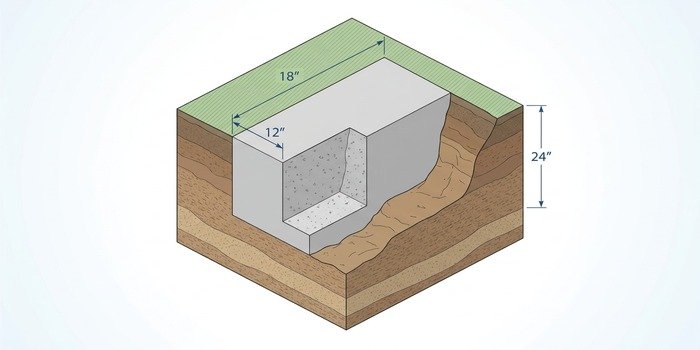
How Much Concrete for a 12x18x24 Footing?
How much concrete for a 12" × 18" × 24" rectangular footing — cubic feet, cubic yards, and bag counts.
Get the exact material takeoff for a 12" × 18" × 24" footing: 3.0 cu ft (0.1111 yd³) nominal, 3.3 cu ft (0.1222 yd³) with 10% waste, and bag planning counts included.
At 24 inches deep, this 12" × 18" footing needs a careful excavation because depth drives both volume and frost considerations. Start by planning the hole and shoring the sides if the soil is loose; working from the depth downward helps you size your excavation and determine if extra reinforcement will be required.
This footing size is commonly used for single posts, small beams, or isolated pier supports where a 2-foot depth aligns with local frost-depth requirements. It’s small enough that bagged concrete often makes sense, but site access, reinforcement needs, and the number of footings can change the best delivery method.
Quick Answer
Nominal volume for a single 12" × 18" × 24" footing is 3.0 cubic feet, which is 0.1111 cubic yards. Allowing 10% waste for mixing and spillage brings the planning volume to 3.3 cubic feet or 0.1222 cubic yards.
For planning: expect about 11 40-lb bags, 8 60-lb bags, or 6 80-lb bags when you include the 10% waste allowance. The exact counts without waste are 10, 7, and 5 bags respectively, but use the waste-adjusted numbers for ordering and on-site preparation.
Need a custom estimate? Use the Footing Calculator, try the concrete yardage calculator for any pour, or browse footing size pages. All project pages.
How to Use This Footing Estimate
Quick steps to prepare and pour a single 12" × 18" × 24" footing.
- Excavate to a clean, firm bottom at 24 inches deep and remove loose soil and organic material.
- Compact the footing bottom and add a thin layer of gravel if drainage or bearing is a concern.
- Place any required reinforcement such as rebar or a wire mesh per structural direction.
- Mix bagged concrete to the manufacturer’s instructions or arrange ready-mix delivery if using larger quantities.
- Pour into the form, consolidate with a bar or rod, and screed the top level.
- Float and finish the surface as needed, then keep the concrete damp for the first several days to cure properly.
Formula
Use the rectangular volume formula: volume = length × width × depth (all in feet). For this footing the dimensions are 1 ft × 1.5 ft × 2 ft.
Compute the exact math: 1 × 1.5 × 2 = 3.0 cubic feet. To convert cubic feet to cubic yards divide by 27, so 3.0 ÷ 27 = 0.111111... which we round to 0.1111 cubic yards.
Apply a waste factor to account for mixing, spillage, and small measurement errors. With 10% waste: 3.0 cu ft × 1.10 = 3.3 cu ft. In cubic yards that is 0.1111 × 1.10 = 0.1222 yd³. Use these planning numbers for ordering material and counting bags.
Worked Example
Single-footing example: One 12" × 18" × 24" footing has a total of 3.0 cubic feet of concrete, which equals 0.1111 cubic yards. With 10% waste you should plan on 3.3 cubic feet (0.1222 cubic yards) — roughly 11 40-lb bags when using bagged concrete.
Multiple-footing example: If you need three identical footings, total the volumes first: 3 × 3.0 cu ft = 9.0 cubic feet, which is 0.3333 cubic yards before waste. With 10% waste plan on 9.9 cubic feet (0.3667 cubic yards). For bagged concrete, multiply the per-footing planning counts: about 11 × 3 = 33 40-lb bags (or 8 × 3 = 24 60-lb bags).
Bag Count Estimate
- 6 bags of 80 lb concrete mix
- 8 bags of 60 lb concrete mix
- 12 bags of 40 lb concrete mix
Always verify the actual yield on the product label before buying materials.
Bag Counts by Waste Buffer for 12" x 18" x 24"
Pick a buffer based on site conditions: clean forms and accurate measurements can run leaner; rough subgrade or hard-to-reach pours need more cushion.
| Buffer | Volume (ft³) | 80 lb bags | 60 lb bags | 40 lb bags |
|---|---|---|---|---|
| No buffer | 3 | 5 | 7 | 10 |
| +5% typical DIY | 3.15 | 6 | 8 | 11 |
| +10% recommended | 3.3 | 6 | 8 | 12 |
| +15% rough conditions | 3.45 | 6 | 8 | 12 |
When Bagged Concrete vs Ready-Mix Makes Sense
For this footing the planning volume is only 0.1222 cubic yards, which is well under a typical ready-mix minimum. Bagged concrete is usually more practical for one or a few footings because it avoids paying for and handling a large truckload of concrete.
Choose ready-mix only when you have multiple footings or continuous pours that bring your total close to a cubic yard or more. Also consider crew size and speed: ready-mix reduces on-site mixing labor but needs good access and a pour plan, while bags give flexibility to mix small batches and control placement.
If you go with bags, order the waste-adjusted counts (11 of the 40-lb bags, 8 of the 60-lb bags, or 6 of the 80-lb bags) so you have a margin for small spillage and over-excavation.
Common Uses for This Footing Size
A 12x18x24 footing is often used for supporting deck posts, pergola posts, fence posts, and small porch columns. Its rectangular shape and size make it suitable for single-point supports where the loads are relatively light. This footing can help keep posts stable in typical residential settings, especially for outdoor structures that don’t carry heavy weight. It’s a common choice when you need a footing that fits under narrow posts or beams and fits within limited space.
Whether this footing size is appropriate depends on several factors. The weight of what’s being supported, the type of soil, how deep the footing needs to go to avoid frost, and whether reinforcement like rebar is necessary all affect its use. Local building codes may have specific requirements that influence footing size and placement as well.
Common Mistakes to Avoid
Common mistakes that increase cost or lead to poor footing performance.
- Under-excavating or leaving soft soil at the bottom instead of compacting the bearing surface.
- Skipping required reinforcement or using undersized rebar for the design load.
- Ordering too little concrete by ignoring the 10% waste allowance.
- Mixing batches inconsistently when using bags, producing variable strength.
- Poor consolidation that leaves voids inside the footing.
- Inadequate curing — failing to keep the concrete moist for the first several days.
Frequently Asked Questions
How much concrete does a 12" × 18" × 24" footing need in cubic feet and cubic yards?
The footing needs 3.0 cubic feet of concrete, which equals 0.1111 cubic yards. With a 10% waste allowance plan on 3.3 cubic feet (0.1222 cubic yards).
How many bags of concrete mix should I buy for this footing?
Plan for the waste-adjusted counts: about 11 40-lb bags, 8 60-lb bags, or 6 80-lb bags. The exact counts without waste are 10, 7, and 5 respectively, but order the higher numbers to allow for waste.
Why is a 10% waste factor used and when might I need more?
A 10% waste factor covers mixing losses, runoff, and small measurement errors. Use a larger allowance if the site is hard to work in, you have longer travel for mixed loads, or you expect over-excavation or broken bags.
Is this footing size suitable for a deck post?
It depends on the applied loads, soil-bearing capacity, frost depth at your site, and the design requirements set by your local building department. A 24-inch depth may be suitable where it meets frost-depth and load requirements, but reinforcement, footing diameter, and permit conditions can change what’s acceptable.
Keep Planning Your Concrete Project
Use the calculator, compare footing pages, and keep your estimate practical before you buy materials.
Disclaimer: This page provides planning estimates only. Actual concrete needs vary with excavation accuracy, site conditions, local code requirements, bag yield, and supplier guidance. Always verify measurements before buying materials, and consult a qualified professional for structural or code-sensitive work.