
A professionally installed concrete driveway commonly costs about $6 to $20 per square foot in the U.S. in 2026, depending on site preparation, thickness, reinforcement, labor, location, and finish. A basic broom-finished driveway often falls toward the lower-middle part of that range, while stamped, stained, difficult-access, or heavily reinforced projects can cost significantly more.
For a typical two-car driveway of about 400 to 600 square feet, that can mean roughly $3,200 to $7,200 for a straightforward broom-finished project using an $8–$12 per square foot planning range, before unusual excavation, demolition, drainage, permits, or decorative upgrades.
Quick Answer
How much does a concrete driveway cost per square foot?
A broad 2026 planning range is approximately $6–$20 per square foot installed. Plain gray concrete can fall around $6–$8 per square foot in favorable conditions, while broom-finished and basic textured work commonly falls around $8–$12. Decorative stamped, stained, or specialty finishes can move into the $12–$20 range or higher.
What does a two-car concrete driveway cost?
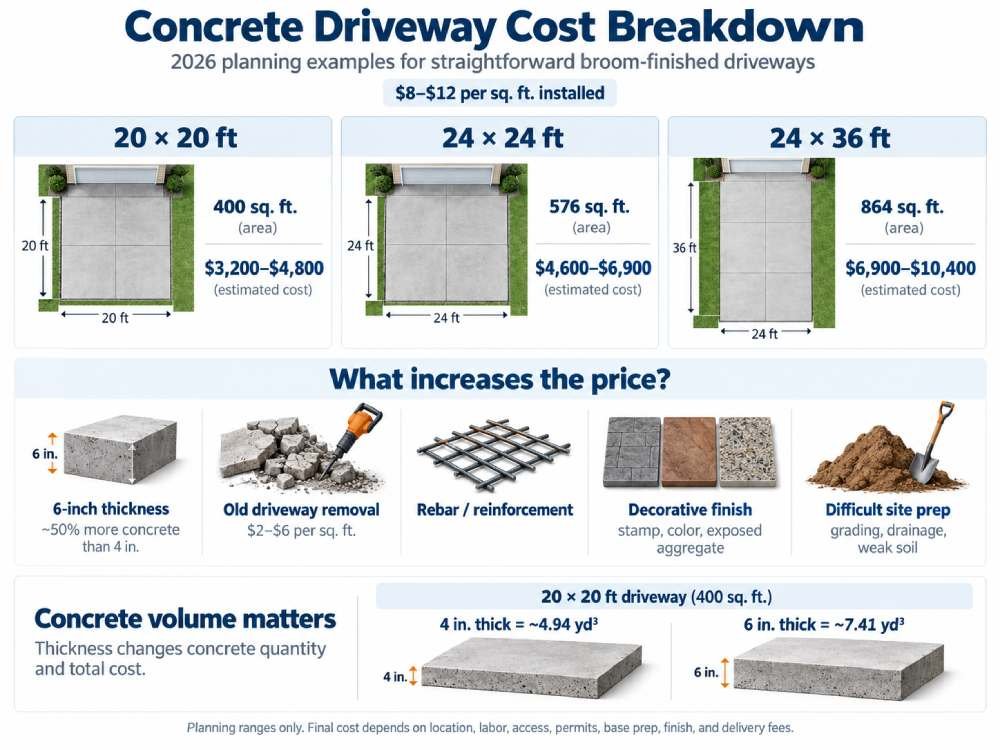
A 20 × 20-foot driveway is 400 ft². At $8–$12 per square foot, that gives a simple planning range of about $3,200–$4,800. A larger 24 × 24-foot driveway is 576 ft², or about $4,600–$6,900 at the same rate.
Rule of thumb: Calculate the driveway’s square footage, thickness, and concrete volume first, then price site work, reinforcement, finishing, removal, and delivery separately.
Do not estimate a driveway from square footage alone
A 6-inch reinforced driveway on weak soil costs more than a simple 4-inch slab of the same area because it uses more concrete and may require more base preparation and steel.
Main driveway cost drivers
- Driveway size: more square footage means more excavation, base, concrete, labor, and finishing.
- Thickness: increasing from 4 to 6 inches uses 50% more concrete.
- Site preparation: weak soil, grading, drainage, and deep excavation increase cost quickly.
- Reinforcement: rebar or other specified reinforcement adds material and labor.
- Finish: plain and broom finishes cost less than stamped, stained, or decorative surfaces.
- Existing driveway: demolition, hauling, and disposal can add several dollars per square foot.
1. Concrete Driveway Cost by Size
The easiest first estimate is to multiply driveway square footage by a realistic installed cost per square foot. The table below uses $8–$12 per ft² as a planning range for a relatively straightforward broom-finished driveway.
| Driveway Size | Area | Planning Cost at $8–$12/ft² |
|---|---|---|
| 10 × 20 ft | 200 ft² | $1,600–$2,400 |
| 12 × 24 ft | 288 ft² | $2,300–$3,500 |
| 20 × 20 ft | 400 ft² | $3,200–$4,800 |
| 24 × 24 ft | 576 ft² | $4,600–$6,900 |
| 24 × 36 ft | 864 ft² | $6,900–$10,400 |
These are planning examples, not contractor quotes. Difficult access, demolition, drainage, local labor rates, high-strength concrete, decorative finishes, permits, or unusually deep base work can push the actual total higher.
2. How Much Concrete Does a Driveway Need?
Driveways are priced by square foot for installation, but ready-mix concrete itself is purchased by cubic yard. Thickness therefore has a direct effect on material cost.
A 20 × 20-foot driveway contains 400 square feet.
At 4 inches thick
400 ft² × 0.333 ft = about 133.3 ft³, or approximately 4.94 yd³ before waste.
At 6 inches thick
400 ft² × 0.5 ft = 200 ft³, or approximately 7.41 yd³.
Moving from 4 to 6 inches therefore adds about 2.47 cubic yards to this 400 ft² driveway—roughly 50% more concrete.
Use the concrete calculator to calculate the actual volume for your driveway instead of relying on generic sizes.
The 4-inch vs. 6-inch concrete slab guide explains why vehicle loads, soil support, and project requirements matter when choosing thickness.
3. How Much Does the Concrete Itself Cost?
Concrete material is only one part of the driveway price. Current 2026 cost data puts ordinary ready-mix delivery at roughly $110–$150 per cubic yard in many markets before project-specific delivery charges and other fees.
That means a theoretical 5-yard driveway might contain roughly $550–$750 worth of concrete at the basic per-yard price, but the actual invoice can be higher once delivery, short-load fees, higher-PSI mixes, fuel, minimum orders, and local pricing are included.
This is why multiplying cubic yards by a concrete price does not give you the installed driveway cost.
The concrete cost per yard guide explains material pricing, delivery, and why short-load orders can cost more per yard.
Short-load charges matter
Ready-mix trucks commonly carry around 10 cubic yards. A smaller driveway may require less than a full truck and can trigger a short-load fee. This makes a 4- or 5-yard order cost more per delivered yard than the headline material price suggests.
Before calling the plant, review the ready-mix concrete ordering tips so quantity, access, timing, slump, strength, and delivery conditions are clear.
4. Site Preparation Can Cost as Much as the Concrete
A driveway must carry repeated vehicle loads, so the soil and base beneath the slab matter enormously.
A simple replacement on stable, already graded soil is very different from a new driveway that requires excavation, tree-root removal, drainage corrections, imported aggregate, compaction, and major elevation changes.
Typical preparation work includes
- Removing sod, topsoil, or unsuitable material
- Excavating to the required depth
- Correcting soft areas
- Installing and compacting granular base
- Setting forms and elevations
- Establishing drainage slope
- Preparing driveway aprons or transitions
Trying to save money by reducing base preparation can become very expensive later. Settlement can create cracking, rocking sections, drainage problems, and vertical displacement that are difficult to correct after the driveway is poured.
5. How Much Does Reinforcement Add?
Driveways may use rebar, welded wire reinforcement, fibers, or a combination depending on the design. Reinforcement adds both material cost and installation labor.
Do not select reinforcement simply by choosing the cheapest grid. Vehicle loads, slab thickness, subgrade, joints, soil conditions, and local requirements determine what is appropriate.
If the project specifies bars, the rebar spacing for a concrete slab guide explains grid spacing, bar sizes, chairs, and why reinforcement should not be left lying on the ground.
Rebar does not replace proper thickness or base
More steel cannot turn unstable soil into good subgrade, and it cannot compensate automatically for a driveway that is too thin for its expected loads.
6. Driveway Finish Has a Major Effect on Price
A plain or broom-finished driveway is normally the lowest-cost option. Decorative work requires extra materials, labor, tools, timing, and skill.
| Finish | Typical 2026 Planning Range |
|---|---|
| Plain gray | About $6–$8/ft² |
| Broom finished | About $8–$12/ft² |
| Colored or exposed aggregate | Often around $8–$12/ft² |
| Stamped or decorative | Often around $12–$18/ft² |
| Higher-end specialty finish | Can approach $18–$20+/ft² |
These ranges are national planning numbers. Decorative labor costs vary significantly by region and design complexity.
A basic broom finish is usually the practical baseline for a residential driveway because it provides traction without the added cost of elaborate decorative work.
7. Replacing an Existing Driveway Costs More
If an old concrete driveway already exists, demolition and disposal need to be added before the new installation begins.
Current cost guides put concrete removal around $2–$6 per square foot in many cases. A 400 ft² driveway could therefore add roughly $800–$2,400 in removal cost alone before the new slab is installed.
Removal can cost more when:
- The old slab is unusually thick
- Heavy reinforcement is present
- Access for demolition equipment is limited
- Concrete must be carried a long distance to a truck
- Disposal fees are high locally
Do not assume the new driveway can simply be poured over a badly cracked old slab. The existing failure may be related to settlement, drainage, poor base preparation, or frost movement that should be corrected first.
8. Example Budget: 24 × 24 ft Two-Car Driveway
A 24 × 24-foot driveway covers 576 ft².
Installed cost
At a straightforward broom-finished planning rate of $8–$12/ft²:
576 × $8 = $4,608
576 × $12 = $6,912
So a reasonable early planning range is approximately $4,600–$6,900 before unusual site work or upgrades.
Concrete volume at 4 inches
A 4-inch-thick 24 × 24 slab contains approximately 7.11 yd³ of concrete before waste.
Concrete volume at 6 inches
At 6 inches, the same driveway jumps to approximately 10.67 yd³.
This example shows why the final driveway thickness should be decided before asking suppliers or contractors for pricing.
You can browse common slab dimensions to compare volumes for other lengths, widths, and thicknesses.
9. Other Costs Homeowners Often Forget
The quote for a driveway can include much more than ready-mix and finishing labor.
Permits and inspections
Some jurisdictions require permits, inspections, or specific driveway-apron requirements. Costs vary locally, so verify them before construction.
Drainage
A driveway that sends water toward a garage or neighboring property may require grading changes, drains, or other drainage work.
Concrete pumping
If a ready-mix truck cannot reach the forms, a pump may be required, adding equipment and operator cost.
Thickened edges or footings
Some designs include thicker perimeter sections or other reinforced areas that increase concrete volume beyond a simple rectangular slab calculation.
Sealing
Some driveway finishes or exposure conditions may justify a compatible sealer after the concrete has cured sufficiently.
Weather protection
Cold-weather or hot-weather placement can require additional labor, blankets, curing materials, shade, wind protection, or scheduling changes.
10. DIY vs. Hiring a Contractor
A small slab can be a realistic DIY project. A full driveway is a different scale.
A 24 × 24-foot driveway only 4 inches thick contains more than 7 cubic yards of concrete. At roughly 4,000 lb per yard, that represents around 28,000 lb of fresh concrete that must be placed, screeded, edged, jointed, and finished within a limited working window.
For most homeowners, a full driveway is better treated as a professional pour, especially when grading, reinforcement, drainage, vehicle loads, or decorative finishes are involved.
DIY preparation may still reduce cost in some situations, but coordinate any homeowner-performed excavation or base work with the contractor before doing it. Incorrect elevations or compaction can create more work rather than savings.
Tools & Next Steps
Calculate driveway concrete
Enter length, width, and thickness to estimate the cubic yards required before requesting concrete or contractor quotes.
Compare driveway sizes
Browse pre-calculated slab dimensions to compare concrete volume at different sizes and thicknesses.
Frequently Asked Questions
How much does a concrete driveway cost per square foot?
A broad 2026 U.S. planning range is roughly $6–$20 per square foot installed. Plain and broom-finished driveways tend to fall toward the lower end, while decorative finishes, difficult site conditions, and higher labor costs push projects upward.
How much does a 20 × 20 concrete driveway cost?
A 20 × 20 driveway covers 400 ft². At a simple $8–$12 per square foot broom-finish planning range, the installation would be approximately $3,200–$4,800 before unusual site preparation, removal, drainage, or decorative upgrades.
How much does a 24 × 24 concrete driveway cost?
A 24 × 24 driveway covers 576 ft². Using $8–$12 per square foot as an early planning range gives approximately $4,600–$6,900.
How thick should a concrete driveway be?
Four inches is common for many residential passenger-car driveways, but 5 or 6 inches may be appropriate for heavier vehicles or project-specific conditions. Soil, base support, reinforcement, loading, climate, and local requirements all affect the final design.
How much concrete does a two-car driveway need?
A 20 × 20-foot driveway at 4 inches thick needs about 4.94 cubic yards before waste. A 24 × 24-foot driveway at the same thickness needs about 7.11 cubic yards.
How much does driveway concrete cost per yard?
Ready-mix concrete itself is often around $110–$150 per cubic yard in current national cost data, before delivery and project-specific fees. Driveway-strength mixtures, short loads, fuel, distance, and local pricing can raise the delivered cost.
Does a concrete driveway need rebar?
Not every driveway uses the same reinforcement system. Rebar, welded wire reinforcement, fibers, slab thickness, joints, and base support should be selected for the actual loading and project requirements.
How much does it cost to remove an old concrete driveway?
Concrete removal commonly runs about $2–$6 per square foot as a national planning range. Thickness, reinforcement, equipment access, hauling distance, and disposal fees can change the price substantially.
Is it cheaper to pour a concrete driveway yourself?
DIY can reduce labor cost, but full driveways are difficult pours because several tons of concrete must be placed and finished quickly. Equipment rental, helpers, formwork, base preparation, delivery, finishing tools, and mistakes can reduce the apparent savings.
Calculate the concrete before comparing quotes
Disclaimer
This guide provides general U.S. cost and DIY planning information. Concrete, labor, excavation, reinforcement, demolition, disposal, permits, delivery, and finishing prices vary significantly by location and project. The cost ranges shown are planning estimates rather than contractor quotes. Verify local pricing and building requirements, and consult a qualified concrete contractor or engineer for unusual vehicle loads, poor soils, steep grades, structural work, or complex drainage conditions.