
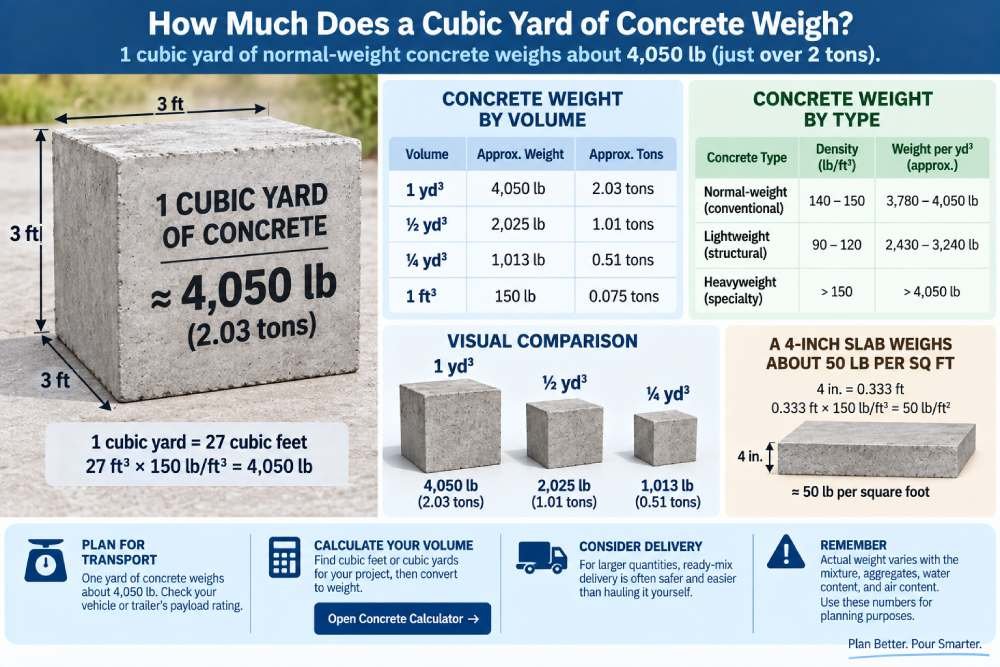
One cubic yard of normal-weight concrete weighs about 4,050 lb, or just over 2 tons, using a typical density of 150 lb per cubic foot. Actual weight varies with the aggregates, water content, air content, and whether the mix is normal-weight, lightweight, or heavyweight concrete.
For quick DIY planning, you can round that to about 4,000 lb per cubic yard. That number is useful when estimating trailer loads, slab weight, demolition debris, and how much material you are really dealing with before a pour.
Quick Answer
How much does 1 cubic yard of concrete weigh?
About 4,050 lb for typical normal-weight concrete. One cubic yard contains 27 cubic feet, so at approximately 150 lb/ft³:
27 ft³ × 150 lb/ft³ = 4,050 lb
How many tons is a yard of concrete?
At 4,050 lb per cubic yard, one yard weighs approximately 2.03 US tons. For quick estimates, many homeowners simply use 2 tons per cubic yard.
Rule of thumb: Use 4,000–4,050 lb per cubic yard when estimating ordinary residential concrete unless the mix supplier specifies a different unit weight.
Volume and weight are different
Concrete is ordered by volume, usually cubic yards. Calculate the volume first, then convert that volume to approximate weight when you need it for transport or load planning.
Concrete weight at a glance
- 1 cubic foot: about 150 lb
- 1 cubic yard: about 4,050 lb
- ½ cubic yard: about 2,025 lb
- ¼ cubic yard: about 1,010 lb
- 1 cubic yard in tons: about 2.03 tons
1. Concrete Weight per Cubic Yard Chart
The following chart uses 150 lb/ft³ as the planning density for normal-weight concrete. Because one cubic yard equals 27 cubic feet, the weight increases directly with volume.
| Concrete Volume | Approx. Weight | Approx. Tons |
|---|---|---|
| ¼ yd³ | 1,013 lb | 0.51 tons |
| ½ yd³ | 2,025 lb | 1.01 tons |
| ¾ yd³ | 3,038 lb | 1.52 tons |
| 1 yd³ | 4,050 lb | 2.03 tons |
| 2 yd³ | 8,100 lb | 4.05 tons |
| 3 yd³ | 12,150 lb | 6.08 tons |
| 5 yd³ | 20,250 lb | 10.13 tons |
These are approximate planning weights. If the exact load matters—for example, for structural engineering or transportation—use the actual unit weight of the specified concrete mixture.
Start by finding your volume with the concrete estimator and then multiply the resulting cubic yards by the appropriate weight per yard.
2. How Much Does Concrete Weigh per Cubic Foot?
Normal-weight concrete is commonly estimated at about 150 lb per cubic foot. A more typical real-world range can be approximately 140 to 150 lb/ft³ depending on the mixture.
That makes cubic-foot calculations especially useful for slabs because you can convert thickness directly into weight per square foot.
| Slab Thickness | Concrete per ft² | Approx. Weight per ft² |
|---|---|---|
| 2 in. | 0.167 ft³ | 25 lb |
| 3 in. | 0.250 ft³ | 37.5 lb |
| 4 in. | 0.333 ft³ | 50 lb |
| 5 in. | 0.417 ft³ | 62.5 lb |
| 6 in. | 0.500 ft³ | 75 lb |
This means a typical 4-inch normal-weight slab adds roughly 50 lb per square foot from the concrete itself, before considering reinforcement, finishes, equipment, or other loads.
3. Example: How Much Does a 12 × 20 × 6-Inch Slab Weigh?
A 12 × 20-foot slab has an area of 240 ft². At 6 inches thick, the concrete depth is 0.5 feet.
240 ft² × 0.5 ft = 120 ft³
At approximately 150 lb/ft³:
120 ft³ × 150 lb = 18,000 lb
That is approximately 9 US tons of concrete.
The same slab contains about 4.44 cubic yards. You can review that configuration on the 12×20 6-inch slab example.
This is why even an ordinary backyard slab represents a substantial material load. The concrete may look manageable when measured as a few cubic yards, but those yards quickly become several tons.
For other common layouts, the pre-calculated slab sizes make it easier to compare volume before converting it to approximate weight.
4. Normal-Weight vs. Lightweight vs. Heavyweight Concrete
Not all concrete weighs 150 lb/ft³. The aggregates used in the mixture have a major effect on density.
Normal-weight concrete
Approximately 140–150 lb/ft³ is typical for normal-weight concrete made with conventional aggregates. This is the type most homeowners encounter for patios, driveways, footings, sidewalks, and many structural applications.
At that density, one cubic yard weighs about 3,780 to 4,050 lb.
Structural lightweight concrete
Structural lightweight concrete can have a density around 90–120 lb/ft³, depending on the mixture and aggregate. That works out to roughly 2,430–3,240 lb per cubic yard.
Lightweight concrete is a specialized material and should not be substituted for normal concrete simply because a lower weight is convenient.
Heavyweight concrete
Heavyweight concrete uses high-density aggregates for specialized applications such as counterweights and radiation shielding. Some specialty mixtures can reach densities far above ordinary concrete.
For a normal residential project, do not use heavyweight-concrete numbers unless the project specifically calls for that material.
5. Does Wet Concrete Weigh More Than Cured Concrete?
Fresh concrete can weigh somewhat more than the same concrete after long-term drying because fresh concrete contains water that is later consumed by hydration or lost as moisture. The exact change depends on the mixture and environmental conditions.
For everyday planning, however, using approximately 150 lb/ft³ or 4,050 lb/yd³ gives a practical estimate for normal-weight concrete.
Why the exact number changes
Concrete density can vary because of:
- Aggregate type and density
- Amount of entrained or entrapped air
- Water and cementitious material content
- Lightweight or heavyweight aggregates
- Moisture condition
- Mixture proportions
If weight is critical to a structural or transportation calculation, use the batch-specific density instead of the general 4,050 lb estimate.
6. Can You Carry a Cubic Yard of Concrete in a Pickup Truck?
Do not assume a pickup can safely carry one cubic yard of concrete. A full cubic yard of normal-weight concrete is approximately 4,050 lb before including passengers, tools, containers, trailer tongue weight, or other cargo.
That load can exceed the payload rating of many consumer vehicles by a substantial amount.
Check the actual payload rating
Payload and towing capacity are not the same thing. If material is placed in the truck bed, the relevant limit is the vehicle’s available payload. If it is carried on a trailer, you must consider the trailer’s gross vehicle weight rating, axle ratings, tires, hitch, tongue weight, and the tow vehicle’s limits.
Never estimate safe transport from truck size or appearance. Check the manufacturer’s ratings for the exact vehicle and equipment configuration.
Even half a yard is heavy
Half a cubic yard weighs approximately 2,025 lb. A quarter-yard still weighs about 1,000 lb.
For larger quantities, ready-mix delivery may make far more sense than trying to transport material yourself. The ready-mix concrete ordering guide covers quantity planning, access, timing, and ordering considerations.
7. How Much Do Concrete Bags Weigh Compared With a Cubic Yard?
Bag weight and finished concrete weight are related but they are not exactly the same calculation. An 80 lb bag contains 80 lb of dry concrete mix before you add water.
Using the planning yields for this site:
- 80 lb bag = about 0.60 ft³
- 60 lb bag = about 0.45 ft³
- 40 lb bag = about 0.30 ft³
Since one cubic yard contains 27 ft³, it takes approximately 45 × 80 lb bags at 0.60 ft³ per bag to produce one cubic yard theoretically.
Those 45 dry bags alone weigh 3,600 lb, before adding the required water.
Use the bag calculator to convert your project volume into common bag sizes.
The how many bags of concrete do I need guide explains the conversion in more detail, including why you should round bag quantities up rather than planning around fractional bags.
8. Why Concrete Weight Matters When Planning a Project
Knowing weight is useful even though concrete is normally purchased by volume.
Transportation
A seemingly small volume can weigh thousands of pounds. Weight determines whether a truck, trailer, cart, or other handling method is appropriate.
Labor
Moving 40, 60, or 80 lb bags repeatedly is physically demanding. A project requiring dozens of bags can involve several thousand pounds of dry material before water is added.
Demolition
Broken concrete remains heavy. If you remove a slab, disposal weight affects dumpsters, trailers, haul vehicles, and disposal costs.
Project cost
Weight itself usually does not determine ready-mix pricing, but the same volume that produces high weight also represents a substantial amount of material.
The concrete cost per yard guide explains how concrete volume translates into material and delivery costs.
For smaller projects, compare delivery with bagged material using the bagged vs. ready-mix concrete comparison.
9. Concrete Weight Conversion Formula
If you already know the concrete volume, the conversion is simple.
Cubic feet × density in lb/ft³ = total weight in pounds
Using 150 lb/ft³:
Weight = cubic feet × 150
If you know cubic yards instead:
Weight = cubic yards × 4,050 lb
To convert pounds to US tons:
Tons = pounds ÷ 2,000
For a fast mental estimate, multiply cubic yards by about 2 tons. Use the more exact 4,050 lb figure when you want a closer normal-weight-concrete estimate.
Tools & Next Steps
Calculate your concrete volume
Enter slab dimensions to determine cubic feet and cubic yards before converting the result to weight.
Compare common slab sizes
Browse pre-calculated dimensions to see how concrete volume changes with slab size and thickness.
Frequently Asked Questions
How much does 1 cubic yard of concrete weigh?
One cubic yard of typical normal-weight concrete weighs about 4,050 lb. A quick planning estimate of approximately 4,000 lb, or 2 tons, is usually convenient for ordinary residential concrete.
How many tons is a cubic yard of concrete?
A cubic yard of normal-weight concrete is approximately 2.03 US tons. The exact figure varies with the concrete mixture and density.
How much does half a yard of concrete weigh?
Half a cubic yard weighs approximately 2,025 lb at 150 lb/ft³. That is just over one US ton.
How much does a cubic foot of concrete weigh?
Typical normal-weight concrete weighs about 150 lb per cubic foot. Actual normal-weight mixtures can vary, so use the specified unit weight when precision matters.
How much does a 4-inch concrete slab weigh per square foot?
A 4-inch normal-weight concrete slab weighs about 50 lb per square foot. This uses a concrete density of approximately 150 lb/ft³ and does not include reinforcement or other materials.
How much does a 6-inch concrete slab weigh per square foot?
A 6-inch normal-weight slab weighs about 75 lb per square foot. Six inches equals half a foot, so 0.5 ft³ of concrete exists beneath every square foot of slab.
Does wet concrete weigh more than dry concrete?
Fresh concrete can weigh somewhat more than the same concrete after long-term drying because some moisture eventually leaves the material. For general planning, about 150 lb/ft³ remains a useful normal-weight concrete estimate.
Can a pickup truck carry one yard of concrete?
Do not assume it can. One cubic yard of normal concrete weighs roughly 4,050 lb, which can exceed the available payload of many consumer pickups. Check the exact vehicle’s payload and axle ratings before carrying heavy material.
How many 80 lb bags make one cubic yard of concrete?
At an estimated yield of 0.60 ft³ per 80 lb bag, one cubic yard requires about 45 bags theoretically. Real projects should include an allowance for waste, uneven dimensions, and incomplete bag yields.
Calculate the volume before estimating the weight
Disclaimer
This guide provides approximate concrete weights for DIY planning. Actual unit weight varies with aggregate type, mixture proportions, air content, moisture, and specialty concrete type. Do not use approximate weight figures as a substitute for verified vehicle payload ratings, trailer limits, structural design loads, batch information, or professional engineering calculations where safety depends on the exact weight.