
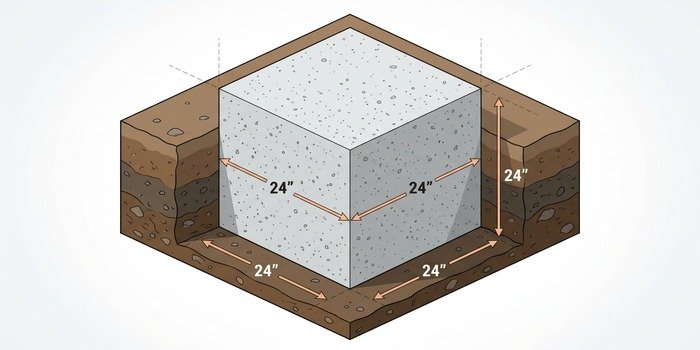
How Much Concrete for a 24x24x24 Footing?
Concrete volumes and bag planning for a 24" x 24" x 24" footing: cubic feet, cubic yards, and bag counts.
Calculate the 8 cu ft (0.2963 yd³) concrete need for a 24x24x24 footing, plus a 10% waste allowance and planning bag counts for 40-, 60-, and 80-lb mixes.
At 24 inches square and 24 inches deep, the depth is as important as the footprint for excavation and frost considerations. This footing requires a 24-inch excavation and a stable compacted base before any concrete is placed.
This size is commonly used for single post foundations, small columns, or light freestanding structures where a two-foot depth fits site conditions. Plan for excavation, access, and a short concrete pour — and consider reinforcement if the load or soil demands it.
Quick Answer
Exact concrete volume for this 24" x 24" x 24" footing is 8.0 cubic feet, which is 0.2963 cubic yards. Allowing 10% waste increases the planning volume to 8.8 cubic feet (0.3259 yd³).
For planning, expect to buy about 30 40-lb bags, 20 60-lb bags, or 15 80-lb bags to cover the footing with waste included. The exact no-waste counts are 27 40-lb, 18 60-lb, or 14 80-lb bags if you were to use every bit of mixed material.
Need a custom estimate? Use the Footing Calculator, try the concrete estimator for any pour, or browse footing size pages. All project pages.
How to Use This Footing Estimate
Basic steps to place concrete for this footing.
- Mark and excavate to a 24" depth, keeping the sides as vertical as practical.
- Compact the soil at the bottom and add a few inches of gravel if drainage or soft soil requires it.
- Set forms or use the prepared excavation as the form, and place any required reinforcement such as rebar or wire mesh.
- Mix bagged concrete or schedule delivery, then place concrete into the form, working it around reinforcement and consolidating to remove voids.
- Screed level, finish the surface according to need, and keep the concrete damp for at least a few days while it gains strength.
Formula
The basic formula for footing volume is length × width × depth. Convert all dimensions to feet before multiplying to get cubic feet, then divide by 27 to convert cubic feet to cubic yards.
For this footing: length = 2 ft, width = 2 ft, depth = 2 ft. Multiply 2 ft × 2 ft × 2 ft = 8.0 cubic feet. Convert to cubic yards: 8.0 ÷ 27 = 0.2963 cubic yards (rounded to four decimals).
Include waste for ordering: apply a 10% allowance to the cubic-foot figure. 8.0 × 1.10 = 8.8 cubic feet, which is 8.8 ÷ 27 = 0.3259 cubic yards. Use the waste-adjusted cubic yards to choose bag counts or ready-mix quantities; the planning bag counts supplied reflect that 10% allowance.
Worked Example
Single-footing example — one 24" x 24" x 24" footing uses 8.0 cubic feet (0.2963 yd³) of concrete. With a 10% waste allowance plan for 8.8 cubic feet (0.3259 yd³) and about 30 40-lb bags, 20 60-lb bags, or 15 80-lb bags.
Multiple-footing example — three identical footings total 24.0 cubic feet of concrete (24.0 ÷ 27 = 0.8889 yd³). With 10% waste the planning total is 26.4 cubic feet, which is about 0.9778 cubic yards; order roughly 90 40-lb bags, 60 60-lb bags, or 45 80-lb bags to cover all three footings.
Bag Count Estimate
- 15 bags of 80 lb concrete mix
- 20 bags of 60 lb concrete mix
- 30 bags of 40 lb concrete mix
Always verify the actual yield on the product label before buying materials.
Bag Counts by Waste Buffer for 24" x 24" x 24"
Pick a buffer based on site conditions: clean forms and accurate measurements can run leaner; rough subgrade or hard-to-reach pours need more cushion.
| Buffer | Volume (ft³) | 80 lb bags | 60 lb bags | 40 lb bags |
|---|---|---|---|---|
| No buffer | 8 | 14 | 18 | 27 |
| +5% typical DIY | 8.4 | 15 | 19 | 29 |
| +10% recommended | 8.8 | 15 | 20 | 30 |
| +15% rough conditions | 9.2 | 16 | 21 | 31 |
When Bagged Concrete vs Ready-Mix Makes Sense
For a single 24" x 24" x 24" footing the waste-adjusted volume is only about 0.3259 cubic yards, so buying bags of concrete mix is often more convenient and cost-effective for one or a few footings. Bagged concrete lets you control batch size and timing, and it’s easy to store on a small site.
If you have several footings or other nearby concrete work that pushes total volume higher, ready-mix can save time and provide consistent mixing. Ready-mix deliveries have scheduling and delivery constraints, so compare the total planned volume against delivery options before deciding.
Common Uses for This Footing Size
A 24x24x24 footing is often used for supporting deck posts, pergola posts, fence posts, or small porch columns. Its size fits well for single-point loads where the weight isn’t too heavy, such as a modest deck or a garden structure. It can also be used for light-duty applications around the yard where a simple, square concrete base is needed to keep posts stable and prevent sinking.
Whether this footing size is suitable depends on several factors like how much weight the post will carry, the type of soil it sits on, and how deep the frost line is in your area. Reinforcement and local building codes also play a role in deciding if this footing will meet the needs of your specific project.
Common Mistakes to Avoid
Common mistakes to avoid with this footing size.
- Underestimating volume by skipping a waste allowance and running short on site.
- Failing to compact the base, which can lead to uneven settlement.
- Skipping reinforcement when design loads or soil conditions call for it.
- Pouring in poor weather without protection or proper temperature measures.
- Using the wrong concrete strength for the intended load or exposure.
- Poor curing — not keeping the concrete moist long enough to reach intended strength.
Frequently Asked Questions
How much concrete does a 24x24x24 footing require?
The exact volume is 8.0 cubic feet, which equals 0.2963 cubic yards. With a 10% waste allowance plan for 8.8 cubic feet (0.3259 cubic yards).
How many bags of concrete mix do I need for a 24x24x24 footing?
Exact bag counts (no waste) are 27 40-lb bags, 18 60-lb bags, or 14 80-lb bags. For planning with 10% waste expect about 30 40-lb bags, 20 60-lb bags, or 15 80-lb bags.
Why should I add 10% waste to the concrete estimate?
A 10% allowance covers spillage, slight overpour, variation in excavation shape, and mixing inefficiencies. It helps avoid running short on a small pour where a quick top-up is difficult.
Is a 24x24x24 footing big enough for a deck post?
It depends on applied loads, soil bearing capacity, frost depth at your site, and local building department requirements. A 24-inch depth may be suitable where that depth aligns with frost-depth needs, but consult a structural designer or your local building department to confirm adequacy and reinforcement requirements.
Keep Planning Your Concrete Project
Use the calculator, compare footing pages, and keep your estimate practical before you buy materials.
Disclaimer: This page provides planning estimates only. Actual concrete needs vary with excavation accuracy, site conditions, local code requirements, bag yield, and supplier guidance. Always verify measurements before buying materials, and consult a qualified professional for structural or code-sensitive work.