
How Much Concrete for a 22-Inch Round Footing 48 Inches Deep?
Quantities for a 22" diameter × 48" deep round Sonotube footing: cu ft, cu yd, and bag counts
Exact volume, cubic yards, and bag counts for a 22-inch round footing poured 48 inches deep, with a 10% planning allowance and quick planning notes for single or multiple pours.
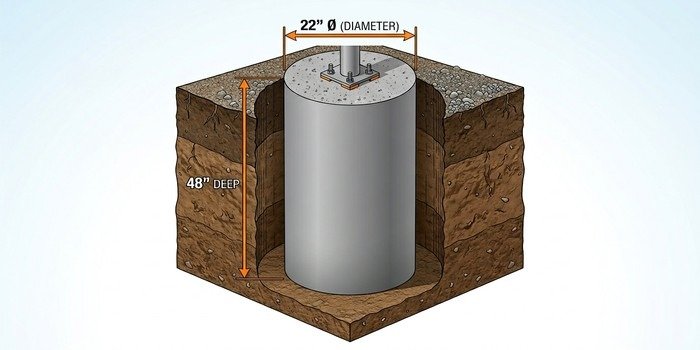
A 22" diameter Sonotube poured 48" deep is a narrow cylinder footing often used as an isolated support for a deck post, pergola column, or small sign post. This page treats the pour as a single round footing and gives the exact volumes and bag counts for that exact size.
Expect a shallow excavation down to 48" and a small-volume concrete pour. Use the exact numbers below for ordering, then add reinforcement or change dimensions to suit load and soil. Keep soil-bearing and load needs in mind before finalizing size or reinforcement.
Quick Answer
Exact volume: 10.5592 cubic feet (0.3911 cubic yards).
Planning with 10% waste: 11.6151 cubic feet (0.4302 cubic yards). Exact bag counts for the single footing are 36 40-lb bags, 24 60-lb bags, or 18 80-lb bags. Planning bag counts with 10% waste are 39 40-lb bags, 26 60-lb bags, or 20 80-lb bags.
Need a custom estimate? Use the Footing Calculator, try the concrete estimator for any pour, or browse footing size pages. All project pages.
How to Use This Footing Estimate
Quick steps to estimate and plan for this 22" × 48" round footing.
- Measure the finished diameter and depth (22" diameter × 48" deep). Use the tube form diameter as your pouring diameter.
- Confirm the calculated volume (10.5592 cu ft / 0.3911 yd3) matches your layout.
- Add a 10% waste allowance for mixing losses and small overfills.
- Decide between bagged concrete for a single footing or ready-mix for multiple footings based on total yardage.
- Multiply quantities by the number of footings and round up bag counts to the next whole bag.
- Order a little extra if you expect slumping, thick reinforcement, or uneven forms.
Formula
Use this round footing formula:
Volume (ft³) = π × Radius (ft) × Radius (ft) × Depth (ft)
3.1416 × 0.92 × 0.92 × 4 = 10.56 ft³
10.56 ÷ 27 = 0.39 yd³
If you add a 10% waste allowance, you should plan closer to 0.43 cubic yards.
Worked Example
Single-footing example — before waste: 10.5592 cu ft (0.3911 yd3). With 10% waste: 11.6151 cu ft (0.4302 yd3). Bag counts: exact = 36 40-lb / 24 60-lb / 18 80-lb; with waste = 39 40-lb / 26 60-lb / 20 80-lb.
Multiple-footing example (4 footings) — before waste: 42.2368 cu ft (1.5644 yd3). With 10% waste: 46.4604 cu ft (1.7208 yd3). Bags for 4 footings: exact = 144 40-lb / 96 60-lb / 72 80-lb; with waste = 156 40-lb / 104 60-lb / 80 80-lb.
Bag Count Estimate
- 20 bags of 80 lb concrete mix
- 26 bags of 60 lb concrete mix
- 39 bags of 40 lb concrete mix
Always verify the actual yield on the product label before buying materials.
Bag Counts by Waste Buffer for 22" diameter × 48" deep
Pick a buffer based on site conditions: clean forms and accurate measurements can run leaner; rough subgrade or hard-to-reach pours need more cushion.
| Buffer | Volume (ft³) | 80 lb bags | 60 lb bags | 40 lb bags |
|---|---|---|---|---|
| No buffer | 10.56 | 18 | 24 | 36 |
| +5% typical DIY | 11.09 | 19 | 25 | 37 |
| +10% recommended | 11.62 | 20 | 26 | 39 |
| +15% rough conditions | 12.14 | 21 | 27 | 41 |
When Bagged Concrete vs Ready-Mix Makes Sense
For a single 22" × 48" footing the pour is small (0.3911 yd3), so mixing with bags of concrete mix is often the simpler option: you can buy the 39 40-lb bags (planning) and mix on-site without a truck. Bagged concrete also lets you control the amount you actually use for a single pier.
If you're doing multiple footings, the volumes add up quickly. Four footings are about 1.5644 yd3 before waste, which is over a cubic yard; at that point a short ready-mix delivery can be more efficient and faster than mixing many bags. Choose ready-mix when the total yardage and continuous pour timing make sense for the layout.
Common Uses for This Footing Size
This 22" diameter × 48" deep round footing fits narrow, isolated supports: pergola and gazebo posts, deck posts in a close-span layout, sign posts, or freestanding columns where the footprint must be small. The narrow tube form keeps the pour volume low while centering bearing under a single vertical load.
Limits depend on the imposed load, soil bearing capacity at the site, frost depth, and required reinforcement. Heavier loads, poor soils, deep frost, or seismic requirements can push you to a wider footing or added reinforcement; evaluate those conditions before finalizing the size or reinforcement plan.
Common Mistakes to Avoid
Common estimating and planning mistakes for this footing size.
- Forgetting to add the 10% waste and ordering exactly the calculated volume.
- Using the outside tube diameter instead of the actual poured diameter when calculating volume.
- Confusing depth of excavation with finished concrete depth.
- Relying on a single bag-size conversion without checking all bag options.
- Not accounting for space taken by thick reinforcement or anchor hardware.
- Ordering ready-mix for a single small pour and paying for more truck time than needed.
Frequently Asked Questions
What is the exact concrete volume for a 22-inch round footing 48 inches deep?
The exact volume is 10.5592 cubic feet, which is 0.3911 cubic yards.
How many bags of concrete will I need for this footing?
Exact counts are 36 40-lb bags, 24 60-lb bags, or 18 80-lb bags for the single footing; with a 10% waste allowance plan on 39 40-lb, 26 60-lb, or 20 80-lb bags.
Why include a 10% waste allowance for this small footing?
The 10% covers mixing loss, small over-pours, and rounding up bag counts; it prevents coming up short when working with a narrow tube form.
Is a 22" × 48" footing adequate for a deck or pergola post?
It may work in some cases for a deck or pergola post, but adequacy depends on the post load, soil bearing, frost depth, and reinforcement requirements; assess those factors before relying on this size.
Keep Planning Your Concrete Project
Use the calculator, compare more footing pages, and review your estimate before buying materials.
Disclaimer: This page provides planning estimates only. Actual concrete needs vary with excavation accuracy, site conditions, local code requirements, bag yield, and supplier guidance. Always verify measurements before buying materials, and consult a qualified professional for structural or code-sensitive work.