
How Much Concrete for an 8-Inch Round Footing 48 Inches Deep?
8″ diameter × 48″ deep round footing: 1.3963 ft³ (0.0517 yd³), exact bag estimates and a 10% planning example.
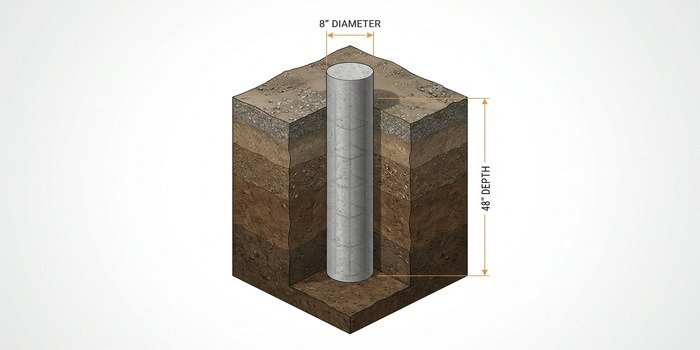
A 8″ diameter × 48″ deep round footing holds 1.3963 ft³ (0.0517 yd³) of concrete before a placement allowance. Its circular plan area is 0.3491 ft². The quantity is calculated as a straight cylinder, not as a square excavation or a bell-shaped footing.
The 8″ circular opening is narrow, but its small diameter should never be treated as proof that it can support a post. At 48 inches, utility locating, excavation safety, access, and the approved bearing elevation are especially important; a deeper hole is not automatically a better footing. The page estimates material for the dimensions shown; soil bearing, supported loads, reinforcement, frost exposure, and post anchorage are separate design checks. If the actual pier has a widened base or concrete above the stated depth, calculate that additional geometry separately.
Quick Answer
One 8″ diameter × 48″ deep round footing: 1.3963 ft³ (0.0517 yd³) before waste. With a 10% example allowance, the planned volume is 1.5359 ft³ (0.0569 yd³). The appropriate allowance depends on the actual form, excavation and placement conditions.
Base quantities: 5 × 40 lb, 4 × 60 lb, or 3 × 80 lb bags. With 10% extra volume: 6 × 40 lb, 4 × 60 lb, or 3 × 80 lb bags. The calculation assumes mixed yields of 0.30/0.45/0.60 ft³ for 40/60/80 lb bags; check your exact product label.
Need a custom estimate? Use the Footing Calculator, try the concrete yardage calculator for any pour, or browse footing size pages. All project pages.
How to Use This Footing Estimate
Use this sequence to estimate material for the 8″ diameter × 48″ deep geometry. It is not a structural design or a permit guide.
- Check the specified footing: verify that a 8″-diameter, 48″-deep cylinder is shown on the approved plan. Confirm design load, soil bearing, frost exposure, utilities, and the required base elevation. Plan safe excavation and access procedures appropriate to the soil and hole depth.
- Measure the form and cavity: measure the clear inside diameter and actual concrete-filled height. A flared base, irregular excavation, or raised pier extension adds volume beyond the simple cylinder.
- Calculate the concrete volume: use π × radius² × depth, with units converted consistently. This footing needs 1.3963 ft³ before waste; a 10% example makes 1.5359 ft³.
- Combine multiple locations: for 4 identical cylinders, sum the concrete volumes first. The combined amount with 10% extra is 6.1436 ft³, equivalent to 21 × 40 lb, 14 × 60 lb, or 11 × 80 lb bags.
- Plan material handling: one footing with 10% extra needs 3 80 lb bags (approximately 240 lb dry). Check access, form bracing, water, mixing rate, and ready-mix availability.
- Place and cure per the design: follow the engineer or local building requirements for preparation, reinforcement, embeds, placement, and consolidation, and the manufacturer’s instructions for mixing and curing.
Formula
Cylindrical footing formula: V = π × radius² × depth. Using inches directly, V (ft³) = 3.1416 × (diameter in inches ÷ 2)² × depth in inches ÷ 1,728.
For this 8″ × 48″ footing: 3.1416 × (8 ÷ 2)² × 48 ÷ 1,728 = 1.3963 ft³. Divide the unrounded result by 27 to obtain 0.0517 yd³. The radius is half the diameter; no radius value is rounded before squaring.
10% example: original volume × 1.10 = 1.5359 ft³ (0.0569 yd³). Apply the extra percentage to cubic feet before converting to whole bags—do not multiply an already-rounded bag count by 1.10.
Worked Example
One 8″ diameter × 48″ deep footing: base volume 1.3963 ft³ (0.0517 yd³). A 10% allowance gives 1.5359 ft³ (0.0569 yd³), requiring 6 × 40 lb, 4 × 60 lb, or 3 × 80 lb bags on the assumed yields.
4 identical round footings: 4 × the unrounded single-pier volume = 5.5851 ft³ (0.2069 yd³). Allow 10% on the combined volume to reach 6.1436 ft³ (0.2275 yd³), then round up once: 21 × 40 lb, 14 × 60 lb, or 11 × 80 lb bags. These totals can differ from multiplying individually rounded bag counts by 4.
Bag Count Estimate
- 3 bags of 80 lb concrete mix
- 4 bags of 60 lb concrete mix
- 6 bags of 40 lb concrete mix
Always verify the actual yield on the product label before buying materials.
Bag Counts by Waste Buffer for 8" diameter × 48" deep
These buffers are examples, not a universal recommendation. The right percentage depends on excavation accuracy, how precisely you measured, soil and ground conditions, and placement losses such as spillage or over-dig. This page uses 10% as its own planning figure.
| Buffer | Volume (ft³) | 80 lb bags | 60 lb bags | 40 lb bags |
|---|---|---|---|---|
| No buffer | 1.4 | 3 | 4 | 5 |
| +5% example | 1.47 | 3 | 4 | 5 |
| +10% example | 1.54 | 3 | 4 | 6 |
| +15% example | 1.61 | 3 | 4 | 6 |
When Bagged Concrete vs Ready-Mix Makes Sense
For one 8″ diameter × 48″ deep cylinder, the 10% example calls for 3 × 80 lb bags (240 lb of dry material). Bagged mix is a possible option for a single isolated pier if you can maintain a consistent placement and follow the approved construction details.
For 4 identical footings, the combined 10%-adjusted volume is 0.2275 yd³ and the one-time rounded bag requirement is 11 bags of 80 lb mix. Ask suppliers about minimum loads, short-load charges, delivery scheduling, form access, and any need for pumping. Concrete volume and bag weight do not establish the bearing capacity of the foundation.
Common Uses for This Footing Size
The 8″-diameter form is a relatively narrow round column. It can be used as a measurement reference for an isolated post or pier cavity only when that diameter is actually specified; this page does not establish that such a narrow base is suitable for a deck, pergola, fence, or sign post.
This 8″ diameter × 48″ deep cylinder has 0.3491 ft² of circular area and requires 1.3963 ft³ of concrete before waste. At an unchanged diameter, 48 inches of concrete height doubles the volume of a 24-inch cylinder. Verify the intended filled height, excavation stability, and bearing elevation. If the design includes a flared base, bell, enlargement, or above-grade extension, include those separately. Soil conditions, frost requirements, structural loads, reinforcement and anchors require project-specific verification.
Common Mistakes to Avoid
Avoid these calculation and site-planning errors for the 8″ diameter × 48″ deep circular footing:
- Using 8″ as the radius rather than the diameter; the actual radius is 8/2 = 4″.
- Treating a 8″-diameter round hole like a 8″ × 8″ square excavation, which produces a different volume.
- Calculating bags from a rounded 0.05 yd³ display rather than from the full-precision cylinder volume.
- Adding a waste percentage to already-rounded whole bags rather than to concrete volume before bag rounding.
- Assuming a tube form or a straight hole includes the volume of a bell-shaped base or above-grade extension.
- Overlooking buried services and excavation stability when working with a 48-inch-deep footing cavity.
- Failing to verify the actual mix yield, water instructions, form setup and placement continuity for multiple small batches.
Frequently Asked Questions
How much concrete does a 8-inch round footing 48 inches deep need?
A straight cylinder 8 inches in diameter and 48 inches deep contains 1.3963 ft³ (0.0517 yd³) before waste. A 10% planning example is 1.5359 ft³ (0.0569 yd³). Add any bell, flared base or extension separately.
How many 40, 60 or 80 lb bags are needed for a 8″ × 48″ round footing?
Before waste, allow 5 of the 40 lb bags, 4 of the 60 lb bags, or 3 of the 80 lb bags. With 10% extra concrete volume, those totals are 6, 4, and 3 respectively. Assumed bag yields are 0.30, 0.45 and 0.60 ft³; use the yield stated on the actual bag.
Does a 48-inch-deep 8-inch round footing use twice as much concrete as one 24 inches deep?
Yes. With diameter held at 8 inches, a 24-inch-deep cylinder contains 0.6981 ft³, while the 48-inch version contains 1.3963 ft³. This describes concrete quantity only, not which depth is appropriate for frost, soil or structural loads.
Is a 8-inch-diameter, 48-inch-deep round footing enough for a deck or pergola post?
It cannot be confirmed from diameter, depth, or bag count alone. The load, soil bearing, frost depth, reinforcement, post anchorage and local code requirements must be checked against the approved plan. This page estimates concrete volume only, not structural adequacy.
Keep Planning Your Concrete Project
Use the calculator, compare more footing pages, and review your estimate before buying materials.
Disclaimer: This page provides planning estimates only. Actual concrete needs vary with excavation accuracy, site conditions, local code requirements, bag yield, and supplier guidance. Always verify measurements before buying materials, and consult a qualified professional for structural or code-sensitive work.