
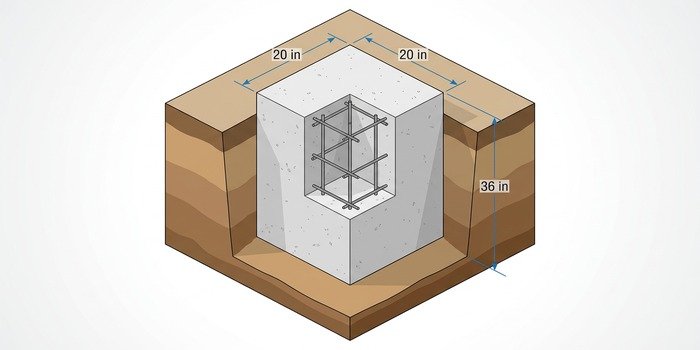
How Much Concrete for a 20x20x36 Footing?
Concrete requirements for a 20" x 20" x 36" square footing — cubic feet, cubic yards, and bag planning counts.
Get the exact quantities for a 20" × 20" × 36" footing: 8.3333 cu ft (0.3086 yd³), 10% waste planning, and recommended bag counts for a small poured footing.
This 20" × 20" × 36" (1.6667 ft × 1.6667 ft × 3 ft) square footing is often used for single-column supports, small porch posts, and similar point loads where a compact, deep footing is required. The shape and 36" depth make it useful where deeper bearing or frost considerations matter more than a wide spread.
Before you pour, check with your local building department about required depth, reinforcement, and any permit or inspection needs for this footing size. Local rules and soil-bearing values determine whether this footing is acceptable for your project and whether additional measures are needed.
Quick Answer
Exact volume for the 20" × 20" × 36" footing is 8.3333 cubic feet, which equals 0.3086 cubic yards. Allowing the default 10% waste increases the planning volume to 9.1666 cubic feet (0.3395 cubic yards).
For planning, expect to buy about 31 40-lb bags, 21 60-lb bags, or 16 80-lb bags to cover the footing with waste. The exact counts (no waste) are 28 40-lb, 19 60-lb, or 14 80-lb bags.
Need a custom estimate? Use the Footing Calculator, try the concrete yardage calculator for any pour, or browse footing size pages. All project pages.
How to Use This Footing Estimate
Steps to prepare and pour a 20" × 20" × 36" footing:
- Confirm footing location and depth with layout stakes and locate any underground utilities before digging.
- Excavate to a clean, firm base and compact the bottom; add a few inches of gravel if drainage and bearing need improvement.
- Place any required formwork and reinforcement (rebar or mesh) per engineering or building department instructions.
- Mix or order concrete to the planning volume: 9.1666 cu ft (0.3395 yd³) including 10% waste, then place and consolidate the concrete around reinforcement.
- Level, screed, and finish the top; protect the pour and cure according to the mix instructions and local requirements.
Formula
The basic formula for a rectangular footing is length × width × depth to get cubic feet, then divide by 27 to convert to cubic yards. Using the supplied dimensions in feet: 1.6667 ft × 1.6667 ft × 3 ft gives the cubic-foot volume.
Using the numbers above: 1.6667 × 1.6667 = 2.7778 square feet of area. Multiply area × depth: 2.7778 × 3 = 8.3333 cubic feet. Convert to cubic yards by dividing by 27: 8.3333 ÷ 27 = 0.3086 cubic yards.
To plan for waste and small adjustments, multiply the cubic-foot volume by 1.10 (10% waste): 8.3333 × 1.10 = 9.1666 cubic feet, which is 0.3395 cubic yards. Bag counts are then derived from that planning volume to ensure you have a bit extra on site.
Worked Example
Single-footing example: this footing requires 8.3333 cubic feet (0.3086 cubic yards) of concrete. With 10% waste plan for 9.1666 cubic feet (0.3395 cubic yards), which corresponds to about 31 40-lb bags, 21 60-lb bags, or 16 80-lb bags.
Multiple-footing example: if you need three identical 20" × 20" × 36" footings, total volume is 3 × 8.3333 = 24.9999 cubic feet. Converted to yards that is 24.9999 ÷ 27 = 0.9259 cubic yards. With 10% waste plan for 27.49989 cubic feet (1.0185 cubic yards) and multiply the planning bag counts by 3 (about 93 40-lb bags, 63 60-lb bags, or 48 80-lb bags).
Bag Count Estimate
- 16 bags of 80 lb concrete mix
- 21 bags of 60 lb concrete mix
- 31 bags of 40 lb concrete mix
Always verify the actual yield on the product label before buying materials.
Bag Counts by Waste Buffer for 20" x 20" x 36"
Pick a buffer based on site conditions: clean forms and accurate measurements can run leaner; rough subgrade or hard-to-reach pours need more cushion.
| Buffer | Volume (ft³) | 80 lb bags | 60 lb bags | 40 lb bags |
|---|---|---|---|---|
| No buffer | 8.33 | 14 | 19 | 28 |
| +5% typical DIY | 8.75 | 15 | 20 | 30 |
| +10% recommended | 9.17 | 16 | 21 | 31 |
| +15% rough conditions | 9.58 | 16 | 22 | 32 |
When Bagged Concrete vs Ready-Mix Makes Sense
For a single 20" × 20" × 36" footing the planning volume is only 0.3395 cubic yards. That small amount makes bagged concrete practical if you have the tools and labor to mix on-site. Bagged concrete gives granular control: you bring exactly the number of bags needed for the planning volume (for example, about 31 40-lb bags) and mix in manageable batches.
Ready-mix is faster on the pour but often has minimum-delivery quantities and truck fees that can make it expensive for less than a third of a cubic yard. If you choose ready-mix, plan for the delivery minimums and discuss short-load options with suppliers so you don’t pay for more concrete than you can place.
Common Uses for This Footing Size
A 20x20x36 footing is commonly used for supporting deck posts, pergola posts, fence posts, or small porch columns. Its size fits well for single-point supports where the load is relatively light, such as backyard structures or small additions. This footing can help keep posts stable and anchored in place, especially when the posts are spaced apart and not carrying heavy weight.
Whether this footing size is suitable depends on several factors like the weight it needs to hold, the type of soil at the site, how deep the frost line is in your area, and if any reinforcement is needed. Local building codes may also have specific requirements, so it’s important to consider all these aspects before deciding on footing dimensions.
Common Mistakes to Avoid
Avoid these common errors when planning a small footing pour:
- Ordering exactly 8.3333 cu ft and skipping waste—always add about 10% for spillage and adjustments.
- Failing to confirm required reinforcement and relying only on plain concrete where rebar is needed.
- Neglecting to compact and level the footing base before placing concrete.
- Mixing batches with inconsistent water content, which weakens the final concrete.
- Assuming ready-mix will be economical without checking minimum delivery sizes and fees.
- Not checking with the local building department about depth, embedment, or inspection requirements before pouring.
Frequently Asked Questions
What is the concrete volume for a single 20" × 20" × 36" footing?
The exact volume is 8.3333 cubic feet, which is 0.3086 cubic yards. With a 10% allowance for waste plan on 9.1666 cubic feet (0.3395 cubic yards).
How many bags of concrete mix do I need for this footing?
Exact bag counts (no waste) are 28 40-lb, 19 60-lb, or 14 80-lb bags. For planning with 10% waste buy about 31 40-lb, 21 60-lb, or 16 80-lb bags.
Why add 10% waste and how is it applied?
A 10% waste factor covers over-excavation, spillage, uneven forms, and slight measurement differences. Multiply the exact volume by 1.10 (8.3333 × 1.10 = 9.1666 cu ft) and use that planning volume to calculate bag counts or order size.
Is this footing size adequate for a deck post?
It depends. Adequacy hinges on the applied loads, soil-bearing capacity, reinforcement, frost depth, and local building department requirements. Confirm required bearing area and depth with a structural designer or the building department before relying on this footing for deck support.
Keep Planning Your Concrete Project
Use the calculator, compare footing pages, and keep your estimate practical before you buy materials.
Disclaimer: This page provides planning estimates only. Actual concrete needs vary with excavation accuracy, site conditions, local code requirements, bag yield, and supplier guidance. Always verify measurements before buying materials, and consult a qualified professional for structural or code-sensitive work.