
How Much Concrete for an 18x18x24 Footing?
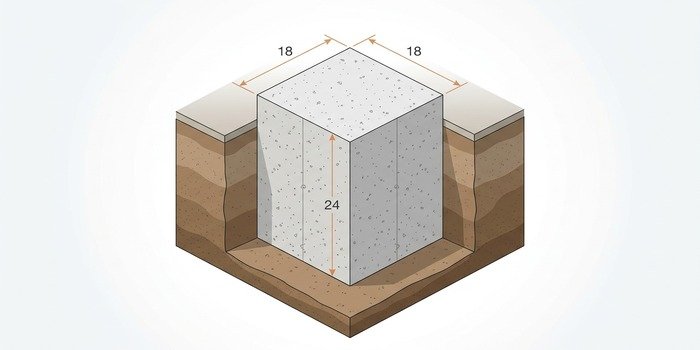
Materials and quantities for an 18" x 18" x 24" square footing — 4.5 cu ft (0.1667 yd³) and bag planning counts
Find the exact concrete volume and recommended purchase counts for an 18" x 18" x 24" footing: 4.5 cu ft (0.1667 yd³) core volume, plus 10% waste and bag vs ready-mix guidance.
If you're buying materials, start here: an 18" x 18" x 24" square footing uses 4.5 cubic feet of concrete. That translates to a small, manageable amount for bagged concrete — plan on 17 40-lb bags, 11 60-lb bags, or 9 80-lb bags when you include a typical 10% waste allowance.
Before you pour, have someone qualified review the footing for the loads it will carry and the local soil and code requirements. Depending on loads, reinforcement needs, and frost-depth rules, a 24-inch depth may be suitable where local frost-depth requirements align, but a structural review is the safe next step.
Quick Answer
Exact concrete volume for an 18" x 18" x 24" footing is 4.5 cubic feet, which is 0.1667 cubic yards. With a 10% waste allowance, plan on 4.95 cubic feet (0.1834 cubic yards).
For purchasing, use the waste-adjusted planning counts: 17 40-lb bags, 11 60-lb bags, or 9 80-lb bags. The exact bag counts before waste are 15 40-lb bags, 10 60-lb bags, and 8 80-lb bags.
Need a custom estimate? Use the Footing Calculator, try the concrete yardage calculator for any pour, or browse footing size pages. All project pages.
How to Use This Footing Estimate
Quick process to go from measurement to a poured footing:
- Confirm dimensions: 18" × 18" footprint and 24" deep.
- Calculate volume (area × depth) and convert to cubic yards or use the planning numbers.
- Add 10% for waste and small overages.
- Decide bags versus ready-mix and buy the planning quantity of bags or order the required yardage.
- Prepare formwork and reinforcement per engineer or code, mix or receive concrete, place and consolidate the concrete.
- Finish, cover, and cure the footing for the recommended time before applying load.
Formula
The math uses three simple steps: compute the footing area, multiply by depth to get cubic feet, then divide by 27 to get cubic yards. For a square footing the area is length × width.
Area = 1.5 ft × 1.5 ft = 2.25 sq ft. Multiply by depth: Volume = 2.25 sq ft × 2 ft = 4.5 cubic feet. Convert to cubic yards: 4.5 cu ft ÷ 27 = 0.1667 cubic yards.
To allow for waste, multiply by 1.10 (10%): 4.5 cu ft × 1.10 = 4.95 cu ft, which is 4.95 ÷ 27 = 0.1834 cubic yards. Use those planning numbers when ordering bags or estimating a ready-mix delivery.
Worked Example
Single footing example: this one footing needs 4.5 cu ft (0.1667 yd³) of concrete. With 10% waste expect to purchase 4.95 cu ft (0.1834 yd³). If you choose bagged concrete, that means buying 17 40-lb bags (planning number), 11 60-lb bags, or 9 80-lb bags.
Multiple-footing example: three identical footings require a total of 13.5 cu ft of concrete, which is 0.5 cubic yards. With 10% waste the total is 14.85 cu ft, or 0.55 cubic yards. For bags, multiply the planning bag counts by three: 51 40-lb bags, 33 60-lb bags, or 27 80-lb bags.
Bag Count Estimate
- 9 bags of 80 lb concrete mix
- 11 bags of 60 lb concrete mix
- 17 bags of 40 lb concrete mix
Always verify the actual yield on the product label before buying materials.
Bag Counts by Waste Buffer for 18" x 18" x 24"
Pick a buffer based on site conditions: clean forms and accurate measurements can run leaner; rough subgrade or hard-to-reach pours need more cushion.
| Buffer | Volume (ft³) | 80 lb bags | 60 lb bags | 40 lb bags |
|---|---|---|---|---|
| No buffer | 4.5 | 8 | 10 | 15 |
| +5% typical DIY | 4.73 | 8 | 11 | 16 |
| +10% recommended | 4.95 | 9 | 11 | 17 |
| +15% rough conditions | 5.18 | 9 | 12 | 18 |
When Bagged Concrete vs Ready-Mix Makes Sense
For a single 18" × 18" × 24" footing, bagged concrete is often the easiest choice. It lets you buy only what you need, store it easily, and mix in a wheelbarrow or portable mixer. The planning counts make shopping straightforward: 17 40-lb bags, 11 60-lb bags, or 9 80-lb bags with the 10% allowance.
If you have multiple footings or want a faster, more consistent pour, ready-mix can save labor and produce more consistent slump and strength. Check with the concrete plant about minimum delivery volumes and timing — some plants have small-order limits. For three or more footings, ready-mix often becomes more practical despite short delivery minimums because it eliminates multiple mixing and wheelbarrow loads.
Common Uses for This Footing Size
An 18x18x24 footing is commonly used for supporting deck posts, pergola posts, fence posts, and small porch columns. Its size fits well for single-point supports in residential projects where loads are relatively light. This footing can help anchor structures that don’t carry heavy weight but still need a solid base to prevent shifting or settling over time.
Whether this footing size is suitable depends on factors like the weight of the structure it supports, soil conditions, frost line depth, and if any reinforcement is needed. Local building codes may also have specific requirements. It’s important to consider these aspects before deciding if this footing dimension will work for your project.
Common Mistakes to Avoid
Common mistakes to avoid when planning and pouring this footing size:
- Underordering: not accounting for the 10% waste allowance.
- Incorrect unit conversion between cubic feet and cubic yards.
- Buying exact bag counts and not adding extra for minor spillage or uneven subgrade.
- Skipping a structural review for load and reinforcement needs.
- Ordering ready-mix without confirming plant minimums and delivery timing.
- Poor consolidation or finishing that leaves voids or weak spots.
Frequently Asked Questions
How much concrete do I need for an 18x18x24 footing?
The exact volume is 4.5 cubic feet (0.1667 cubic yards). With a 10% waste allowance plan on 4.95 cubic feet (0.1834 cubic yards).
How many 60-lb bags of concrete do I need?
Plan to buy 11 60-lb bags when you include a 10% waste allowance. The exact count before waste is 10 60-lb bags.
Why should I add 10% waste to the calculated volume?
Adding about 10% covers small measurement errors, spillage, uneven subgrade, and the extra needed for finishing and consolidation. It helps avoid a shortfall while pouring.
Is this footing size adequate for a deck post?
It depends on the post load, ledger and beam arrangement, soil bearing capacity, and local code requirements. A 24-inch depth may be suitable where that depth meets local frost-depth rules, but have loads and site conditions reviewed by a qualified professional before relying on this footing for a deck post.
Keep Planning Your Concrete Project
Use the calculator, compare footing pages, and keep your estimate practical before you buy materials.
Disclaimer: This page provides planning estimates only. Actual concrete needs vary with excavation accuracy, site conditions, local code requirements, bag yield, and supplier guidance. Always verify measurements before buying materials, and consult a qualified professional for structural or code-sensitive work.