
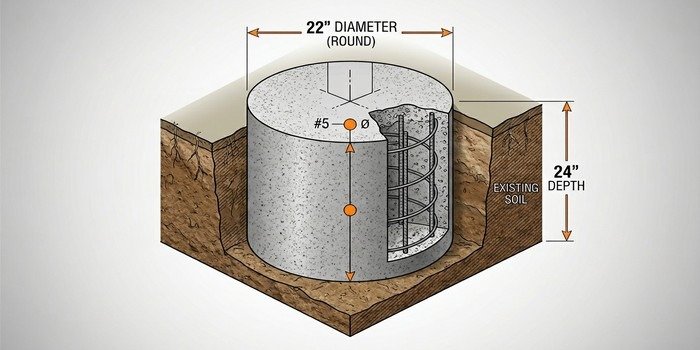
How Much Concrete for a 22-Inch Round Footing 24 Inches Deep?
Material takeoff for a 22" diameter × 24" deep round footing: cu ft, cu yd, and bag counts
Exact and planning quantities for a 22-inch diameter by 24-inch deep round footing: 5.2796 cu ft (0.1955 yd³), exact bag counts, and 10% waste-adjusted ordering numbers.
Start with the concrete amount. This is a narrow, tube-form round footing 22" diameter × 24" deep that needs about 5.2796 cubic feet of concrete for one pour.
That volume usually translates to a small number of bags. You’ll also want to note the 24" excavation depth and consider reinforcement and soil conditions before finalizing quantities. Order the planning counts if you want a simple buffer on the day of the pour.
Quick Answer
Exact volume: 5.2796 cubic feet (about 0.1955 cubic yards). Exact bag counts: 18 40‑lb bags, 12 60‑lb bags, or 9 80‑lb bags.
With a 10% waste allowance plan on 5.8076 cubic feet (≈ 0.2151 cubic yards) which equals about 20 40‑lb bags, 13 60‑lb bags, or 10 80‑lb bags for one footing.
Need a custom estimate? Use the Footing Calculator, try the concrete yardage calculator for any pour, or browse footing size pages. All project pages.
How to Use This Footing Estimate
Quick steps to estimate and plan for this 22" × 24" footing.
- Confirm the diameter (22") and depth (24") at the site before buying materials.
- Use the given volume (5.2796 cu ft) to compare bag counts or ready-mix tickets.
- Add a waste allowance — 10% is used here — and round up to whole bags.
- Decide between bags of concrete mix for a single footing or ready-mix when doing several at once.
- If ordering multiple footings, multiply the exact and planning numbers by the number of footings before purchasing.
- Keep a small extra supply on hand for minor adjustments or spillage.
Formula
Use this round footing formula:
Volume (ft³) = π × Radius (ft) × Radius (ft) × Depth (ft)
3.1416 × 0.92 × 0.92 × 2 = 5.28 ft³
5.28 ÷ 27 = 0.2 yd³
If you add a 10% waste allowance, you should plan closer to 0.22 cubic yards.
Worked Example
Single footing: exact volume is 5.2796 cu ft (0.1955 yd³). Exact bag counts are 18 40‑lb, 12 60‑lb, or 9 80‑lb. With 10% waste the planning volume is 5.8076 cu ft (0.2151 yd³) and the planning bags are 20 40‑lb, 13 60‑lb, or 10 80‑lb.
Multiple footings example (4 footings): total exact volume = 21.1184 cu ft (0.7820 yd³) and total exact bags = 72 40‑lb, 48 60‑lb, or 36 80‑lb. With 10% waste total planning volume = 23.2304 cu ft (0.8604 yd³) and planning bags = 80 40‑lb, 52 60‑lb, or 40 80‑lb.
Bag Count Estimate
- 10 bags of 80 lb concrete mix
- 13 bags of 60 lb concrete mix
- 20 bags of 40 lb concrete mix
Always verify the actual yield on the product label before buying materials.
Bag Counts by Waste Buffer for 22" diameter × 24" deep
Pick a buffer based on site conditions: clean forms and accurate measurements can run leaner; rough subgrade or hard-to-reach pours need more cushion.
| Buffer | Volume (ft³) | 80 lb bags | 60 lb bags | 40 lb bags |
|---|---|---|---|---|
| No buffer | 5.28 | 9 | 12 | 18 |
| +5% typical DIY | 5.54 | 10 | 13 | 19 |
| +10% recommended | 5.81 | 10 | 13 | 20 |
| +15% rough conditions | 6.07 | 11 | 14 | 21 |
When Bagged Concrete vs Ready-Mix Makes Sense
For one 22"×24" footing, bagged concrete is usually the simpler option: you’re dealing with under 6 cu ft of concrete and the planning counts are 20 40‑lb bags (or 13 of the 60‑lb bags, or 10 of the 80‑lb bags). Mixing a few bags on site avoids a truck call for this small volume.
If you have several footings or need a continuous pour, ready-mix starts to make sense. Once the total yardage approaches a half to one cubic yard, a small truck or volumetric truck can be more efficient than mixing many bags.
Common Uses for This Footing Size
This 22" diameter × 24" deep round footing is often used for isolated post supports where a narrow cylindrical footing fits the layout: pergola posts, single deck posts in tight spacing, sign supports, or similar isolated columns. The small footprint works where the plan calls for a minimal ground disturbance and a focused bearing point.
Limits matter: the footing’s adequacy depends on the applied load, the soil’s bearing capacity, frost depth in your area, and whether you use reinforcement. In some cases this size may work; in others a larger diameter, deeper footing, or added reinforcement will be required to meet structural needs and permit conditions.
Common Mistakes to Avoid
Common estimating and ordering slip-ups to avoid.
- Forgetting to convert inches to feet when using the volume formula.
- Mixing up diameter and radius — use radius = 0.9167 ft here.
- Ordering exact bag counts instead of planning counts and running short on site.
- Rounding down instead of up when converting fractional yards to bags or truck loads.
- Neglecting reinforcement, voids, or sleeves that reduce concrete volume in the tube.
- Not multiplying both volume and bag counts correctly when ordering for multiple footings.
Frequently Asked Questions
How much concrete volume is in a 22-inch diameter by 24-inch deep footing?
The exact volume is 5.2796 cubic feet, which is about 0.1955 cubic yards.
How many bags of concrete mix do I need for this footing?
Exact bag counts are 18 40‑lb bags, 12 60‑lb bags, or 9 80‑lb bags. With a 10% waste allowance order 20 40‑lb, 13 60‑lb, or 10 80‑lb.
Should I add a waste allowance when ordering bags or ready-mix?
Yes. A 10% waste allowance is used here to cover spillage, small overpour, and minor measurement differences. Increase the allowance if site conditions or multiple pours make handling more variable.
Is a 22"×24" footing adequate for a deck post, pergola, or column?
It may work in some cases, especially for lighter isolated supports, but adequacy depends on load, soil bearing capacity, frost depth, and required reinforcement. Review the specific load and site conditions before finalizing footing size.
Keep Planning Your Concrete Project
Use the calculator, compare more footing pages, and review your estimate before buying materials.
Disclaimer: This page provides planning estimates only. Actual concrete needs vary with excavation accuracy, site conditions, local code requirements, bag yield, and supplier guidance. Always verify measurements before buying materials, and consult a qualified professional for structural or code-sensitive work.