
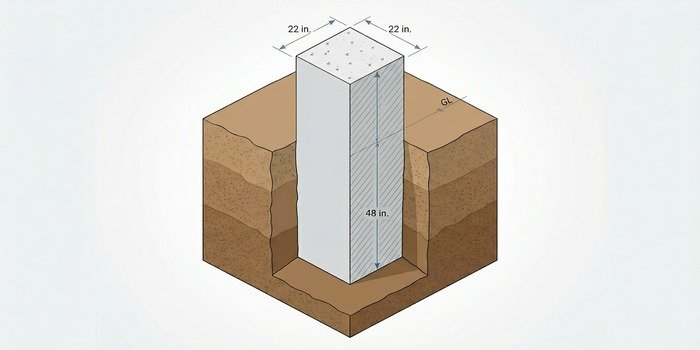
How Much Concrete for a 22x22x48 Footing?
Depth-first rundown for the 22" x 22" x 48" footing: cubic feet, cubic yards, and bag planning counts
Get exact material numbers for a 22" x 22" x 48" (48" deep) square footing: 13.4444 cu ft (0.4979 yd³) plus waste-adjusted bags and practical tips for excavation and reinforcement.
This footing is 48 inches deep — the depth will drive excavation and frost considerations more than the shallow footprint. A 22" x 22" square footing at four feet deep is typically used for isolated columns or posts where extra depth picks up bearing capacity and frost protection.
Because the depth matters here, plan excavation, shoring, and spoil handling before you start. For this exact 22" x 22" x 48" footing you’ll also want to think about rebar layout and concrete placement access since the hole is relatively narrow but deep.
Quick Answer
Exact concrete volume for a single 22" x 22" x 48" footing is 13.4444 cubic feet, which is 0.4979 cubic yards. With a standard 10% waste allowance the planning volume is 14.7888 cubic feet, or 0.5477 cubic yards.
Exact bag counts for the raw volume are 45 of the 40-lb bags, 30 of the 60-lb bags, or 23 of the 80-lb bags. For planning with 10% waste use 50 40-lb bags, 33 60-lb bags, or 25 80-lb bags.
Need a custom estimate? Use the Footing Calculator, try the concrete yardage calculator for any pour, or browse footing size pages. All project pages.
How to Use This Footing Estimate
Quick steps to pour this deep, narrow footing without surprises.
- Mark the center and layout the 22" × 22" footprint and mark 48" depth on your digging tool.
- Excavate to clean, firm soil, keeping sides as vertical as safely possible and removing loose material.
- Compact a thin gravel working pad if required, and set any required form or trench box for safety.
- Place reinforcement per design — typically a short vertical dowel cage or horizontal rebar depending on the engineer’s requirements.
- Mix and place concrete, consolidating to remove voids; finish the top for proper bearing and cure per instructions.
Formula
The basic formula is length × width × depth (all in feet) to get cubic feet, then divide by 27 to convert cubic feet to cubic yards. For this footing the dimensions in feet are 1.8333 ft × 1.8333 ft × 4 ft.
Area = 1.8333 × 1.8333 = 3.3611 square feet. Volume = 3.3611 × 4 = 13.4444 cubic feet. Cubic yards = 13.4444 ÷ 27 = 0.4979 cubic yards.
To include a 10% waste allowance multiply by 1.10: 13.4444 × 1.10 = 14.7888 cubic feet, which is 14.7888 ÷ 27 = 0.5477 cubic yards. Use the waste-adjusted volume for ordering or bag planning.
Worked Example
Single-footing example: you need concrete for one 22" × 22" × 48" footing. That is 13.4444 cubic feet (0.4979 yd³) exact, and with 10% waste plan for 14.7888 cubic feet (0.5477 yd³). That equals about 50 40-lb bags, 33 60-lb bags, or 25 80-lb bags when you include the waste allowance.
Multiple-footing example: if your project has three identical footings, total volume is 3 × 13.4444 = 40.3332 cubic feet, which converts to 1.4949 cubic yards. With 10% waste plan for 3 × 14.7888 = 44.3664 cubic feet, or 1.6431 cubic yards. That would be about 150 40-lb bags, 99 60-lb bags, or 75 80-lb bags in total.
Bag Count Estimate
- 25 bags of 80 lb concrete mix
- 33 bags of 60 lb concrete mix
- 50 bags of 40 lb concrete mix
Always verify the actual yield on the product label before buying materials.
Bag Counts by Waste Buffer for 22" x 22" x 48"
Pick a buffer based on site conditions: clean forms and accurate measurements can run leaner; rough subgrade or hard-to-reach pours need more cushion.
| Buffer | Volume (ft³) | 80 lb bags | 60 lb bags | 40 lb bags |
|---|---|---|---|---|
| No buffer | 13.44 | 23 | 30 | 45 |
| +5% typical DIY | 14.12 | 24 | 32 | 48 |
| +10% recommended | 14.79 | 25 | 33 | 50 |
| +15% rough conditions | 15.46 | 26 | 35 | 52 |
When Bagged Concrete vs Ready-Mix Makes Sense
For a single 22" × 22" × 48" footing the waste-adjusted volume is only 0.5477 cubic yards, which is below most ready-mix minimum delivery quantities. Bagged concrete is often more practical for one or two footings because you can buy exactly the number of bags and mix on site.
If you have multiple footings or other pours that push the total over about 1 cubic yard, ready-mix becomes more efficient and saves onsite mixing time. Also consider labor: 50 40-lb bags for one footing is manageable but physically demanding; three footings at 150 40-lb bags may justify a truck delivery.
Common Uses for This Footing Size
A 22x22x48 footing is commonly used for supporting posts in residential projects. You might see it under deck posts, pergola posts, fence posts, or small porch columns. Its size fits well for single-point supports where the load isn’t too heavy. This footing can help keep posts stable and anchored in the ground for structures that don’t carry major weight or large spans.
Whether this footing size works depends on several factors. The weight of what you’re supporting, soil type and bearing capacity, frost line depth in your area, and if reinforcement is needed all play a role. Local building codes may also have specific requirements for footing dimensions and placement. It’s important to consider these details before deciding on footing size for your project.
Common Mistakes to Avoid
Common pitfalls to avoid when building this deep, narrow footing.
- Underestimating excavation volume and not planning for spoil removal.
- Skipping a compacted base — soft soil at the bottom reduces bearing capacity.
- Neglecting required reinforcement or using undersized rebar for the applied loads.
- Ordering too little concrete by forgetting the 10% waste allowance.
- Mixing different bag weights or brands on the same pour without checking yield differences.
- Poor curing at the top of the footing, which can reduce long-term strength and bearing performance.
Frequently Asked Questions
How much concrete do I need for one 22" x 22" x 48" footing?
One 22" x 22" x 48" footing requires 13.4444 cubic feet of concrete, which is 0.4979 cubic yards. With a 10% waste allowance plan for 14.7888 cubic feet or 0.5477 cubic yards.
How many bags of concrete mix do I need for this footing?
Exact bag counts for the raw volume are 45 40-lb bags, 30 60-lb bags, or 23 80-lb bags. With 10% waste plan for about 50 40-lb bags, 33 60-lb bags, or 25 80-lb bags.
Why should I add 10% waste to the calculated concrete volume?
Adding about 10% accounts for spillage, overexcavation, uneven subgrade, and slight measurement errors. It ensures you have enough material on site without multiple small trips for more bags or an extra truck.
Is this footing size adequate for a deck post?
It may be suitable, but adequacy depends on applied loads, soil bearing capacity, frost-depth requirements, and any permit or design requirements from the local building department. Consider reinforcement and consult a structural professional when in doubt.
Keep Planning Your Concrete Project
Use the calculator, compare footing pages, and keep your estimate practical before you buy materials.
Disclaimer: This page provides planning estimates only. Actual concrete needs vary with excavation accuracy, site conditions, local code requirements, bag yield, and supplier guidance. Always verify measurements before buying materials, and consult a qualified professional for structural or code-sensitive work.