
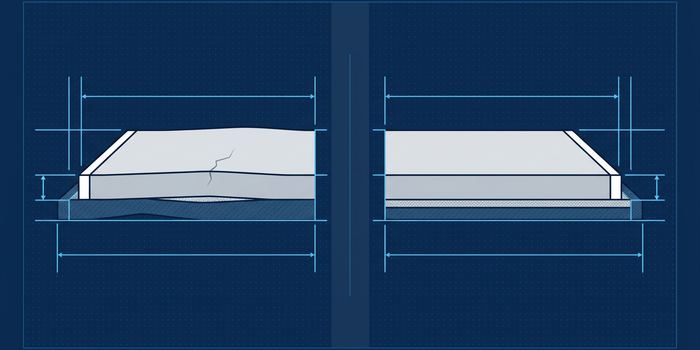
Most concrete slab failures don’t happen when the concrete hardens—they happen before concrete ever arrives. Poor measurement leads to ordering the wrong volume. Inadequate base preparation creates settlement and cracking. Weak forms blow out under concrete pressure. Missing control joints guarantee random cracks in the worst possible locations. And ignoring weather conditions compromises surface quality no amount of finishing skill can fix.
These mistakes are completely preventable. They don’t require specialized knowledge or expensive equipment—just attention to details that matter and willingness to do basic preparation properly. The difference between a slab that performs well for decades and one that cracks within months often comes down to a few critical decisions made before concrete touches the forms.
This guide walks through the most common concrete slab mistakes in order of how often they occur and how much damage they cause. You’ll learn what actually goes wrong, how to recognize problems before they become permanent, and practical steps to avoid each mistake on your project.
Quick Answer
The five mistakes that cause the most slab problems:
- Measuring outside forms instead of inside: Inflates area calculations and leads to over-ordering concrete. Always measure where concrete actually goes, not the outer perimeter including form boards.
- Poor base preparation: Loose, uncompacted base settles unevenly under the slab’s weight, causing cracks and surface problems. Proper compaction prevents most settlement issues.
- Weak or poorly braced forms: Concrete pressure pushes forms outward, creating bulges, uneven thickness, or complete blowouts. Adequate staking and bracing keeps forms in position.
- Missing or poorly planned control joints: Concrete shrinks as it cures. Without joints to control where cracks form, you get random cracks in visible locations. Joints guide cracks to planned lines.
- Ignoring weather conditions: Hot sun and wind cause rapid surface drying that weakens concrete. Rain during finishing damages the surface. Temperature extremes create placement and curing problems.
If you only do three things right:
1️⃣
Compact the base thoroughly
2️⃣
Build strong, braced forms
3️⃣
Plan control joints before pouring
Start With Accurate Planning
Browse pre-calculated concrete needs for common slab sizes or calculate your custom dimensions.
Measuring Mistakes (Volume and Dimensions)
Measuring Outside Forms Instead of Inside
This is the most common measurement error and it’s easy to make. Form boards have thickness—typically 1.5 inches for dimensional lumber. When you measure the outside perimeter of your forms, you’re including that board thickness in your dimensions. This inflates your area calculation by several percent, leading to over-ordering concrete.
The fix is simple but requires conscious attention: always measure the inside face of forms. This is where concrete actually goes. Place your tape measure against the inner surface and measure from inside edge to inside edge. Ignore the form boards completely when calculating area—they’re just temporary containers, not part of the slab.
This mistake compounds on rectangular slabs. If you measure outside on both length and width, you’ve added form thickness to both dimensions. On a typical residential slab, this can mean ordering an extra half cubic yard or more—concrete you don’t need and money wasted.
Forgetting Unit Conversion (Inches vs Feet)
Multiplying square feet by thickness in inches without converting units produces results that are wildly wrong—off by a factor of twelve. This is one of the most common calculation errors and it creates absurdly large volume estimates that should be obviously wrong but somehow get ordered anyway.
Here’s what happens: you measure a 10×10 slab (100 square feet) at 4 inches thick. If you multiply 100 × 4 directly, you get 400. But 400 what? Not cubic feet—you’ve mixed units. That calculation treats 4 inches as if it were 4 feet, giving you twelve times more volume than you actually need.
❌ Wrong calculation (mixing units):
100 sq ft × 4 inches = 400 ??? ← meaningless number
✓ Correct calculation (consistent units):
4 inches ÷ 12 = 0.33 feet
100 sq ft × 0.33 ft = 33 cubic feet
The fix is mandatory: always convert thickness to feet before multiplying by area. Divide your thickness in inches by 12. Then multiply square feet by thickness in feet to get cubic feet. Finally, divide cubic feet by 27 to get cubic yards for ordering.
Better yet, use a calculator that handles unit conversions automatically. This eliminates the conversion error completely and ensures your volume estimate makes sense. If your calculated volume seems suspiciously large, check whether you forgot to convert inches to feet—this is likely the culprit.
Confusing Total Excavation Depth With Concrete Thickness
When you dig for a slab, you excavate for base material plus concrete. Many builders measure from the bottom of their excavation up to the form tops and use that number as concrete thickness. This is wrong—it includes base depth that isn’t part of concrete volume.
Only the distance from the top of your compacted base to the finished surface counts as concrete thickness. If you excavated 8 inches deep, installed 4 inches of compacted gravel base, your concrete thickness is 4 inches—not 8 inches.
Mark a clear grade line on your forms showing where the base surface sits. Measure concrete thickness from this line up to the form top. This prevents confusion and ensures accurate volume calculations.
Ignoring Subgrade Irregularities
Assuming uniform thickness when your base has high and low spots leads to incorrect volume estimates. If your subgrade varies by an inch or two across the slab area, actual concrete thickness varies too. Low spots require more concrete than your nominal thickness suggests. High spots use less.
Walk your prepared base and look for obvious variations. Measure thickness at multiple points—all four corners, center, and anywhere that looks questionable. If you find significant variation, you have two choices: level the base better before pouring, or increase your volume estimate to account for extra depth in low areas.
This is one reason the waste buffer exists. Perfect uniform thickness across an entire slab is rare. Small variations are normal. The buffer covers these minor inconsistencies so you don’t run short.
Skipping Waste Buffer or Rounding Down
Calculated volume assumes perfect measurements and uniform conditions. Real projects have measurement uncertainties, minor base irregularities, small amounts of spillage, and concrete that sticks to tools and forms. These small losses add up.
Add a modest buffer—five to ten percent depending on confidence in your measurements and base quality. This prevents the expensive and frustrating problem of running short mid-pour.
When rounding your order, round up to the next reasonable increment your supplier offers. If you calculate 3.3 cubic yards and your supplier batches in quarter-yard units, order 3.5 yards rather than trying to hit exactly 3.25. The slight extra cost of rounding up is insurance against shortage.
Measurement Checklist (Before Calculating Volume):
- Measure inside forms only: Place tape against inner face of form boards where concrete will actually reach.
- Verify concrete thickness separately: Measure from top of compacted base to form top, not from excavation bottom.
- Check thickness at multiple points: Don’t assume uniform depth. Spot-check corners, center, and anywhere that looks irregular.
- Add waste buffer: Include 5-10% extra to cover measurement variations and minor irregularities.
- Round up intelligently: If calculated volume falls between supplier increments, round to the next higher available amount.
Base Prep & Compaction Mistakes
Insufficient Compaction
Loose, uncompacted base settles under the slab’s weight, creating the exact problems proper base preparation should prevent. Settlement happens unevenly because soil and base material compress at different rates in different locations. This differential settlement stresses the rigid concrete slab, causing cracks.
How do you know if compaction is adequate? Walk the base. It should feel solid and firm under your weight with minimal give. Footprints should barely indent the surface. If you can easily push stones around with your foot or if the surface feels spongy, you need more compaction.
Compaction isn’t something you can fix after concrete is poured. This is prevention work that must happen before placement. Use a plate compactor for anything larger than very small projects. Make multiple passes from different directions until the base shows no further densification.
Edges are particularly vulnerable. Many builders compact the field adequately but neglect perimeter areas where compaction is more difficult. Pay extra attention to slab edges—they experience higher stress and settlement here shows first.
Wrong Base Material or Inadequate Thickness
Base material should provide structural support and drainage. Good base material is angular crushed stone that compacts well and allows water to move through. Poor base material is clay soil, organic matter, or rounded stones that don’t interlock when compacted.
Base thickness depends on your soil conditions and project requirements, but the concept is universal: you need enough base material to bridge over weak spots in native soil and provide uniform support. Too thin a base doesn’t accomplish this goal.
If you’re unsure what constitutes adequate base for your soil type and slab use, consult local contractors or building officials familiar with your area. Regional practices reflect generations of experience with local soils and climate.
Ignoring Drainage
Water accumulating under a slab creates problems that are difficult to fix after construction. In freezing climates, trapped water expands during freeze-thaw cycles, lifting and cracking concrete. In all climates, water softens clay subgrades and causes erosion that creates voids beneath the slab.
Drainage planning starts with site grading. The ground should slope away from the slab in all directions, carrying water away from the perimeter rather than pooling against edges. Even gentle slopes are effective—water flows downhill given any gradient.
Your base material should allow water to percolate through rather than trapping it. This is why well-draining gravel is standard for base material. If your site has drainage challenges—high water table, clay soil, or location at the bottom of a slope—you may need more aggressive solutions like drainage pipes or deeper excavation with more permeable material.
✓ Do this instead:
- Compact base in thin lifts with a plate compactor, making multiple passes until no visible movement occurs
- Use angular crushed stone that interlocks when compacted and provides drainage
- Verify soil around slab perimeter slopes away in all directions to prevent water accumulation
- Walk the entire base before pouring and recompact any soft spots you find
Forms & Thickness Consistency
Weak or Poorly Braced Forms
Concrete is heavy and generates substantial outward pressure against forms. Weak forms bend, shift, or blow out completely under this pressure. The result is a slab with wavy edges, uneven thickness, or—in worst cases—concrete spilling outside intended boundaries.
Form strength comes from adequate material, sufficient stakes, and proper bracing. Thin or damaged form boards flex under pressure. Stakes spaced too far apart allow bowing between them. Missing braces let stakes tip outward.
The fix is methodical bracing. Drive stakes every few feet along forms. Add diagonal braces from stakes back to solid ground or across to opposite forms. Check that nothing moves when you push hard against forms. If you can deflect forms with hand pressure, concrete pressure will move them much more.
Verify form integrity the day before your pour. Walk the perimeter and inspect every stake, every brace, every connection. Finding a loose section now means five minutes of additional staking. Finding it when concrete is already poured means dealing with a permanent problem you can’t easily fix.
Inconsistent Thickness From Poor Grade Control
Maintaining uniform concrete thickness across the slab requires both level forms and level base. High spots in the base reduce concrete thickness above them. Low spots increase thickness. Forms that aren’t properly leveled to each other create thickness variation even with perfect base.
Use string lines and levels to verify form tops are at consistent elevation. For sloped slabs, verify the slope is uniform rather than having high and low spots. Check multiple points along each form and across the span between opposite sides.
Mark reference lines on forms showing where the base surface should be. This helps during base preparation and provides a visual check that thickness will be consistent. If you see areas where base is noticeably higher or lower than your marks, correct them before pouring.
No Plan for Concrete Placement
Discovering placement logistics problems when the concrete truck arrives is too late. Can the chute reach your forms? If not, do you have wheelbarrows and crew to move concrete? If wheelbarrows won’t work, did you arrange pump service? These aren’t questions to answer during the pour—they’re pre-planning decisions.
Walk through the entire placement sequence before pour day. Stand where the truck will park and visualize reaching your forms with the chute. If reach is questionable, measure it. Concrete chutes extend about 10-12 feet from where the truck can position. If your forms are farther, you need another solution.
Wheelbarrows work but require crew and energy. Moving concrete by wheelbarrow is hard work that slows placement. Make sure you have adequate crew and a clear path from truck to forms. Consider whether placement pace will allow proper finishing without concrete setting before you’re ready.
For difficult access situations, get pump quotes early in planning. Knowing pump cost helps you decide whether to modify access, adjust project design, or budget for pumping.
Before the Pour (Forms Checklist):
- Push test every section: Walk the entire perimeter and push hard on forms. Nothing should move or flex significantly.
- Verify level and alignment: Use string lines and level to confirm forms are at intended elevations with proper slope if applicable.
- Check stake and brace security: Every stake should be driven solidly. Every brace should be tight and anchored properly.
- Confirm base is ready: Base should be compacted, at correct depth, and free of debris or soft spots.
- Verify access and placement plan: Know exactly how concrete will reach forms—chute, wheelbarrow, or pump—and confirm the plan works.
- Stage tools and supplies: Everything needed for placement and finishing should be on-site and ready before concrete arrives.
Control Joint Mistakes
What Control Joints Actually Do
Control joints don’t prevent cracking—they control where cracks occur. Concrete shrinks as it cures and as moisture leaves over time. This shrinkage creates stress. When stress exceeds concrete’s tensile strength, cracks form. You cannot prevent this.
What you can do is create intentional weak planes where you want cracks to form. That’s what control joints are: planned locations for shrinkage cracks. Cut or formed joints create a thin section that cracks first, guiding the crack to a straight line in a location you chose rather than letting random cracks appear wherever stress happens to concentrate.
Think of joints as crack insurance. You’re not stopping cracks—you’re choosing their location. A straight joint line running where you planned it looks intentional and is structurally acceptable. A random jagged crack across the middle of your slab looks like failure and may create structural problems.
Common Joint Mistakes
The biggest joint mistake is not having any. Some DIY builders think skipping joints will prevent cracks. The opposite happens—concrete will crack anyway, but in random locations you can’t control. Joints guide cracks to planned lines. Without joints, cracks go wherever internal stress patterns dictate.
Common joint planning errors:
- No joints at all: Hoping concrete won’t crack or thinking joints “weaken” the slab. Concrete will crack. Joints just control where.
- Cutting joints too late: Waiting too long after finishing means concrete has already cracked randomly before joints are cut. Cut joints within 6-18 hours typically, while concrete is still gaining strength but before shrinkage stress builds.
- Poor joint layout: Creating panels with wildly different sizes, ignoring re-entrant corners (inside corners), or placing joints where they don’t control stress effectively.
- Wrong depth: Joints should be cut to about one-quarter of slab thickness. Shallower joints may not control cracking. Deeper joints aren’t necessary and waste effort.
Simple Joint Planning Approach
Good joint layout divides your slab into reasonably consistent panels. You don’t need complex engineering for most residential slabs. Follow these principles:
Start with problem areas—re-entrant corners (inside corners where two slab sections meet at an angle), penetrations like drain pipes, and locations where slab geometry changes. These are natural stress concentrators that need joints.
Divide the remaining area into panels that are roughly square rather than long and narrow. Concrete shrinks in all directions. Square panels handle this more predictably than rectangular panels with high length-to-width ratios.
Plan joint spacing based on slab thickness and expected conditions, but typical residential slabs use joints roughly every 8-12 feet. Don’t obsess over exact spacing—consistent, reasonable spacing matters more than hitting a precise number.
If your project is complex, large, or has structural loads, consult a professional for joint layout. For simple patios and walkways, basic attention to the principles above prevents most joint-related problems.
| Situation | Joint Planning Tip |
|---|---|
| Re-entrant corner (inside corner) | Always put a joint from the corner to both slab edges—cracks will form here whether you plan for them or not |
| Long rectangular slab | Divide into roughly square panels rather than one long rectangle—better shrinkage control |
| Penetrations (drains, posts) | Run joints to penetrations so cracks occur at the joint rather than randomly near the opening |
| Doors or openings | Place joints at openings—natural weak points that will crack anyway |
| Change in slab geometry | Use joints to separate sections with different characteristics—width changes, thickness changes, etc. |
Weather Planning Mistakes
Ignoring Wind and Sun
Hot, dry, windy conditions create rapid surface evaporation that damages concrete quality. Water evaporates from the surface faster than it can be replaced from below. This rapid drying stops hydration in the surface layer before it develops proper strength and durability.
The result is surface dusting, scaling, and fine cracking—problems that appear months later but originate from poor curing protection immediately after finishing. Prevention requires having your curing plan ready before concrete arrives. Plastic sheeting, wet burlap, or curing compound should be staged and ready to deploy immediately after finishing.
Don’t wait to see if problems develop. If conditions are hot, dry, or windy, assume rapid evaporation will occur and protect the surface proactively. It’s much easier to prevent surface drying than to fix weak, dusty concrete later.
Pouring When Rain Threatens
Rain during finishing or immediately after placement damages the surface. Raindrops create pockmarks in fresh concrete. Heavy rain can wash cement paste off the surface, creating a weak layer. Water accumulating on the surface dilutes the top layer, reducing its strength.
If rain hits while you’re finishing, stop working the surface. Troweling or floating concrete with rain falling on it incorporates excess water and washes away cement paste. Cover the slab with plastic sheeting immediately, supporting the plastic above the surface if concrete hasn’t hardened enough to prevent marking.
Once concrete has set enough that the surface won’t be damaged by rain—typically several hours after finishing—rain is not harmful and may even help curing by maintaining moisture. The concern is rain during the plastic period when the surface is still soft and workable.
Check weather forecasts carefully before scheduling delivery. If significant rain is likely during placement or the first few hours after finishing, reschedule. The minor inconvenience of rescheduling is nothing compared to dealing with rain-damaged concrete that can’t be fixed.
Extreme Temperature Conditions
Very hot or very cold weather creates placement and curing challenges that require special attention. Extreme heat accelerates concrete setting, makes finishing more difficult, and increases evaporation rate. Extreme cold slows or stops hydration and risks freeze damage if concrete freezes before gaining adequate strength.
For hot weather, consider scheduling pours early morning to avoid peak afternoon heat. Discuss with your supplier whether they recommend hot-weather admixtures or adjustments to the mix. Plan extra attention to curing—rapid evaporation in heat makes surface protection critical.
For cold weather, concrete may need protection from freezing through insulation, heating, or special mix designs that maintain adequate temperature during curing. Below certain temperatures, concrete placement becomes impractical without substantial protective measures.
Don’t ignore temperature extremes hoping everything will work out. Talk to your concrete supplier about conditions and ask for recommendations. They have experience with their mixes in local weather and can guide you toward success.
Weather Go/No-Go Questions:
- Is rain likely during placement or first 6 hours after? If yes, strongly consider rescheduling.
- Will conditions be hot, dry, and windy? If yes, have aggressive curing protection ready.
- Are temperatures extreme (very hot or very cold)? If yes, discuss with supplier before proceeding.
- Do you have plastic sheeting or other protection ready? If no, don’t pour until you do.
- Can you protect finished concrete from traffic and weather for several days? If no, wait until you can.
The “One-Day” Slab Success Plan
Pour day requires orchestration of details that must come together in sequence. This chronological checklist helps you stay ahead of problems:
Day Before Pour
- Base compacted, verified firm, no soft spots
- Forms staked and braced, push-tested for movement
- All tools staged: screeds, floats, trowels, edgers, groovers
- Crew confirmed and briefed on roles
- Access verified—truck can reach, path is clear
- Curing materials ready: plastic sheeting, wet burlap, or curing compound
Morning of Pour
- Final walk-through: forms, base, tools all ready
- Water source connected and tested for finishing and curing
- Weather check—any changes from forecast?
- Crew on-site and ready before truck arrival
During Pour
- Keep concrete moving—avoid long pauses that create cold joints
- Screed and bull float sections as they’re filled
- Monitor for bleed water before final finishing
- Stay ahead of concrete stiffening—work pace matches setting time
After Finishing
- Apply curing protection immediately—don’t wait
- Protect from all traffic: foot traffic, pets, tools, vehicles
- Shield from sun and wind if conditions are harsh
- Plan to cut control joints at appropriate time
- Maintain curing protection for several days minimum
Following this sequence keeps you ahead of problems rather than reacting to them during the pour. The difference between a smooth pour and a chaotic disaster often comes down to preparation done before concrete arrives.
Tools & Calculators
Plan your project with accurate estimates:
Browse Slab Sizes
Pre-calculated concrete needs for common dimensions—no measuring required.
Slab Calculator
Calculate volume for your specific dimensions with automatic conversions.
Concrete Calculator
General-purpose calculator for any project shape with waste factors.
For small projects:
- Bag Calculator – Convert volume to bag quantities for hand-mixed projects
Frequently Asked Questions
What’s the most common concrete slab mistake?
Poor base preparation causes more slab failures than any other single mistake. Specifically, inadequate compaction lets the base settle unevenly under the slab’s weight. This differential settlement creates bending stress that concrete cannot resist, resulting in cracks that appear within months of placement.
The mistake is common because base work happens before concrete arrives, feels less “important” than the concrete itself, and the consequences aren’t immediately visible. But proper compaction—making multiple passes with a plate compactor until the base shows no further densification—prevents most settlement-related cracking.
If you do nothing else right, compact the base thoroughly. This single step eliminates a huge category of potential problems.
Do I really need a compacted gravel base?
A properly compacted base provides uniform support that prevents differential settlement and provides drainage that keeps water from accumulating beneath the slab. Both functions are critical for long-term slab performance.
Can you pour concrete directly on soil? Technically yes, and some people do it for non-critical applications. But you’re accepting significant risk of settlement cracks, drainage problems, and frost heaving in cold climates. The relatively small cost and effort of proper base preparation provides enormous value in preventing these problems.
For any slab where quality and longevity matter—which is most slabs—invest in proper base preparation. It’s the foundation of everything above it.
Why do slabs crack even with good concrete?
Concrete cracks aren’t necessarily a sign of bad concrete—they’re often a sign of missing control joints, settlement from poor base preparation, or restraint that prevents natural shrinkage movement. Even perfect concrete will crack if it’s not properly supported, properly jointed, or if it’s restrained from shrinking as it cures.
Understanding this helps you focus prevention efforts correctly. You can’t prevent shrinkage—concrete shrinks as it cures and as moisture leaves over time. But you can control where shrinkage cracks occur through proper joint layout. You can prevent settlement cracks through good base preparation. And you can minimize restraint cracks by allowing movement at slab edges rather than tying concrete rigidly to foundations or other structures.
Most residential slab cracks are preventable through proper planning and execution, not through upgrading to “stronger” concrete.
How do I know if my forms are strong enough?
Push hard on your forms from the inside—where concrete pressure will push. If you can deflect the form noticeably with hand pressure, concrete pressure will move it much more. Forms should feel solid and unyielding when pushed.
Check that stakes are driven firmly and spaced close enough to prevent bowing between them. Verify that braces are actually bracing—they should run at an angle from stakes back to solid ground or across to opposite forms, not just touching the stake without real support.
The best test: imagine the forms will be filled with water (concrete is heavier than water, but water is easier to visualize). Would your form system hold water without leaking or bulging? If you’re confident it would, your forms are probably adequate for concrete.
Can I pour concrete if rain is possible?
If significant rain is likely during placement or within a few hours after finishing, strongly consider rescheduling. Rain during finishing damages the surface in ways you cannot easily repair. The inconvenience of rescheduling is minor compared to dealing with permanently rain-damaged concrete.
If rain threatens but isn’t certain, have plastic sheeting ready to cover the slab immediately if rain starts. Support the plastic above the surface if concrete hasn’t set enough to resist marking. Once you’ve covered it, stop working the surface—don’t try to finish or re-finish with rain falling on the concrete.
Light rain after concrete has set enough that the surface won’t be damaged—typically several hours after finishing—is generally not harmful and may help curing by maintaining moisture.
What if my slab thickness varies?
Small thickness variations are normal and acceptable. Perfect uniform thickness across an entire slab is difficult to achieve. Minor variations—perhaps half an inch—fall within the waste buffer you should be including in volume estimates.
Larger variations indicate problems you should correct before pouring. If your base has high and low spots creating significant thickness differences, level the base better. This ensures structural uniformity and prevents using substantially more concrete in some areas than planned.
If variations are unavoidable due to site constraints, increase your volume estimate to account for areas where thickness exceeds nominal design. Don’t assume average thickness accurately represents volume when actual thickness varies substantially across the slab area.
Do control joints weaken concrete?
Control joints create intentional weak planes, but this doesn’t mean they weaken the slab in any problematic way. Think of it this way: concrete will crack from shrinkage stress regardless of whether you create joints. The question is whether cracks occur in controlled locations you chose or in random locations determined by stress patterns you can’t predict.
Joints let you choose crack locations. They guide shrinkage cracks to straight lines in planned positions rather than letting jagged random cracks form across the middle of panels. This is structural planning, not weakening. The joint location is designed to handle the crack that will form there.
A properly jointed slab with cracks at the joints performs better and looks better than an un-jointed slab with random cracks in unpredictable locations.
Is it better to over-order or under-order concrete?
Always lean toward over-ordering by a small margin. Having a bit of excess concrete costs relatively little—you might spend an extra fifty to hundred dollars on concrete you don’t use. Running short mid-pour costs much more: emergency partial loads command premium pricing, you get a cold joint that weakens the slab and looks bad, and you deal with stress and complications during the pour.
The modest waste buffer you add to calculated volume exists specifically to prevent shortage. It’s insurance against measurement errors, base irregularities, and the inevitable small losses during placement. This insurance is cheap relative to the problems it prevents.
If you finish your pour and have a bit of concrete left over, you can always pour a small pad, fill a low spot, or dispose of the excess. These minor inconveniences are nothing compared to running short before your forms are filled.
Plan Your Slab Project
Disclaimer
This guide provides general information about common concrete slab mistakes and prevention strategies for typical residential projects. Specific requirements vary by local building codes, soil conditions, climate, project scale, and intended use. Always verify local code requirements, consult with your concrete supplier about appropriate practices for your region, and consider hiring qualified professionals for complex projects, poor soil conditions, or when structural loads are involved. The information provided is for educational purposes and does not replace professional evaluation, engineering design, or compliance with applicable building codes and standards for your specific project.