
How Much Concrete for a 14-Inch Round Footing 48 Inches Deep?
Concrete needed for a 14" diameter × 48" deep round footing — cu ft, cu yd, and bag counts
Exact and waste-adjusted quantities for a 14" round Sonotube footing 48" deep: cubic feet, cubic yards, and how many 40-, 60-, and 80-lb bags to buy.
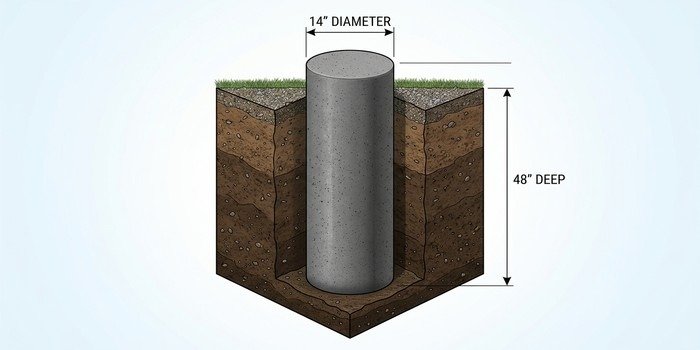
This is a small, narrow tube-form footing: 14" diameter by 48" deep. The pour is treated as a cylinder, so the estimate is focused on volume rather than complicated layout geometry.
At 48" deep the tube will need about 4.2761 cubic feet of concrete. That usually translates to a handful of bags for one footing, but deeper frost depths or heavier loads can change layout and reinforcement choices.
Quick Answer
Exact volume: 4.2761 cubic feet (0.1584 cubic yards) for one 14" diameter × 48" deep round footing.
Planning with 10% waste: plan on 4.7037 cu ft (0.1742 cu yd). Exact bag counts: 15 40-lb bags, 10 60-lb bags, or 8 80-lb bags. Waste-adjusted planning counts: 16 40-lb bags, 11 60-lb bags, or 8 80-lb bags.
Need a custom estimate? Use the Footing Calculator, try the concrete yardage calculator for any pour, or browse footing size pages. All project pages.
How to Use This Footing Estimate
Quick steps to estimate and order concrete for this footing size.
- Confirm the tube internal diameter is 14" and depth is 48" before ordering.
- Use the cylinder formula or the provided numbers to get the exact volume (4.2761 cu ft).
- Add a waste allowance (this page uses 10%) to get 4.7037 cu ft for ordering.
- Decide bagged mix or ready-mix: for one footing bagged concrete is usually simpler; for several footings re-evaluate.
- When planning multiple footings multiply the planning volume and planning bag counts by the number of footings, then round up to whole bags.
- Double-check reinforcement and anchorage needs before final purchase.
Formula
Use this round footing formula:
Volume (ft³) = π × Radius (ft) × Radius (ft) × Depth (ft)
3.1416 × 0.58 × 0.58 × 4 = 4.28 ft³
4.28 ÷ 27 = 0.16 yd³
If you add a 10% waste allowance, you should plan closer to 0.17 cubic yards.
Worked Example
Single footing: before waste the pour is 4.2761 cu ft (0.1584 cu yd). With 10% waste plan on 4.7037 cu ft (0.1742 cu yd). Bag counts: exact 15 40-lb / 10 60-lb / 8 80-lb; planning 16 40-lb / 11 60-lb / 8 80-lb.
Multiple footings example (3 identical footings): total before waste = 12.8283 cu ft, total = 0.4752 cu yd; with 10% waste = 14.1111 cu ft, 0.5226 cu yd. Bag totals exact: 45 40-lb, 30 60-lb, 24 80-lb. Bag totals planning: 48 40-lb, 33 60-lb, 24 80-lb.
Bag Count Estimate
- 8 bags of 80 lb concrete mix
- 11 bags of 60 lb concrete mix
- 16 bags of 40 lb concrete mix
Always verify the actual yield on the product label before buying materials.
Bag Counts by Waste Buffer for 14" diameter × 48" deep
Pick a buffer based on site conditions: clean forms and accurate measurements can run leaner; rough subgrade or hard-to-reach pours need more cushion.
| Buffer | Volume (ft³) | 80 lb bags | 60 lb bags | 40 lb bags |
|---|---|---|---|---|
| No buffer | 4.28 | 8 | 10 | 15 |
| +5% typical DIY | 4.49 | 8 | 10 | 15 |
| +10% recommended | 4.7 | 8 | 11 | 16 |
| +15% rough conditions | 4.92 | 9 | 11 | 17 |
When Bagged Concrete vs Ready-Mix Makes Sense
For a single 14" × 48" footing bagged concrete is usually easier — you can buy 40-, 60-, or 80-lb bags and mix on site. One footing uses about 16 40-lb bags after waste, which fits a weekend DIY or a small crew's mixing plan.
If you're pouring several of these footings, ready-mix starts to look more efficient because it saves repeated mixing and can be proportionally cheaper per yard. Still, for small sets (two or three) many crews stick with bags because they avoid minimum truck orders and wait time.
Common Uses for This Footing Size
This 14" diameter by 48" deep footing usually fits isolated post supports where a narrow, round footprint is acceptable — pergola posts, small deck posts, sign posts, or similar single-column supports. The narrow tube saves excavation width when layout calls for tight spacing.
Limits matter: adequacy depends on the applied load, soil bearing capacity, frost depth, and whether rebar or anchors are required. If loads are heavy or frost depth is deep, the footing diameter or reinforcement may need to change and you should factor that into design decisions.
Common Mistakes to Avoid
Common estimating and planning mistakes to avoid for this footing size.
- Using the tube outside diameter instead of the internal diameter when calculating volume.
- Skipping a waste allowance and running short on bags at the pour.
- Ordering exact bags without rounding up to whole bags for practical purchase quantities.
- Assuming the same bag yield for different manufacturers or mixes.
- Forgetting to multiply planning volumes and bag counts when ordering multiple footings.
- Neglecting to plan for reinforcement or anchor bolts that change concrete placement needs.
Frequently Asked Questions
How much concrete does a single 14" × 48" round footing need?
One footing requires 4.2761 cubic feet of concrete, which is 0.1584 cubic yards.
How many bags of concrete mix should I buy for this footing?
Exact counts per footing: 15 40-lb bags, 10 60-lb bags, or 8 80-lb bags. With a 10% waste allowance plan on 16 40-lb, 11 60-lb, or 8 80-lb.
Why use a 10% waste allowance instead of ordering exact volume?
Ten percent covers small overordering for spillage, slight under-depths, and mixing losses. It keeps you from running short during placement while still being a conservative add-on for one small footing.
Is this 14" × 48" footing big enough for a deck post or pergola support?
It may work in some cases for deck or pergola posts, but actual adequacy depends on the load, soil bearing capacity, frost depth, and reinforcement. Verify the design requirements before relying on this size for heavy or code-controlled loads.
Keep Planning Your Concrete Project
Use the calculator, compare more footing pages, and review your estimate before buying materials.
Disclaimer: This page provides planning estimates only. Actual concrete needs vary with excavation accuracy, site conditions, local code requirements, bag yield, and supplier guidance. Always verify measurements before buying materials, and consult a qualified professional for structural or code-sensitive work.