
How Much Concrete for a 16x24x36 Footing?
Material planning for a 16 in × 24 in × 36 in footing — 8 cu ft total, 0.2963 yd3, bag estimates included
Find exact concrete volume (8 cu ft, 0.2963 yd³), waste-adjusted totals, and recommended bag counts for a 16×24×36 footing. Practical guidance for single posts and small column footings.
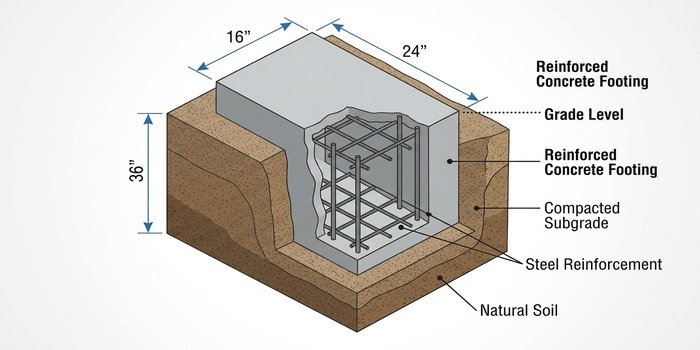
This 16 in × 24 in × 36 in rectangular footing is a practical size for a larger deck post base, a porch column pad, or a single support for a light roof overhang. It holds 8.00 cubic feet of concrete (about 0.2963 cubic yards), so it’s compact enough to mix with bags but substantial enough that planning matters.
Before pouring, confirm that the footing dimensions match the load and soil where it will sit. Soil bearing capacity, column loads, and reinforcement choices determine whether this size is appropriate; if soil is weak or loads are high you may need a larger footing or engineered design.
Quick Answer
Exact volume for a single 16 in × 24 in × 36 in footing is 8.00 cubic feet, which equals 0.2963 cubic yards.
With a 10% waste allowance plan for 8.80 cubic feet (0.3259 cubic yards). That translates to roughly 30 40-lb bags, 20 60-lb bags, or 15 80-lb bags when you order bagged concrete for a single footing.
Need a custom estimate? Use the Footing Calculator, try the concrete calculator for any pour, or browse footing size pages. All project pages.
How to Use This Footing Estimate
Quick steps to figure and place concrete for this footing.
- Confirm the required footing size and depth for the load and site conditions.
- Calculate volume (length × width × depth) and add 10% for waste; use the planning totals for ordering.
- Decide between bagged mix or ready-mix based on quantity and access.
- Set forms and place any required reinforcement or anchor hardware before pouring.
- Mix, pour, and consolidate the concrete, then float and finish the exposed surfaces.
- Cure the concrete properly for the first several days to reach intended strength.
Formula
The basic formula for a rectangular footing is length × width × depth to get cubic feet. Convert cubic feet to cubic yards by dividing by 27.
Applying the numbers: length = 1.3333 ft, width = 2.0000 ft, depth = 3.0000 ft. Multiply 1.3333 × 2 × 3 = 8.00 cubic feet.
Convert to cubic yards: 8.00 cu ft ÷ 27 = 0.296296... which is 0.2963 cubic yards when rounded to four decimal places. To allow for spillage, uneven forms, and slight over-excavation add 10%: 8.00 × 1.10 = 8.80 cu ft and 8.80 ÷ 27 = 0.325925... so 0.3259 yd³.
Bag counts are then based on the planning volume. For this footing the exact bag counts for the exact volume are 27 (40-lb), 18 (60-lb), and 14 (80-lb), and the waste-adjusted planning counts are 30 (40-lb), 20 (60-lb), and 15 (80-lb).
Worked Example
Example — single deck post: One 16 in × 24 in × 36 in footing is 8.00 cu ft total, or 0.2963 yd³. Plan for 8.80 cu ft (0.3259 yd³) with 10% waste, which means about 30 40-lb bags, 20 60-lb bags, or 15 80-lb bags to purchase.
Example — three porch columns: Three identical footings total 24.00 cu ft (3 × 8.00 cu ft). Convert that total to cubic yards: 24.00 ÷ 27 = 0.8889 yd³. With 10% waste plan for 26.40 cu ft (0.9778 yd³) and purchase roughly 90 40-lb bags, 60 60-lb bags, or 45 80-lb bags.
Bag Count Estimate
- 15 bags of 80 lb concrete mix
- 20 bags of 60 lb concrete mix
- 30 bags of 40 lb concrete mix
Always verify the actual yield on the product label before buying materials.
Bag Counts by Waste Buffer for 16" x 24" x 36"
Pick a buffer based on site conditions: clean forms and accurate measurements can run leaner; rough subgrade or hard-to-reach pours need more cushion.
| Buffer | Volume (ft³) | 80 lb bags | 60 lb bags | 40 lb bags |
|---|---|---|---|---|
| No buffer | 8 | 14 | 18 | 27 |
| +5% typical DIY | 8.4 | 15 | 19 | 29 |
| +10% recommended | 8.8 | 15 | 20 | 30 |
| +15% rough conditions | 9.2 | 16 | 21 | 31 |
When Bagged Concrete vs Ready-Mix Makes Sense
For a single 16 in × 24 in × 36 in footing the volume is under one-third of a cubic yard, so bagged concrete is often the simplest option: you can buy exactly what you need in 40-, 60-, or 80-lb bags and mix on-site. Use the waste-adjusted bag counts when purchasing: 30 (40-lb), 20 (60-lb), or 15 (80-lb).
If you have several footings or other work on the same day, ready-mix can save mixing time and give a more consistent slump. Be aware that ready-mix suppliers may have minimum delivery sizes or other fees, so compare the labor and transport costs against the convenience and speed of a truck mix.
Common Uses for This Footing Size
A 16x24x36 footing is often used for supporting posts in residential projects like deck posts, pergola posts, fence posts, or small porch columns. Its rectangular shape and size make it suitable for single-point supports where the load isn’t too heavy. This footing can help keep these structures stable by spreading the weight over a decent area of soil. It’s a common choice when you need something a bit larger than a typical post hole but don’t want to pour a large concrete slab.
Whether this footing size works for your project depends on several factors. The weight of what you’re supporting, the type of soil, how deep the frost line is in your area, and if any reinforcement is needed all play a role. Local building codes may also have specific requirements about footing dimensions and depth, so it’s important to check those before starting.
Common Mistakes to Avoid
A few common mistakes to avoid when planning and pouring a 16 in × 24 in × 36 in footing:
- Underestimating waste—don’t skip the 10% allowance for spillage and overfill.
- Failing to account for soil bearing and actual loads—size changes may be required if soil is weak or loads are high.
- Not using required reinforcement or anchors called out on the plan.
- Poor formwork or insufficient consolidation leading to voids in the footing.
- Pouring without proper curing—concrete needs moisture and time to develop strength.
- Mixing inconsistent batches on-site when multiple batches are required without matching water and mix proportions.
Frequently Asked Questions
How much concrete is needed for one 16x24x36 footing?
One 16 in × 24 in × 36 in footing requires 8.00 cubic feet of concrete, which is 0.2963 cubic yards. With a 10% waste allowance plan for 8.80 cubic feet (0.3259 cubic yards).
How many bags of concrete mix should I buy for this footing?
For purchasing use the waste-adjusted counts: about 30 40-lb bags, 20 60-lb bags, or 15 80-lb bags. The exact-volume counts without waste are 27 (40-lb), 18 (60-lb), and 14 (80-lb).
Why add a waste allowance to the concrete estimate?
Waste covers spillage, uneven forms, minor over-excavation, and mixing variability. A 10% allowance is typical for small pours to avoid coming up short on the job.
Is a 16x24x36 footing big enough for a deck post?
It depends on column loads, soil bearing capacity, reinforcement, and local frost depth or code requirements. A 16×24×36 footing may be suitable where the soil and loading conditions are adequate and the depth meets frost considerations, but check with an engineer or your building department if loads or soils are uncertain.
Keep Planning Your Concrete Project
Use the calculator, compare footing pages, and keep your estimate practical before you buy materials.
Disclaimer: This page provides planning estimates only. Actual concrete needs vary with excavation accuracy, site conditions, local code requirements, bag yield, and supplier guidance. Always verify measurements before buying materials, and consult a qualified professional for structural or code-sensitive work.