
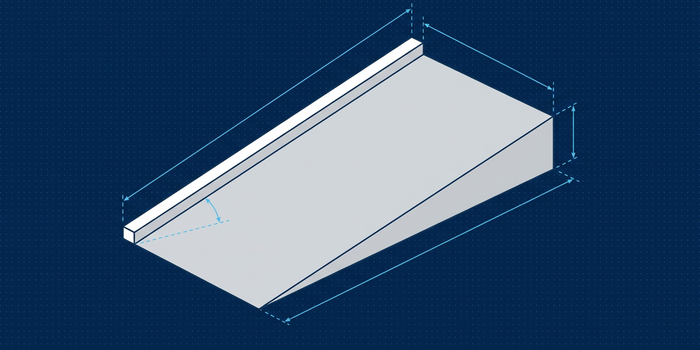
Sloped slabs and ramps are among the most commonly miscalculated concrete projects. The thickness changes continuously from one end to the other, yet many builders try to estimate volume using a single thickness measurement. This approach either dramatically overestimates or underestimates concrete needs depending on which end you measure.
The solution is simpler than most people expect: average the thin and thick ends, then calculate volume using that average thickness. This method works for any uniformly sloped slab—wheelchair ramps, driveway approaches, drainage slopes, or any concrete surface that transitions from one elevation to another.
This guide explains the average thickness method step-by-step, shows you exactly what to measure and where, walks through a complete calculation example, and helps you recognize situations where slopes are too complex for simple averaging and need to be divided into sections.
Quick Answer
The Average Thickness Formula
Average Thickness = (Thin End + Thick End) ÷ 2
Volume = Area × Average Thickness
The method is straightforward: Measure the concrete thickness at the thin end of your slope and at the thick end. Average these two measurements to get your working thickness. Then calculate volume exactly as you would for a flat slab—multiply area by average thickness.
For a uniform (linear) slope, this method matches the true volume—so it’s not just a rough guess. The volume of a uniformly sloped slab equals the volume of a flat slab with thickness equal to the average of the slope’s extremes.
📏
Step 1
Measure thin end and thick end thickness
🔢
Step 2
Calculate average: add both, divide by 2
📐
Step 3
Multiply area × average thickness
Critical unit conversion reminder: Thickness must be in feet, not inches. Divide your thickness in inches by 12 to convert to feet before multiplying by area (if you’re still deciding on the slab’s base thickness, see our guide on 4-inch vs 6-inch slabs). After calculating cubic feet, divide by 27 to convert to cubic yards for ordering ready-mix concrete.
Always add a small buffer—five to ten percent extra—to account for measurement variations, uneven subgrade, and the practical reality that slopes are rarely perfectly uniform. This buffer prevents running short mid-pour when ordering a partial load would cost more than the concrete you’re buying.
Calculate With Confidence
Use our calculator and enter your average thickness as the slab thickness input for accurate volume estimates with automatic unit conversions.
Understanding the Average Thickness Method
What “Thin End” and “Thick End” Actually Mean
Every sloped slab has a high point and a low point. The concrete is thinnest where the slab surface meets the high point of the subgrade, and thickest where the slab surface meets the low point of the subgrade.
For a typical ramp, the thin end is usually at the top where the ramp meets existing grade or another surface at a higher elevation. The thick end is at the bottom where the ramp transitions to lower grade. The slab surface slopes smoothly between these points while the base or subgrade remains relatively level—or slopes less steeply than the slab surface—creating the thickness variation.
Thickness Increases Toward the Low End
Concrete thickness increases gradually from high elevation to low elevation
Understanding which end is which matters for accurate measurement. Stand at your site and identify the high and low points, then measure thickness at both locations—our guide on how to measure a concrete slab covers taking accurate measurements. These two numbers are all you need for the averaging calculation.
Don’t overthink it. If you’re looking at a wheelchair ramp going down from a door, the thin end is at the door threshold and the thick end is where the ramp meets the walkway or driveway below. For a driveway approach sloping up from the street to your garage, the thin end is at street level and the thick end is at the garage entrance.
When This Method Works (Uniform Slope)
The average thickness method works well for slabs with uniform, linear slope from one end to the other. “Uniform” means the rate of slope is constant—the surface rises or falls at the same angle throughout the length.
This includes most residential ramps, driveway approaches, walkway transitions, and slabs sloped for drainage. As long as the cross-section profile is a straight line from thin end to thick end, averaging gives you accurate volume estimates.
The method works regardless of how steep or gentle the slope is. A wheelchair ramp with 1:12 slope and a drainage slope of 1:48 both use the same calculation—measure the extremes, average them, multiply by area.
Width doesn’t matter for the averaging calculation. Whether your ramp is three feet wide or twenty feet wide, you still average the thickness measurements from thin end to thick end. Width only affects the area calculation, not the thickness averaging.
✓ Perfect for averaging:
- Straight ramps with consistent slope
- Driveway approaches transitioning to street level
- Patio or walkway drainage slopes
- Any slab where thickness changes linearly from one end to the other
When Averaging Doesn’t Work (Complex Slopes)
Averaging fails when slope changes rate, direction, or has multiple distinct sections with different characteristics. These situations require dividing the project into separate sections, calculating each independently, then summing the volumes.
Common scenarios where simple averaging doesn’t work include ramps with flat landings interrupting the slope, multi-stage ramps where slope angle changes partway through, crowned surfaces that slope in two directions from a high center, or curved ramps where thickness varies along the curve.
Stepped slopes—where the surface rises or falls in discrete steps rather than continuously—obviously can’t be averaged as a single slope. Each step or landing needs individual calculation as a flat section, and connecting slopes between them need separate averaging calculations.
⚠ Requires section division:
- Ramp with flat landing in the middle
- Slope that changes angle (steeper then gentler, or vice versa)
- Crowned surface sloping away from center in both directions
- Curved ramps where thickness varies unpredictably
When you encounter complex slopes, identify natural division points where you can separate the project into simpler sections. A ramp with a landing becomes two ramps plus one flat slab. A changing slope becomes two separate slopes with different thin-end/thick-end measurements. Calculate each section using the appropriate method—averaging for uniform slopes, standard flat-slab calculation for level sections—then add all volumes together.
The principle remains the same: break complexity into simple pieces you can calculate accurately, then combine the results.
Step-by-Step: Measuring a Sloped Slab
Measure Length and Width
Start with the slab dimensions just as you would for any rectangular slab. Measure the length along the direction of slope—from the high end to the low end. Measure the width perpendicular to that length.
A common question: should you measure the length horizontally (the map distance) or along the actual sloped surface? For most residential slopes, the difference is small and either measurement works fine. Very steep ramps might have a few percent difference, but this falls within the waste buffer you’ll add anyway.
The key is using the same reference consistently. Measuring along the surface—following your forms or following the actual slope—is often easier than trying to measure true horizontal distance. Use whichever is more convenient for your site.
📏 Measurement priorities:
Length
Along the slope, inside forms, consistent with form layout
Width
Perpendicular to length, inside forms, check consistency
Always measure inside the forms, not outside. The inside dimensions represent the actual concrete area. Verify that your slab is truly rectangular by checking that width is consistent at multiple points along the length. If width varies significantly, you may need to use an average width or divide into sections.
Measure Thickness at Both Ends
This is where sloped slabs differ from flat slabs: you need two thickness measurements instead of one. At the thin end, measure from the subgrade or base up to where the top of the slab will be. At the thick end, measure the same way.
Measuring thickness accurately requires attention to what you’re measuring from. The bottom reference point should be your prepared base or subgrade—the actual surface that concrete will rest on, not the original ground before excavation. The top reference point should be the top edge of your forms or your intended finished surface elevation.
If you’ve installed forms, measuring is straightforward: place your tape or ruler against the inside face of the form and measure straight down to the base. The form top edge represents your finished surface, and the base is your bottom reference. Write down this measurement immediately.
Move to the opposite end and measure the same way. You should see a significantly different measurement—this is expected and correct for a sloped slab. If both ends measure nearly the same, either your slab isn’t actually sloped or your measuring reference points aren’t consistent.
📏
Thin End
Measure at high elevation
Usually smaller number
📏
Thick End
Measure at low elevation
Usually larger number
Handling Width Variations and Cross-Slope
Most ramps and slopes maintain consistent thickness across their width—one side isn’t significantly thicker than the other at the same length position. But some slabs slope in two directions: along the length for the main grade change, and across the width for drainage or to match existing surfaces.
If your slab has consistent thickness across its width (both edges at the same position along the length have the same thickness), you only need to measure thickness along one edge at the thin and thick ends. The average thickness applies to the entire width.
If thickness varies significantly across the width—one side is noticeably thicker than the other—you have cross-slope in addition to length slope. For moderate cross-slope, you can measure thickness at multiple points across the width and use the average of those measurements as your thickness value at each end. Then proceed with normal thin-end/thick-end averaging.
For severe cross-slope where one side varies much more than the other, consider dividing the slab into two or more width strips, calculating each strip separately with its own thin-end and thick-end measurements, then summing the strip volumes.
Most residential ramps don’t have significant cross-slope complexity. But if you’re working on a surface that slopes noticeably in multiple directions, take the time to measure carefully and divide into sections if simple averaging would introduce substantial error.
Complete Calculation Example
Let’s walk through a real-world example with actual numbers to see how the method works in practice.
The Project: Wheelchair Ramp
Given measurements:
Length (along slope)
20 feet
Width
4 feet
Thin end (top)
4 inches
Thick end (bottom)
8 inches
A typical wheelchair ramp transitioning from door threshold to ground level
Step 1: Calculate Area
Area is straightforward for rectangular slabs:
Area = Length × Width
Area = 20 ft × 4 ft
Area = 80 square feet
Step 2: Calculate Average Thickness
Add the thin and thick measurements, then divide by 2:
Average thickness = (Thin + Thick) ÷ 2
Average thickness = (4 inches + 8 inches) ÷ 2
Average thickness = 6 inches
Convert to feet: 6 inches ÷ 12
Average thickness = 0.5 feet
Step 3: Calculate Volume in Cubic Feet
Multiply area by average thickness:
Volume = Area × Average thickness
Volume = 80 sq ft × 0.5 ft
Volume = 40 cubic feet
Step 4: Convert to Cubic Yards
Ready-mix concrete is ordered in cubic yards. Divide cubic feet by 27:
Cubic yards = Cubic feet ÷ 27
Cubic yards = 40 ÷ 27
Cubic yards ≈ 1.48 cubic yards
Step 5: Add Waste Buffer
Add 10% buffer for measurement variations and subgrade irregularities:
With 10% buffer: 1.48 × 1.10
Estimated need: ≈ 1.6 cubic yards
✓ Order recommendation:
For this 20 ft × 4 ft ramp transitioning from 4 inches to 8 inches thick, you’ll need approximately 1.6 cubic yards of concrete. Check with your supplier about delivery increments—many batch in quarter-yard or half-yard units, so confirm what they can deliver and adjust your order accordingly.
Common Variations and How to Handle Them
Ramp with Flat Landing
Many ramps include a flat landing at the top, bottom, or middle where slope temporarily becomes level. These landings serve as rest areas, turning spaces, or transition zones between different slope sections.
Calculate landings separately as standard flat slabs using their actual thickness. Then calculate the sloped ramp sections using the average thickness method. Sum all sections to get total concrete volume.
Example: Ramp with mid-landing
Use averaging
Standard flat calc
Use averaging
Calculate each section, then add volumes: Section 1 + Section 2 + Section 3
The key is identifying where the slope ends and the landing begins, measuring each section’s dimensions accurately, and treating them as separate volume calculations. Don’t try to average thickness across sections with fundamentally different geometry.
Multi-Stage Ramps (Slope Changes Angle)
Sometimes slope steepness changes partway through a ramp—perhaps starting steep then becoming gentler, or vice versa. This happens when site constraints require different slope rates or when matching existing grades with varying elevation changes.
Divide the ramp at the point where slope angle changes. Each section with consistent slope becomes its own calculation using the average thickness method with the thin-end and thick-end measurements for that specific section.
Where slopes meet, the thick end of one section equals the thin end of the next section. Use this connecting thickness as the shared measurement between adjacent sections.
For example, if your ramp starts at 4 inches thick, reaches 7 inches at a mid-point where slope changes, and ends at 9 inches thick, you’d calculate two sections: first section averages (4 + 7) ÷ 2 = 5.5 inches, second section averages (7 + 9) ÷ 2 = 8 inches. Calculate each section’s volume separately using its specific average thickness and length, then add them.
Gentle Slopes for Drainage
Patios and slabs often incorporate subtle drainage slopes—perhaps dropping only an inch or two over their entire length rather than the dramatic thickness changes of ramps. The average thickness method works identically, but the thin-end and thick-end measurements will be much closer together.
For example, a 20-foot patio sloped for drainage might measure 4 inches thick at the high end and 5 inches thick at the low end. Average these: (4 + 5) ÷ 2 = 4.5 inches = 0.375 feet. Calculate volume using this average thickness.
With gentle slopes, the difference between using average thickness versus assuming uniform thickness is small. But the calculation is just as easy to do correctly, so there’s no reason not to average properly. The method scales to any slope magnitude from barely perceptible drainage slopes to steep ramps.
Drainage slope tip: When designing drainage slopes, plan your base excavation to maintain the same concrete thickness across the slab if possible. This simplifies calculation and ensures structural uniformity. Slope the base rather than varying concrete thickness. But if thickness must vary due to site constraints, averaging handles it accurately.
Curved Ramps
Curved ramps add complexity because thickness may vary unpredictably along the curve. For gentle curves where thickness changes primarily along the length direction, averaging centerline measurements may provide reasonable estimates. For complex curves, divide into multiple straight segments and calculate each separately, then sum the volumes. Professional calculation software can model three-dimensional curved surfaces if project size justifies the additional precision.
Common Mistakes (Checklist)
Avoid these frequent errors when estimating concrete for sloped slabs:
- Using only the thick end measurement: The single most common mistake is measuring the thick end and using that thickness for the entire slab. This dramatically overestimates volume—sometimes by 50% or more—leading to expensive over-ordering. Always average thin and thick ends.
- Forgetting to convert inches to feet: Measuring thickness in inches but failing to divide by 12 before multiplying by area gives results that are 12 times too large. Always convert thickness to feet before volume calculations, or use a calculator that handles unit conversions automatically.
- Measuring outside forms instead of inside: Outside measurements include form board thickness and inflate your area calculation. Always measure inside dimensions where concrete actually goes. This applies to sloped slabs just as it does to flat slabs.
- Not separating landings from ramps: Trying to average thickness across sections with fundamentally different geometry introduces error. Calculate flat landings separately from sloped ramps, then sum the volumes. Don’t average thickness from bottom to top when a flat section interrupts the slope.
- Skipping the waste buffer: Calculated volume assumes perfect measurements and uniform conditions. Real-world variations mean you need five to ten percent extra. Not adding buffer risks running short mid-pour—an expensive and frustrating problem.
- Not accounting for base variations: If your subgrade isn’t consistently graded, actual concrete thickness varies more than form height suggests. Walk your base and look for low spots that will require more concrete. Adjust estimates or level the base better before pouring.
Tools & Calculators
Calculate your sloped slab volume with our tools:
Slab Calculator
Enter your dimensions and average thickness for automatic volume calculation with unit conversions.
General Concrete Calculator
Calculate volume for any shape with waste factors and bag quantity estimates.
Browse pre-calculated estimates for common flat slab sizes:
- Slab Size Pages – Ready-made estimates for standard dimensions
- Bag Calculator – Convert cubic yards to bag quantities for small projects
Frequently Asked Questions
Why can’t I just use one thickness measurement?
Using a single thickness measurement for a sloped slab either dramatically overestimates or underestimates concrete volume depending on which end you measure. If you measure the thick end and apply that to the entire area, you’re calculating as if the whole slab is thick—overestimating by potentially 30-50% or more. If you measure the thin end, you’re underestimating by a similar amount.
The average thickness method accounts for the fact that half the slab is thicker than average and half is thinner, giving you accurate volume for a uniformly sloped surface.
What if my slope isn’t uniform?
Non-uniform slopes require dividing the project into sections with consistent characteristics. Identify points where slope angle changes, where flat landings interrupt the slope, or where geometry becomes distinctly different. Calculate each section independently using the appropriate method—averaging for uniform slopes, standard calculation for flat sections—then sum all volumes.
Most residential ramps and drainage slopes are uniform enough that averaging works well. Complex multi-stage designs need more careful section division and individual calculations.
Should I measure horizontal distance or along the slope?
For most residential slopes, the difference between horizontal distance and slope distance is small enough that either measurement works fine. Very steep slopes have more difference, but this typically falls within the waste buffer you’ll add anyway.
The key is using the same reference consistently. Measuring along the slope—following your forms or the actual surface—is often easier than trying to measure true horizontal distance. Use whichever is more convenient for your site.
Does thickness include the gravel base?
No, thickness measurements should include only concrete depth, not base material. Measure from the top of your prepared and compacted gravel base up to the intended finished surface elevation. The base sits below the concrete and isn’t part of the concrete volume calculation.
If you’ve excavated and installed base, make sure your thickness measurements start from the base surface (what concrete will rest on) rather than from original grade or the bottom of your excavation. Only the concrete thickness between base and finished surface matters for volume calculation.
How much waste buffer should I add?
Add five to ten percent waste buffer to your calculated volume. This accounts for measurement variations, uneven subgrade that creates thicker spots, minor spillage during pouring, and the reality that slopes are rarely perfectly uniform. For small projects under two cubic yards, lean toward 10%. For larger projects with careful measurements and well-prepared base, 5% may be adequate.
Can I use this method for crowned surfaces?
Crowned surfaces that slope away from a high center line in both directions require different treatment than simple end-to-end slopes. A crown creates two opposite slopes meeting at the center, which averaging from one edge to the other doesn’t accurately capture.
For crowned surfaces, consider dividing the slab width-wise into two sections—one for each side of the crown. Calculate each side using averaging from the thin edge to the thick center line. Sum both sides for total volume.
What if one side is thicker than the other?
When thickness varies across the width as well as along the length, you have cross-slope in addition to length slope. For moderate cross-slope, measure thickness at several points across the width at both the thin and thick ends, average those measurements to get representative thin-end and thick-end values, then proceed with normal averaging.
For severe cross-slope where one side is dramatically thicker, divide the slab into width strips. Calculate each strip separately using its specific thin-end and thick-end measurements. Sum the strip volumes for total concrete needed.
How do I verify my calculation is reasonable?
Sanity-check your results by comparing to flat slab estimates. Your sloped slab volume should fall between what you’d calculate using only the thin-end thickness and what you’d calculate using only the thick-end thickness. If your result is outside this range, recheck your math.
Another check: calculate what thickness a flat slab would need to produce the same volume with your area. This should equal your average thickness. If it doesn’t, you’ve made an error in thickness averaging or unit conversion.
Finally, discuss your estimate with your concrete supplier. They can quickly tell you if your volume seems reasonable for the dimensions you describe.
Calculate Your Sloped Slab Volume
Disclaimer
This guide provides general information about estimating concrete volume for sloped slabs using the average thickness method. Actual volume requirements depend on accurate site measurements, uniform slope conditions, and properly prepared subgrade. Always verify measurements carefully before ordering concrete, discuss your project with your concrete supplier to confirm volume calculations, and check local building codes for any specific requirements regarding ramps, slopes, or accessibility standards. The average thickness method works well for uniform linear slopes but may require adjustment for complex geometries, irregular slopes, or sites with variable conditions. Add appropriate waste buffer to account for measurement uncertainties and site variations.