
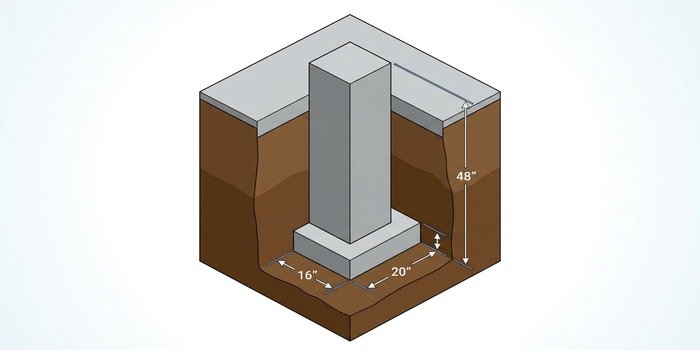
How Much Concrete for a 16x20x48 Footing?
Plan concrete for a 16" x 20" x 48" footing — 8.8889 cu ft (0.3292 yd³) and bag counts for ordering.
Exact volumes and bag quantities for a 16" x 20" x 48" footing, plus waste-adjusted planning totals and practical tips for using bagged concrete on small projects.
Before you buy bags or call a plant, plan the pour for this 16" x 20" x 48" footing so you order the right amount of concrete and avoid job-site delays. This page gives the exact volume, waste-adjusted totals, and bag counts so you can prep tools and reinforcement ahead of time.
Bagged concrete is a practical choice for a single footing like this — easy to carry and mix on site. Check with your local building department for allowable depths, reinforcement requirements, and permit rules before you pour.
Quick Answer
Exact volume: 8.8889 cubic feet, which converts to 0.3292 cubic yards. With a 10% planning allowance for waste and over-excavation, the footing becomes 9.7778 cubic feet or 0.3621 cubic yards.
Bag planning counts (with waste): plan on 33 40-lb bags, 22 60-lb bags, or 17 80-lb bags. For reference, the exact bag counts without the 10% waste allowance are 30 (40-lb), 20 (60-lb), and 15 (80-lb).
Need a custom estimate? Use the Footing Calculator, try the concrete estimator for any pour, or browse footing size pages. All project pages.
How to Use This Footing Estimate
Quick steps to plan and pour this footing:
- Confirm excavation: verify the footing is dug to 16" × 20" × 48" (inside clear of loose soil).
- Calculate materials: use the volume numbers here to order bags or decide on ready-mix.
- Choose bag size: pick 40-, 60-, or 80-pound bags and multiply by the planning counts.
- Prepare reinforcement: place rebar or mesh per engineer or code before pouring.
- Mix and pour: mix to the manufacturer’s instructions and place concrete to avoid cold joints.
- Cure properly: keep the concrete moist for several days to reach designed strength.
Formula
The footing volume uses length × width × depth in feet. Convert inches to feet first: 16 in = 1.3333 ft, 20 in = 1.6667 ft, 48 in = 4 ft.
Multiply those feet values: 1.3333 × 1.6667 × 4 = 8.8889 cubic feet for a single footing.
To get cubic yards, divide cubic feet by 27: 8.8889 ÷ 27 = 0.3292 cubic yards. Add 10% for planning waste: 8.8889 × 1.10 = 9.7778 cu ft, which is 9.7778 ÷ 27 = 0.3621 yd³.
Worked Example
Single footing example: this footing requires 8.8889 cubic feet (0.3292 cubic yards). With a 10% allowance plan on 9.7778 cubic feet (0.3621 cubic yards). That equals about 33 40-lb bags, 22 60-lb bags, or 17 80-lb bags when accounting for waste.
Multiple-footing example: if you need three identical footings, total the volumes: 3 × 8.8889 = 26.6667 cubic feet, which is 0.9876 cubic yards (3 × 0.3292). For planning with waste multiply the planning bag counts by 3: 99 40-lb bags, 66 60-lb bags, or 51 80-lb bags.
Bag Count Estimate
- 17 bags of 80 lb concrete mix
- 22 bags of 60 lb concrete mix
- 33 bags of 40 lb concrete mix
Always verify the actual yield on the product label before buying materials.
Bag Counts by Waste Buffer for 16" x 20" x 48"
Pick a buffer based on site conditions: clean forms and accurate measurements can run leaner; rough subgrade or hard-to-reach pours need more cushion.
| Buffer | Volume (ft³) | 80 lb bags | 60 lb bags | 40 lb bags |
|---|---|---|---|---|
| No buffer | 8.89 | 15 | 20 | 30 |
| +5% typical DIY | 9.33 | 16 | 21 | 32 |
| +10% recommended | 9.78 | 17 | 22 | 33 |
| +15% rough conditions | 10.22 | 18 | 23 | 35 |
When Bagged Concrete vs Ready-Mix Makes Sense
For this footing the planning quantity is only 0.3621 cubic yards, so bagged concrete usually wins on convenience and cost. Using bags lets you buy exactly what you need, store unused bags, and avoid minimum-order surcharges that come with ready-mix deliveries.
Ready-mix can still be attractive if you want consistent slump or have helpers to place a larger continuous pour, but for a single 16" × 20" × 48" footing bagged concrete (33 40-lb bags or the 60/80-lb equivalents) is often the more practical choice. Also consider cleanup, mixing space, and whether you’ll need extra hands for a small pour.
Common Uses for This Footing Size
A 16x20x48 footing is often used for supporting posts in residential projects. It can be found under deck posts, pergola posts, fence posts, or small porch columns where the loads are relatively light. The rectangular shape and these dimensions fit well for single-point supports that don’t carry heavy structural weight. This size footing is common when you need a solid base for wooden or metal posts that hold up outdoor structures but don’t require deep or wide foundations.
Whether this footing size works depends on several factors. The weight of what’s being supported, the type of soil, how deep the frost line is in your area, and whether reinforcement like rebar is needed all play a role. Local building codes may also have specific requirements that affect footing size and depth. It’s important to consider these details before deciding if this footing will suit your project.
Common Mistakes to Avoid
Common mistakes to avoid when ordering and pouring this footing:
- Underestimating waste and ordering only the exact volume without a planning allowance.
- Confusing exact bag counts with the waste-adjusted planning counts.
- Skipping reinforcement or not following the building department’s requirements.
- Mixing inconsistent batches and ending up with variable strength or workability.
- Pouring in freezing or very wet weather without proper protection.
- Neglecting proper curing, which reduces final strength.
Frequently Asked Questions
How much concrete do I need for a 16x20x48 footing?
A single 16" x 20" x 48" footing requires 8.8889 cubic feet of concrete, which is 0.3292 cubic yards. With a 10% planning allowance for waste the total is 9.7778 cubic feet or 0.3621 cubic yards.
How many bags of concrete do I need for this footing?
Plan on 33 40-lb bags, 22 60-lb bags, or 17 80-lb bags after adding a 10% allowance for waste. The exact counts without waste are 30 (40-lb), 20 (60-lb), and 15 (80-lb).
How much extra should I order for waste?
A 10% planning allowance is standard here; that increases the footprint volume from 8.8889 cu ft to 9.7778 cu ft. Adjust upward if you expect over-excavation, spillage, or uneven subgrade.
Is a 16x20x48 footing adequate for a deck post?
That depends on the deck load, soil bearing capacity, local frost depth, and code requirements. A footing this size can work for many deck posts, but confirm reinforcement, embedment depth, and any permit or inspection rules with your building department before proceeding.
Keep Planning Your Concrete Project
Use the calculator, compare footing pages, and keep your estimate practical before you buy materials.
Disclaimer: This page provides planning estimates only. Actual concrete needs vary with excavation accuracy, site conditions, local code requirements, bag yield, and supplier guidance. Always verify measurements before buying materials, and consult a qualified professional for structural or code-sensitive work.