
Use this free concrete footing calculator to estimate cubic yards, cubic feet, and bag counts for isolated footings, deck posts, pergola bases, column supports, and similar foundation pads. Enter the length, width, depth, number of footings, and waste allowance to get a fast footing-specific estimate. Looking for the universal volume formula and conversions? See our main concrete calculator.
Footing Calculator
Estimates only. Bag yields vary by brand and mix. Always confirm with your supplier.
Quick Answer for Footings
To estimate concrete for footings, multiply length × width × depth (in feet) for one footing, multiply by the number of footings, then divide by 27 for cubic yards. Add a 5–10% waste factor for spillage, overdig, and minor depth variations.
Typical footing depths by application:
- Deck post (warm climate): 24″ deep
- Pergola or column base: 30–36″ deep
- Frost-line footing (cold climate): 36–48″ deep
- Heavy structural pier: 48″+ deep (verify with code)
Always verify required depth against your local frost line and building code before pouring.
Keep browsing calculators and project pages
Move to the main calculator hub, compare ready-made footing pages, switch to slab planning, or convert any volume into bag counts.
How to Use the Footing Calculator
- Measure footing dimensions: Measure the length, width, and depth of one footing in feet. For square footings, the length and width are the same. For rectangular footings, measure both carefully.
- Confirm footing depth: Depth usually depends on frost line, soil conditions, and local code. In warm climates, footings may be shallower, while freeze zones often require much deeper excavation.
- Enter the dimensions: Input the footing length, width, and depth into the calculator. The tool handles the math and gives you the concrete volume for one footing and for the full set.
- Add the number of footings: Enter how many footings you plan to pour. This is critical because the total concrete volume scales directly with footing count.
- Choose a waste factor: A 5–10% waste allowance is common. Increase it if your excavations are irregular, your site is rough, or you expect some overdig.
- Review the results: The calculator shows cubic feet, cubic yards, and estimated bag counts so you can compare bagged concrete with ready-mix delivery.
- Double-check before ordering: Verify your dimensions on-site before buying material. It is much easier to have a little extra than to run short during the pour.
The Footing Volume Formula
This calculator uses the universal volume formula plus one footing-specific multiplier — the number of footings.
Total ft³ = (Length × Width × Depth) × Number of Footings
Cubic Yards = Total ft³ ÷ 27
For the underlying volume math, unit conversions, and bag yield reference, see our main concrete calculator. Always finish by adding 5–10% waste before ordering.
Worked Examples
Square Deck Post Footings
🔢 8 footings
Dimensions per footing: Length = 1 ft, Width = 1 ft, Depth = 2 ft
Number of footings: 8
Volume per footing: 1 × 1 × 2 = 2 ft³
Total volume: 2 × 8 = 16 ft³
Volume in cubic yards: 16 ÷ 27 = 0.59 yd³
With 10% waste: 0.59 × 1.10 = 0.65 yd³
Rectangular Pergola Column Footings
🔢 4 footings
Dimensions per footing: Length = 2 ft, Width = 2 ft, Depth = 3 ft
Number of footings: 4
Volume per footing: 2 × 2 × 3 = 12 ft³
Total volume: 12 × 4 = 48 ft³
Volume in cubic yards: 48 ÷ 27 = 1.78 yd³
With 10% waste: 1.78 × 1.10 = 1.96 yd³
Common Footing Types
Most residential footing estimates fall into a few familiar categories. Understanding which type you are building helps you measure correctly and order the right amount of concrete.
Square Footings
Square footings are common for deck posts, pergola columns, and other isolated supports. They spread the load evenly in all directions and are usually the simplest shape to form, measure, and pour.
Rectangular Footings
Rectangular footings are useful when loads are not symmetrical or when space constraints require a longer shape in one direction. The volume calculation is the same, but the length and width are different.
Isolated Footings
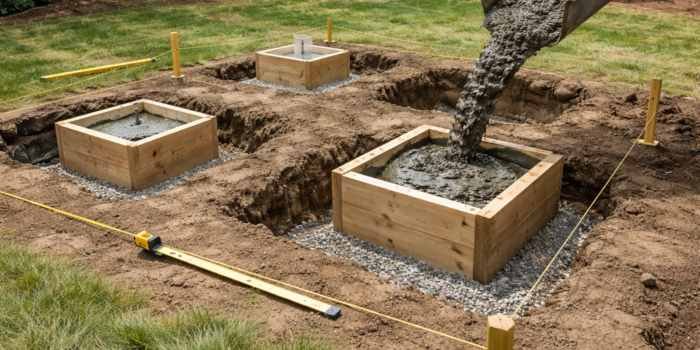
Isolated footings support individual posts or columns rather than a continuous wall. This calculator is primarily designed for that use case, which makes it a strong fit for decks, sheds, gazebos, and similar projects.
Continuous or Wall Footings
Continuous footings run below a wall rather than below separate posts. You can still estimate them by treating the footing as a long rectangular strip with length, width, and depth, but this page is mainly intended for isolated footing layouts and repeated footing counts.
Bagged Concrete or Ready-Mix for Footings?
For most isolated footing projects under 1–2 cubic yards, bagged concrete is practical and easier to handle than scheduling a truck. Once you cross the 2 yd³ threshold or need to pour many footings in one session, ready-mix delivery saves significant labor and gives more consistent results. For a full bag-count breakdown, use our Bag Calculator, or read our guide on how many bags of concrete you need. For the general bagged vs ready-mix decision, see our main concrete calculator.
Footing-Specific Mistakes & Tips
Forgetting to multiply by number of footings
Many people calculate one footing correctly and then forget to multiply by the total footing count.
Not checking frost depth
Footing depth is often controlled by local code. In cold climates, shallow footings can heave and fail.
Undersizing the footing
Saving a small amount of concrete is rarely worth the structural risk. Make sure the footing size matches the load and soil conditions.
Skipping reinforcement
Many footing layouts require rebar. Check your local code and structural requirements before pouring.
Pouring on unstable soil
Footings should bear on compacted, undisturbed soil or properly prepared base material, not loose or organic fill.
Footing Calculator FAQ
How deep should concrete footings be?
Footing depth depends on local frost line and soil conditions. In frost-prone areas, footings must extend below the frost line to prevent heaving, typically 24 to 48 inches or deeper. In warm climates with no frost risk, footings may be as shallow as 12 inches. Always check your local building code for minimum depth requirements before excavating.
What size footing do I need for a 4×4 post?
A common rule of thumb for light structures like decks is a 12-inch by 12-inch square footing for a 4×4 post. For heavier loads or poor soil, increase to 16 inches square or larger. Depth should meet local frost line requirements. Consult your local building inspector or a structural engineer for specific load-bearing requirements.
Can I pour footings and posts at the same time?
Yes, you can set posts directly in wet concrete as you pour footings. This method is common for fence posts and light structures. However, for decks and structural applications, most codes require pouring footings first, letting them cure, then attaching post bases with embedded anchor bolts. Check local requirements and best practices for your specific project.
How many bags of concrete do I need for one footing?
It depends on footing size. A 12-inch by 12-inch by 24-inch deep footing (2 cubic feet) requires about four 80-pound bags. A larger 24-inch by 24-inch by 36-inch deep footing (12 cubic feet) requires about 20 bags. Use this calculator to get precise estimates based on your exact dimensions.
Do I need rebar in concrete footings?
Many building codes require rebar in footings, especially for larger sizes or structural applications. Rebar adds tensile strength and prevents cracking. A common configuration is two to four rebar pieces running horizontally through the footing center. Check local code requirements and consult an inspector if you’re unsure.
How long do concrete footings take to cure?
Concrete footings reach sufficient strength for light loads in 24 to 48 hours under normal conditions. However, full curing takes 28 days. For structural applications like decks or buildings, wait at least seven days before applying significant loads. Keep footings moist during the first few days to ensure proper curing.
Can I use this calculator for round footings?
This calculator is designed for square or rectangular footings. For round or cylindrical footings (common for Sonotubes), use the cylinder volume formula: π × radius² × height. For example, a 12-inch diameter tube that is 36 inches deep has a volume of approximately 2.36 cubic feet.
What PSI concrete should I use for footings?
Standard 3000 PSI concrete is adequate for most residential footings. For heavy structural loads, freeze-thaw exposure, or poor soil conditions, consider 4000 PSI. Consult your local building code and ready-mix supplier for recommendations based on your specific application and climate.
Should I use gravel under footings?
Yes, a four to six inch layer of compacted gravel provides drainage, prevents frost heave, and creates a stable base. Some codes require gravel under footings. The gravel base also helps level the excavation and provides a clean surface for pouring. Compact the gravel thoroughly before placing concrete.
How do I calculate concrete for multiple different-sized footings?
Calculate each footing size separately, then add the totals together. For example, if you have four large footings and eight small footings, calculate cubic feet for one large and multiply by four, calculate one small and multiply by eight, then add both results. This calculator handles one footing size at a time, so run the calculation twice and sum the results.
Keep Planning Your Concrete Project
Explore more tools and guides to keep your footing project on track
Disclaimer: This calculator provides planning estimates only. Always verify local code requirements, soil conditions, and supplier guidance before ordering concrete. Actual material needs can vary based on excavation accuracy, jobsite conditions, waste, and product yield. Consult a licensed contractor or structural engineer for critical structural work.