
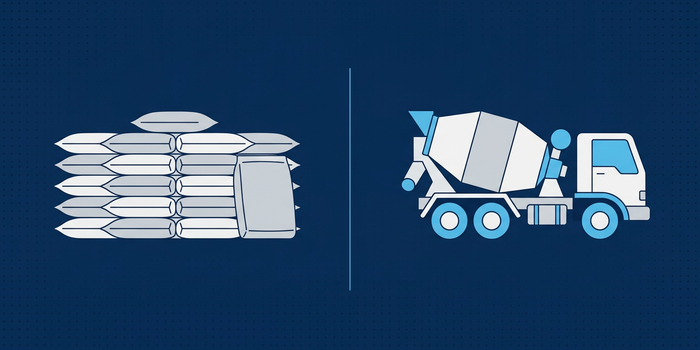
Bagged concrete looks cheaper when you compare price tags at the store. Eighty-pound bags cost a fraction of what ready-mix delivery charges. But price per bag tells only part of the story—and often the smallest part for projects larger than a few post holes.
Ready-mix comes with delivery fees, minimum order requirements, and tight timing demands. Bagged concrete comes with physical fatigue, consistency challenges, and the very real risk of cold joints if you can’t work fast enough. Neither option is universally “cheaper”—the real cost depends on your project size, site access, crew capacity, and how much your time and effort are worth.
This guide shows you how to compare bagged versus ready-mix concrete honestly, accounting for the factors that actually determine total project cost rather than just material price. You’ll learn what drives costs on both sides, where the decision breakpoint typically falls, and how to recognize which option makes sense for your specific situation.
Quick Answer
✓ When bags make sense:
- Small repairs and patches
- Post holes and footings
- No truck access possible
- You control the work pace
- Very small total volume
✓ When ready-mix makes sense:
- Medium to large slabs
- Continuous pour needed
- Truck can reach site
- Finishing quality matters
- You have crew ready
The fast decision framework comes down to three questions:
Ask yourself:
- Can you mix and pour consistently without long pauses? Bags require continuous work to avoid cold joints. If you can’t maintain pace, ready-mix prevents this problem.
- Does a concrete truck have access to your site? If the chute can reach or a pump line can run, ready-mix becomes practical. If not, bags may be your only realistic option.
- Is your time worth more than potential delivery fees? Hours of mixing and hauling bags have real cost even if you’re not paying yourself. Compare honestly.
Most residential projects fall into a gray zone where either option could work. The “right” answer depends less on universal rules and more on your specific constraints: physical capacity, site logistics, timeline flexibility, and whether you value consistency over absolute minimum material cost.
Get Your Numbers in 2 Minutes
Calculate volume and see exactly how many bags you’d need—or whether ready-mix makes more sense.
Bagged vs Ready-Mix: Same Concrete, Different Economics
The concrete itself is fundamentally similar whether it comes in bags or from a truck. Both use portland cement, aggregate, and water in proportions designed to achieve target strength. Quality bagged concrete from major manufacturers meets the same standards as ready-mix concrete for equivalent strength ratings. If the terminology is unfamiliar, the guide on the difference between cement, concrete, and bagged concrete explains how these materials relate.
The difference isn’t in the hardened concrete—it’s in the economic model of how that concrete reaches your forms.
Bagged concrete puts all the mixing, transporting, and timing logistics on you. You pay a relatively low unit price for materials, then contribute labor, time, and physical effort to turn those bags into placed concrete. The cost model is: material cost plus human logistics.
Ready-mix concrete shifts mixing and initial transport to the supplier. You pay for their equipment, their scheduling system, their quality control, and their delivery logistics. The cost model is: delivered product plus supplier overhead and fees.
Cost Model Comparison
Bagged Concrete
Low material cost + High labor input = Total cost depends heavily on your physical capacity and time value
Ready-Mix
Higher material cost + Low labor input = Total cost depends on volume, access, and delivery logistics
Neither model is inherently better. They’re optimized for different situations. Bags make sense when you’re providing labor anyway and project scale is small enough that your mixing capacity isn’t a bottleneck. Ready-mix makes sense when project scale exceeds what you can reasonably mix by hand or when continuous placement quality matters more than minimizing material cost.
The key is matching the economic model to your project reality rather than choosing based on material price alone.
The Real Cost Drivers
Understanding what actually drives total cost helps you compare options accurately. Price per bag or price per cubic yard is just the starting point. Real project cost includes everything required to get mixed concrete into your forms at the right consistency and pace.
Bagged Concrete Cost Drivers
Material cost is just the beginning with bags. Every bag must be transported, opened, mixed with the correct amount of water, and moved to the pour location. This creates several cost factors that scale with volume:
What adds to bagged concrete cost:
- Labor and time: Mixing bags is physically demanding work. Each bag requires opening, dumping into a mixer, adding measured water, mixing thoroughly, then transporting the mixed concrete to forms. For projects requiring dozens or hundreds of bags, this labor dominates total project time and effort. Remember you’re moving real tonnage—the weight of a cubic yard of concrete is roughly 4,050 lb, so every yard placed by hand is about two tons of material.
- Tools and setup: You need a mixer (rental cost if you don’t own one), wheelbarrows or buckets for transport, water source and hose, access to power for the mixer, and often additional help since one person can’t efficiently handle all steps continuously.
- Consistency risk: Maintaining the same water-cement ratio across dozens of separate batches is difficult. Some batches inevitably come out wetter or drier than others, creating visible lines in the finished surface and potentially affecting strength uniformity.
- Fatigue impact: Physical exhaustion increases with volume. The first ten bags go smoothly. By bag fifty, fatigue slows your pace, increases error risk, and degrades finishing quality. This isn’t linear—fatigue compounds as work continues.
Ready-Mix Cost Drivers
Ready-mix shifts cost drivers from your physical labor to supplier logistics and delivery infrastructure. Understanding these helps you anticipate what you’ll actually pay:
What drives ready-mix cost:
- Delivery logistics: Can the truck reach your site? How far can the chute extend? Difficult access increases cost through longer pour time or need for additional equipment like pumps. Distance from the batch plant affects delivery fees.
- Add-on fees: Short load fees apply when you order less than a minimum volume (often around 4-5 cubic yards). Standby or wait time fees accumulate if your site isn’t ready when the truck arrives. After-hours or weekend delivery costs more. Distance charges apply for remote locations.
- Scheduling constraints: You must be completely ready when the truck arrives (see our ready-mix ordering tips for access and timing). Any delay costs money and risks concrete quality. If you’re not prepared, you pay for standby time while scrambling to get ready, and you may get substandard results from concrete that’s been in the drum too long.
- Pump cost: When the truck can’t reach your forms directly, you need a concrete pump. Pump trucks add significant cost—often several hundred dollars for residential jobs—but they’re sometimes the only way to place ready-mix in difficult locations.
Both options have real costs beyond the obvious material price. Honest comparison requires accounting for your specific situation: Do you have help? Can you work continuously? Does a truck fit? Are you paying for your own time? These factors determine which cost model works better for your project.
The “Breakpoint” Idea: When Ready-Mix Starts Winning
There’s a project scale where ready-mix changes from “expensive overkill” to “obviously better choice.” This isn’t a precise number—it’s a zone that depends on your circumstances. But understanding the concept helps you recognize when you’re approaching or crossing that threshold.
⚖️
The Cost Crossover Point
As volume increases: bags grow linearly but your fatigue grows exponentially. Ready-mix has fixed delivery cost plus linear volume cost. Somewhere they cross.
How Costs Scale Differently
Bagged concrete costs scale in a way that seems simple but has a hidden accelerator: Each bag costs the same, so material cost grows linearly with volume. But the human cost doesn’t scale linearly—it accelerates as fatigue accumulates, consistency becomes harder to maintain, and the risk of mistakes or poor finishing increases.
Your first cubic yard from bags might take two hours of reasonable effort. Your third cubic yard—when you’re already tired, the mixer is getting gunked up, and you’re racing to avoid cold joints—might take three hours and produce worse results.
Ready-mix has a different scaling pattern: There’s a substantial fixed cost for delivery—the truck, driver, scheduling system, and minimum order requirements. This makes small volumes expensive per cubic yard. But once you’re past the minimum, additional volume adds only the material cost with minimal added complexity.
The first cubic yard from ready-mix might cost effectively twice the material price when you account for delivery fees. The fifth cubic yard costs barely more than straight material price because delivery cost is already covered.
Three Signals You’ve Crossed the Breakpoint
Watch for these indicators that your project has reached the scale where ready-mix makes more sense:
🚨 Warning signs bags won’t work well:
Signal 1: Continuous pour required
You need several batches in quick succession without breaks to avoid cold joints. If your project demands continuous placement and you can’t maintain that pace with bags, you’re past the breakpoint.
Signal 2: Mixing becomes the bottleneck
Time spent mixing and transporting exceeds time spent placing and finishing. When logistics dominate actual concrete work, you’re fighting the wrong battle. Ready-mix solves this immediately.
Signal 3: Consistency becomes difficult
Keeping all batches at the same consistency is challenging after the first dozen bags. If you’re seeing variation between batches or struggling to maintain proper slump, batch-to-batch quality problems indicate you’re past ideal bag scale.
Your actual breakpoint depends on crew size, site access, and finishing tolerance. A two-person crew with a good mixer and short transport distance might handle more volume with bags than a solo worker with a small mixer and long wheelbarrow runs. A project where perfect finish matters hits the breakpoint sooner than utility concrete where minor imperfections don’t matter.
The question isn’t “what’s the universal breakpoint?” It’s “have I crossed my specific breakpoint given my constraints?” If you see the warning signals above, you probably have.
How to Compare for Your Project (Simple Checklist)
Making an honest comparison requires looking beyond material price to total project reality. Work through this checklist to evaluate both options fairly:
Step-by-step comparison checklist:
1. Calculate real volume
Use the slab calculator to get accurate cubic yards. Don’t guess—small errors compound when you’re comparing costs. Know exactly how much concrete you need before evaluating either option.
2. Convert to bag count
Use the bag calculator to see how many bags your volume requires. This number alone tells you a lot—if you’re looking at 100+ bags, think carefully about whether you can realistically handle that volume.
3. Assess your crew capacity
How many people do you have? Can you maintain continuous work without long breaks? Be honest about physical capacity. One person working alone faces very different limits than a three-person team rotating tasks.
4. Validate site access
Can a concrete truck reach your forms? Measure chute reach from where the truck can park. If direct pour isn’t possible, what’s pump cost? If truck access is impossible, bags may be your only realistic option regardless of volume.
5. Compare quality risks
With bags: cold joints from slow pace, inconsistent batches, fatigue-degraded finishing. With ready-mix: expensive standby fees if not ready, entire load at risk if timing goes wrong. Which risk profile fits your situation better?
After working through this checklist, the right choice often becomes clear. If bags make you nervous about finishing quality and cold joints, that nervousness is valuable information. If ready-mix fees feel disproportionate to your small volume and you’re confident you can handle the work, that confidence matters.
The best choice isn’t always the mathematically cheapest option—it’s the option that matches your constraints and risk tolerance.
Common Scenarios: Which One Usually Makes Sense?
While every project is unique, certain patterns emerge across common residential concrete work. Here’s how the bags-versus-ready-mix decision typically plays out:
Small Repairs and Post Holes
Bags are the obvious choice for very small volumes. Setting a few fence posts, filling a small void, patching a broken section—these projects need maybe a few bags at most. Ready-mix minimums make delivery impractical, and the volumes are so small that mixing by hand or with a small mixer takes minimal time. If you are weighing whether to pour footings at all, compare using concrete for fence posts against a gravel-set alternative.
You control the work pace completely, mixing only what you need when you need it. There’s no pressure to use concrete before it sets, no delivery timing to coordinate, and no fees to worry about.
Medium Slabs and Patios
This is the gray zone where the decision depends heavily on your specific situation. A 10×10 patio at 4 inches thick needs about 1.2 cubic yards—roughly thirty 80-pound bags. That’s manageable for a reasonably fit person with help, but it’s a solid day of hard work. For the full installed budget on a patio this size, see the concrete patio cost guide.
If you have truck access, ready-mix delivers all that concrete in minutes. You spend your energy on screeding and finishing rather than mixing and hauling. The delivery fee might add a couple hundred dollars, but you get consistent concrete and complete the pour in a fraction of the time.
If you don’t have truck access and would need a pump, bags become more attractive. But be realistic about your capacity to maintain pace for finishing quality.
Long Walkways
Walkways create a specific challenge: they need continuous placement to avoid visible cold joints running across the width. A 40-foot walkway at 4 feet wide and 4 inches thick needs about 2 cubic yards—nearly fifty bags.
Can you mix and place fifty bags fast enough to keep concrete workable across the entire length? If you’re working solo or with one helper, probably not without accepting some cold joints. Ready-mix solves this by delivering consistent concrete at a pace that matches your finishing capacity.
Driveways and Garage Floors
Projects this size nearly always favor ready-mix for quality reasons more than pure cost. A single-car garage floor needs roughly 3-4 cubic yards. A driveway can easily exceed 10 cubic yards. These volumes mean hundreds of bags if mixing by hand.
Beyond the physical impossibility of mixing that much concrete fast enough, there’s the finishing quality issue. You want your driveway or garage floor to look good and last decades. Consistent concrete and continuous placement matter. Ready-mix provides both.
Even if bags were somehow cheaper in pure dollar terms—which they’re usually not at this scale once you account for labor—the quality and reliability advantage of ready-mix justifies the cost.
Remote Backyard Projects
Difficult access creates interesting economics. If a truck absolutely cannot reach your forms—maybe the project is in a backyard with no access gate wide enough for a concrete truck—you face a choice: bags or pump plus ready-mix.
Pump costs might run $400-600 for a small residential job. That’s expensive, but compare it honestly to the time and effort of hauling dozens or hundreds of bags through your house or around the side. For larger volumes, pumping ready-mix often wins even with the added cost. For very small volumes, bags avoid the pump fee.
Consider a third option: can you widen access temporarily? Removing a fence section might cost less than either pumping or buying dozens of bags, and it simplifies future maintenance access too.
The Most Expensive Mistakes (On Both Sides)
Both options have specific failure modes that turn “cheaper” into “much more expensive.” Knowing what can go wrong helps you avoid the mistakes that ruin your cost advantage:
Bagged Concrete Mistakes
Mistakes that ruin bag economics:
- Taking too many breaks: Long pauses between batches create cold joints that weaken the slab and look terrible. If you need breaks, you’re working beyond your realistic capacity. The “cheap” bag option becomes expensive when cold joints require repair or when you’re dissatisfied with results you can’t fix.
- Adding too much water: When mixing gets tiring, the temptation to make concrete more flowable by adding water is strong. But wet concrete is weak concrete. You get easy placement at the cost of long-term durability. This trades short-term convenience for permanent quality problems.
- Inconsistent batches: Some batches stiff, some batches soupy, creates visible variation in the finished surface and potentially variable strength throughout the slab. Professional ready-mix avoids this through computerized batching. Your tired eyeball estimates late in the pour don’t match that consistency.
- Underestimating fatigue: The first ten bags feel manageable. By bag forty, you’re exhausted and error-prone. Finishing suffers when you’re physically spent. If you pushed beyond your capacity to “save money,” you’ve actually paid with degraded quality that can’t be recovered.
Ready-Mix Mistakes
Mistakes that ruin ready-mix economics:
- Not being ready when truck arrives: Standby time costs money—often substantial money after the first few minutes. If your forms aren’t built, your site isn’t prepared, or your crew isn’t present when the truck shows up, you pay for that delay. Worse, concrete quality degrades if it sits in the drum too long waiting for you.
- Poor scheduling communication: If you’re not clear about delivery timing, access requirements, or project specifics, the supplier can’t help you succeed. Miscommunication leads to wrong concrete showing up, access problems discovered too late, or delivery at the wrong time. All cost money and risk project failure.
- Under-ordering concrete: Running short mid-pour is catastrophic. You either stop (creating a cold joint) or order emergency additional concrete at premium pricing. The “cheap” decision to cut your estimate close becomes expensive when you need that extra half-yard right now. Always order adequate volume with appropriate waste buffer.
- Ignoring weather timing: Scheduling delivery during rain, extreme heat, or freezing conditions creates problems that cost more than rescheduling would have. Weather-related placement problems compromise quality and may require repair or complete replacement. Pay attention to forecasts and adjust delivery timing accordingly.
The pattern across both options: cutting corners or ignoring warnings to minimize immediate cost creates larger costs later through quality problems, repairs, or complete do-overs — many of these overlap with the most common slab mistakes. Make the decision that lets you do the work properly, not the decision that seems cheapest if everything goes perfectly.
Tools & Calculators
Get accurate numbers for your comparison:
Bag Calculator
Convert cubic yards to bag quantities and compare costs between bag sizes.
Slab Calculator
Calculate volume for your slab dimensions with automatic unit conversions.
Additional resources:
- Concrete Yardage Calculator – Volume estimates for any shape
- Slab Size Pages – Pre-calculated estimates for common dimensions
Frequently Asked Questions
Is bagged concrete as strong as ready-mix?
Yes, properly mixed bagged concrete achieves the same strength as ready-mix concrete of equivalent rating. An 80-pound bag typically produces concrete rated for 3000 or 4000 PSI depending on the product. This matches common ready-mix strengths for residential work.
The difference isn’t in potential strength—it’s in consistency and quality control. Ready-mix benefits from computerized batching, consistent mixing, and professional quality oversight. Bagged concrete mixed by hand depends on your attention to water ratios and mixing thoroughness. Both can produce good concrete, but ready-mix removes much of the human error risk.
What makes ready-mix “more expensive” sometimes?
Ready-mix costs more per unit volume when delivery fees represent a large proportion of total cost—typically on very small orders. If you order one cubic yard and pay a $150 delivery fee plus $120 for the concrete, you’ve spent $270 per yard. Order five yards with the same delivery fee and you’re paying $150 + $600 = $750 total, or $150 per yard.
The delivery infrastructure—truck, driver, scheduling, plant overhead—creates fixed costs that don’t scale with volume. Small orders pay those fixed costs across fewer cubic yards. This is why short-load fees exist and why ready-mix becomes more economical as volume increases. For a full breakdown, see our guide on concrete cost per yard.
Can I mix bags and then add ready-mix later?
Adding ready-mix to bagged concrete after the bagged portion has started setting creates a cold joint—a weak plane between the two pours. If the first pour is still fully plastic and workable when ready-mix arrives, you can continue pouring onto it. But if any setting has begun, you’re creating a structural weakness.
The better approach: if you start with bags and realize you need more concrete, either work fast to get more bags mixed before the first batches set, or plan from the beginning to use one method for the entire pour. Mixing methods mid-project is a sign of poor planning that risks quality problems.
What if access is really limited?
Limited access changes the economics but doesn’t eliminate either option. If a truck can’t reach your forms, consider these alternatives:
For bags: Accept that you’ll be hauling concrete through tight spaces—around the house, through narrow gates, up hills. This is hard work but it’s possible. Just be realistic about how much volume you can handle this way.
For ready-mix: A concrete pump can reach hundreds of feet from where the truck parks. Pump costs add several hundred dollars but might be worth it for the quality and speed advantage on larger pours. Get quotes from local pump operators.
Sometimes creative solutions work: temporarily removing a fence section, using a different access route, or scheduling the pour before permanent landscaping blocks access.
How do I avoid cold joints with bags?
Preventing cold joints when using bags requires maintaining continuous work pace so new concrete bonds properly with previously placed material. Here’s how:
Work with a partner: one person mixes while the other places and finishes. This maintains flow better than solo work where you alternate between mixing and placing.
Mix batches slightly ahead of placement so you’re never waiting for concrete. But don’t mix so far ahead that batches sit too long before use.
Keep edges of previously placed concrete wet while mixing the next batch. This helps new concrete bond to the edge rather than forming a distinct layer.
If you must take a break, plan it at a control joint location where a crack is acceptable anyway. This way any cold joint coincides with an intentional joint.
Should I still add waste buffer with bags?
Yes, add 5-10% waste buffer even when using bags. You might think bags allow exact quantity control—just mix what you need. But in practice you’ll have small amounts of spillage, some concrete sticking to the mixer, and the inevitable discovery that your volume calculation was slightly optimistic.
Running out of concrete near the end of a pour is frustrating regardless of whether you’re using bags or ready-mix. The solution is the same: order a bit extra. With bags this means having a few extra on hand rather than making an emergency run to the store mid-pour.
Unopened bags store for months if kept dry. Having leftovers is much better than running short.
Can I get same-day delivery of ready-mix?
Some suppliers offer same-day delivery if they have capacity, but scheduling ahead is always better. Last-minute orders often mean waiting for an available truck, paying premium rates, or accepting whatever timeslot the supplier can fit you into—which might not align with your preferred work schedule.
Plan your concrete delivery at least several days ahead. This gives you flexibility to choose optimal timing, discuss your specific needs with the dispatcher, and ensure the supplier understands any special requirements like access constraints or mix specifications.
If you discover you need concrete immediately, call suppliers early in the day. Morning availability is better than afternoon when trucks are already committed.
What’s the smallest amount of ready-mix I can order?
Most suppliers have minimums around 1 cubic yard, but will deliver smaller amounts with short-load fees. The fee structure varies but typically adds significant cost per yard for orders under 3-4 cubic yards.
Some suppliers won’t deliver very small amounts at all. Others have minimum charges that make tiny deliveries uneconomical. Call suppliers in your area to understand their policies.
For volumes under 1 cubic yard, bags almost always make more sense economically unless you have multiple projects you can combine into one delivery.
Do I need special equipment for bags?
A concrete mixer makes bag work much easier and produces better results than hand-mixing in a wheelbarrow. You can rent mixers affordably—often $40-60 per day for a decent size electric mixer.
Beyond the mixer, you need standard concrete tools: wheelbarrow or similar for transport, water source and hose, screeds and floats for finishing. The same finishing tools work whether concrete comes from bags or a truck.
For very small volumes—maybe 3-4 bags total—hand-mixing in a wheelbarrow is feasible if exhausting. For anything larger, rent or borrow a mixer.
Calculate Your Project Needs
Disclaimer
This guide provides general information about comparing bagged and ready-mix concrete costs for typical residential projects. Actual costs, delivery fees, product availability, and supplier policies vary significantly by location and supplier. Always obtain specific pricing from local suppliers for your project, verify delivery minimums and fee structures, and honestly assess your crew capacity and site constraints before making decisions. The cost comparison framework presented here is for educational purposes and doesn’t account for your specific regional pricing, site conditions, or project requirements. What makes economic sense depends heavily on factors unique to your situation.